
Motmot

Imperial Eagle vs Golden Eagle

Aquila heliaca versus Aquila chrysaetos

Play a quiz with Imperial Eagle and Golden Eagle
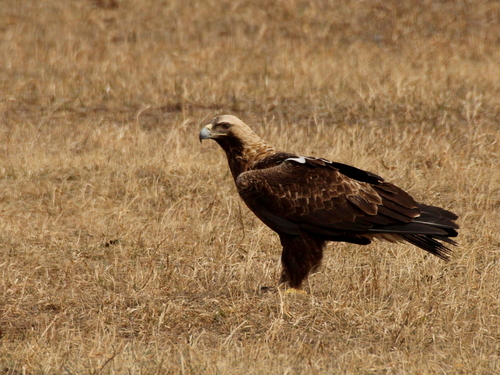
Imperial Eagle (Aquila heliaca) Imperial Eagle
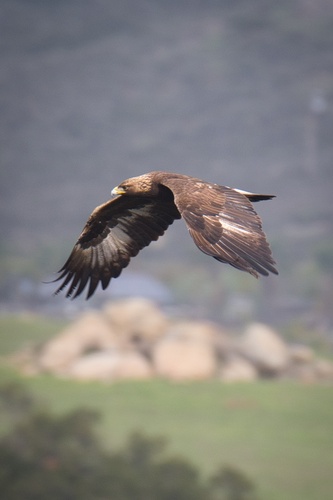
Golden Eagle (Aquila chrysaetos) Golden Eagle

Media

Loading…

In short

The most reliable field mark between Imperial Eagle and Golden Eagle is the overall structure and age-specific plumage: juvenile Imperial Eagles show a unique tawny-buff base with brown streaking and pale primary wedges, while juvenile Golden Eagles have bold white patches on the wings and tail. Adults are best separated by the Imperial Eagle’s darker plumage, white shoulder spots, and longer neck and head, versus the Golden Eagle’s golden nape and bulkier, more powerful build. In flight, Golden Eagles often hold their wings in a shallow dihedral, while Imperial Eagles tend to fly with flatter wings. Size can help, but there is overlap, especially between female Imperial and male Golden Eagles; structural and plumage clues are more reliable.

Identification tips

  1. Juvenile plumage is key: Juvenile Imperial Eagles are pale tawny-buff with brown streaks and a dark mantle/chest band, plus pale primary wedges in flight. Juvenile Golden Eagles are darker brown with bold, crisp white patches on the inner primaries and tail base; no streaking or tawny wash.
  2. Adult shoulder spots: Adult Imperial Eagles have distinct white spots on the shoulder (forewing coverts), visible in flight and at rest; Golden Eagles never show these.
  3. Nape color: Golden Eagles of all ages have a golden to rufous nape-shawl, especially obvious in adults. Imperial Eagles have a paler, cream-straw nape patch, but it is less extensive and not golden.
  4. Overall darkness: Adult Imperial Eagles are darker overall than Golden Eagles, with a more uniform chocolate-brown tone. Golden Eagles are slightly paler brown and have a more contrasting golden nape.
  5. Flight profile: Golden Eagles often soar with wings in a shallow dihedral (V), while Imperial Eagles hold their wings flatter. This is subtle but useful at distance.
  6. Structure: Golden Eagles are bulkier, with a shorter neck and head, and appear more powerful in flight and perched. Imperial Eagles are more slender, with a proportionately longer neck and head.
  7. Hallux claw (rear talon): Golden Eagles have a noticeably larger hallux claw, but this is only visible at close range or in hand.
  8. Tail length: Golden Eagles have a longer tail relative to their body, often appearing two to three times the length of the head in flight. Imperial Eagles’ tails are shorter in proportion.
  9. White on wings/tail (juveniles): Juvenile Golden Eagles have large, sharply defined white patches on the wings and tail base; Imperial Eagle juveniles do not, instead showing pale wedges and streaked underparts.
  10. Shoulder white in flight: Only Imperial Eagles (all ages) show white on the shoulder in flight; Golden Eagles never do.
  11. Underwing pattern: Imperial Eagles (especially juveniles) show contrasting pale primary wedges and dark remiges; Golden Eagles have more uniform underwings with white only in juveniles.
  12. Perched jizz: Perched, Golden Eagles look heavier and more compact; Imperial Eagles look longer-necked and more upright.
  13. Plumage confusion: Beware of rare pale morphs of other Aquila or Clanga eagles, but the combination of streaked tawny body and pale wedges is unique to juvenile Imperial Eagle.
  14. Habitat overlap: Both can occur in open country, but Imperial Eagle is more likely in steppe or agricultural areas in its range; Golden Eagle prefers mountains and uplands.
  15. Size overlap: Size is helpful but not definitive, as female Imperial Eagles can approach male Golden Eagles. Use structure and plumage first.

Size

Golden Eagle is consistently larger and bulkier, averaging about 4383 g versus 3215 g for Imperial Eagle. The Golden Eagle appears more powerful, with a heavier build and larger hallux claw (rear talon), which is a reliable but subtle feature. However, female Imperial Eagles can approach the size of smaller male Golden Eagles, so size alone is not always diagnostic. In the field, Golden Eagles look more robust, while Imperial Eagles are more slender with a proportionately longer neck and head.

Plumage

Juvenile Imperial Eagles are distinctive: they show a tawny-buff base color with brownish streaking, a dark mantle and chest band, pale rear body, blackish tail and remiges, and strikingly pale primary wedges. This combination is unique among eagles in their range. Juvenile Golden Eagles, in contrast, are darker overall but have large white patches on the inner primaries and at the base of the tail, which are sharply defined and not streaked. Adult Imperial Eagles are very dark brown with white spots on the shoulder (forewing coverts) and a paler, cream-straw nape patch, but lack the golden nape of the Golden Eagle. Adult Golden Eagles have a golden to rufous nape-shawl and are more uniformly brown elsewhere, lacking the white shoulder spots. Subadult and immature birds can be tricky, but the Imperial Eagle’s pale shawl and streaked underparts, along with the white shoulder, remain helpful. In all ages, Golden Eagles lack the white shoulder and have a longer, more evenly colored tail.

Behaviour

Golden Eagles often soar with wings held in a shallow dihedral (V-shape), giving a slightly upturned appearance, and display powerful, steady flight. Imperial Eagles tend to fly with flatter wings and appear less bulky in the air. Perched, Golden Eagles look more massive and compact, while Imperial Eagles show a longer neck and head, contributing to a more slender profile. Both species are typically solitary or in pairs and are dominant raptors in their respective ranges.

Habitat

Imperial Eagles breed in southeastern Europe and across West and Central Asia, often in open woodlands, steppe, or agricultural landscapes, and winter in northeastern Africa, the Middle East, and South/East Asia. Golden Eagles are much more widespread across the Northern Hemisphere, favoring mountainous, open, or semi-open habitats. Where their ranges overlap (especially in Eurasia), context can help but is not definitive, as both can occur in open country.

Submit a better description

Use the same sections as the comparison. Your text is published immediately.

The most reliable field mark between Imperial Eagle and Golden Eagle is the overall structure and age-specific plumage: juvenile Imperial Eagles show a unique tawny-buff base with brown streaking and pale primary wedges, while juvenile Golden Eagles have bold white patches on the wings and tail. Adults are best separated by the Imperial Eagle’s darker plumage, white shoulder spots, and longer neck and head, versus the Golden Eagle’s golden nape and bulkier, more powerful build. In flight, Golden Eagles often hold their wings in a shallow dihedral, while Imperial Eagles tend to fly with flatter wings. Size can help, but there is overlap, especially between female Imperial and male Golden Eagles; structural and plumage clues are more reliable.

  1. Juvenile plumage is key: Juvenile Imperial Eagles are pale tawny-buff with brown streaks and a dark mantle/chest band, plus pale primary wedges in flight. Juvenile Golden Eagles are darker brown with bold, crisp white patches on the inner primaries and tail base; no streaking or tawny wash.
  2. Adult shoulder spots: Adult Imperial Eagles have distinct white spots on the shoulder (forewing coverts), visible in flight and at rest; Golden Eagles never show these.
  3. Nape color: Golden Eagles of all ages have a golden to rufous nape-shawl, especially obvious in adults. Imperial Eagles have a paler, cream-straw nape patch, but it is less extensive and not golden.
  4. Overall darkness: Adult Imperial Eagles are darker overall than Golden Eagles, with a more uniform chocolate-brown tone. Golden Eagles are slightly paler brown and have a more contrasting golden nape.
  5. Flight profile: Golden Eagles often soar with wings in a shallow dihedral (V), while Imperial Eagles hold their wings flatter. This is subtle but useful at distance.
  6. Structure: Golden Eagles are bulkier, with a shorter neck and head, and appear more powerful in flight and perched. Imperial Eagles are more slender, with a proportionately longer neck and head.
  7. Hallux claw (rear talon): Golden Eagles have a noticeably larger hallux claw, but this is only visible at close range or in hand.
  8. Tail length: Golden Eagles have a longer tail relative to their body, often appearing two to three times the length of the head in flight. Imperial Eagles’ tails are shorter in proportion.
  9. White on wings/tail (juveniles): Juvenile Golden Eagles have large, sharply defined white patches on the wings and tail base; Imperial Eagle juveniles do not, instead showing pale wedges and streaked underparts.
  10. Shoulder white in flight: Only Imperial Eagles (all ages) show white on the shoulder in flight; Golden Eagles never do.
  11. Underwing pattern: Imperial Eagles (especially juveniles) show contrasting pale primary wedges and dark remiges; Golden Eagles have more uniform underwings with white only in juveniles.
  12. Perched jizz: Perched, Golden Eagles look heavier and more compact; Imperial Eagles look longer-necked and more upright.
  13. Plumage confusion: Beware of rare pale morphs of other Aquila or Clanga eagles, but the combination of streaked tawny body and pale wedges is unique to juvenile Imperial Eagle.
  14. Habitat overlap: Both can occur in open country, but Imperial Eagle is more likely in steppe or agricultural areas in its range; Golden Eagle prefers mountains and uplands.
  15. Size overlap: Size is helpful but not definitive, as female Imperial Eagles can approach male Golden Eagles. Use structure and plumage first.

Golden Eagle is consistently larger and bulkier, averaging about 4383 g versus 3215 g for Imperial Eagle. The Golden Eagle appears more powerful, with a heavier build and larger hallux claw (rear talon), which is a reliable but subtle feature. However, female Imperial Eagles can approach the size of smaller male Golden Eagles, so size alone is not always diagnostic. In the field, Golden Eagles look more robust, while Imperial Eagles are more slender with a proportionately longer neck and head.

Juvenile Imperial Eagles are distinctive: they show a tawny-buff base color with brownish streaking, a dark mantle and chest band, pale rear body, blackish tail and remiges, and strikingly pale primary wedges. This combination is unique among eagles in their range. Juvenile Golden Eagles, in contrast, are darker overall but have large white patches on the inner primaries and at the base of the tail, which are sharply defined and not streaked. Adult Imperial Eagles are very dark brown with white spots on the shoulder (forewing coverts) and a paler, cream-straw nape patch, but lack the golden nape of the Golden Eagle. Adult Golden Eagles have a golden to rufous nape-shawl and are more uniformly brown elsewhere, lacking the white shoulder spots. Subadult and immature birds can be tricky, but the Imperial Eagle’s pale shawl and streaked underparts, along with the white shoulder, remain helpful. In all ages, Golden Eagles lack the white shoulder and have a longer, more evenly colored tail.

Golden Eagles often soar with wings held in a shallow dihedral (V-shape), giving a slightly upturned appearance, and display powerful, steady flight. Imperial Eagles tend to fly with flatter wings and appear less bulky in the air. Perched, Golden Eagles look more massive and compact, while Imperial Eagles show a longer neck and head, contributing to a more slender profile. Both species are typically solitary or in pairs and are dominant raptors in their respective ranges.

Imperial Eagles breed in southeastern Europe and across West and Central Asia, often in open woodlands, steppe, or agricultural landscapes, and winter in northeastern Africa, the Middle East, and South/East Asia. Golden Eagles are much more widespread across the Northern Hemisphere, favoring mountainous, open, or semi-open habitats. Where their ranges overlap (especially in Eurasia), context can help but is not definitive, as both can occur in open country.

Discard your changes?

You have unsaved edits. If you leave now, those changes will be lost.

Imperial Eagle · Golden Eagle · My Tricky Birds