
Iberian Chiffchaff vs Green Warbler
Phylloscopus ibericus versus Phylloscopus nitidus
Play a quiz with Iberian Chiffchaff and Green Warbler
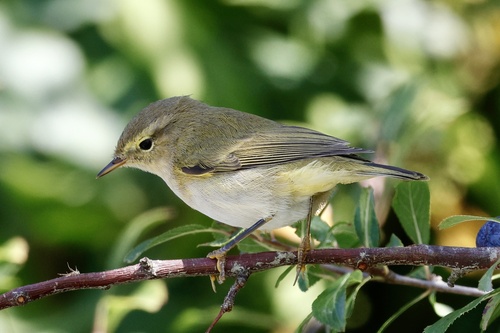 Iberian Chiffchaff
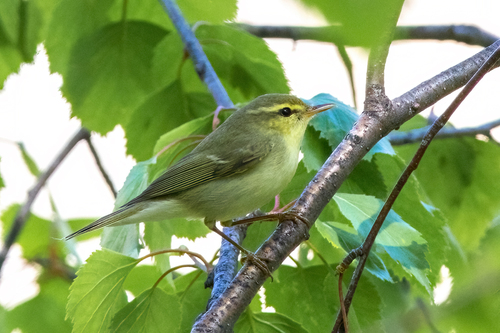 Green Warbler
In short
The most reliable field mark for separating Iberian Chiffchaff from Green Warbler is the presence of wing bars: Green Warbler (especially juveniles and young birds) shows one strong and one faint wing bar, while Iberian Chiffchaff always lacks wing bars. In addition, Green Warbler is overall brighter and more yellow below, whereas Iberian Chiffchaff has a yellow breast but a clean white belly and greener, less yellow upperparts. Both are small leaf warblers, but their underpart coloration and wing pattern provide the clearest separation, especially in flight or with good side views.
Identification tips
- Wing bars are key: Juvenile and young Green Warblers have one strong and one faint wing bar, easily visible in flight or perched side views. Iberian Chiffchaff never shows wing bars at any age—if you see any hint of a bar, rule out Iberian Chiffchaff.
- Underpart coloration: Green Warbler is much more yellow below throughout, while Iberian Chiffchaff has a yellow breast but a clean white belly. If the belly is white and contrasts with a yellow breast, Iberian Chiffchaff is more likely.
- Upperpart tone: Green Warbler is brighter and more vivid green above, whereas Iberian Chiffchaff is a cleaner, paler green without brown hues, but not as bright as Green Warbler.
- Eyestripe: Iberian Chiffchaff has a distinct dark eyestripe, which can enhance its resemblance to Willow Warbler. Green Warbler's eyestripe is not specifically described as diagnostic.
- No brown tones: Iberian Chiffchaff lacks any brown hue on the upperparts, which can help if you are comparing to other chiffchaffs but is less useful against Green Warbler.
- Voice: If heard, Iberian Chiffchaff's song is faster, more monotonous, and includes rattles and whistles, not the simple 'chiff-chaff' of Common Chiffchaff. Green Warbler's song is not described here, so use with caution.
- Habitat and range: If you are in southwestern Europe or North Africa, Green Warbler is extremely unlikely. In the Caucasus, expect Green Warbler, not Iberian Chiffchaff.
- Overall brightness: Green Warbler is generally brighter and more yellowish, especially on the underparts, than Iberian Chiffchaff.
- Plumage pitfall: Both species are greenish above, but Green Warbler's yellow below can be quite striking, while Iberian Chiffchaff's white belly is a strong contrast.
- Seasonality: Both species are migratory, but their ranges do not overlap, so time of year and location can be a strong clue.
- Structure: No reliable difference in bill shape, wing projection, or tail noted in the sources—do not rely on structure alone.
- Sex differences: No sex-specific field marks are described for either species.
- Flight views: In flight, look for wing bars on Green Warbler (especially juveniles/first-years); absence of bars supports Iberian Chiffchaff.
- Perched views: Side-on views are best for checking underpart color and wing bars.
- Confusion with Willow Warbler: Iberian Chiffchaff's white belly and yellow breast can recall Willow Warbler, but Green Warbler's yellow is more extensive and its wing bars are unique among these options.
Size
Both species are small Phylloscopus warblers and are very similar in size and structure, with no reliable difference in length or mass noted in the available sources. If anything, Iberian Chiffchaff is described as slightly larger and paler than Common Chiffchaff, but this does not reliably distinguish it from Green Warbler in the field.
Plumage
Juvenile and young Green Warblers are distinctive for their wing pattern: they show one strong and one faint wing bar, a feature never present on Iberian Chiffchaff of any age. Adult Green Warblers are also brighter green above and much more yellow below than Iberian Chiffchaff. Iberian Chiffchaff has clean green upperparts (without brown tones), a yellow breast, and a white belly, with a distinct dark eyestripe. Its underparts are closer to Willow Warbler than to Green Warbler, lacking the extensive yellow wash of Green Warbler. Both species have a greenish tone above, but Green Warbler is brighter and more vivid, while Iberian Chiffchaff is paler and less yellow overall.
Habitat
Iberian Chiffchaff breeds in southwestern Europe and northwestern Africa, wintering in western Africa south of the Sahara. Green Warbler is found in the Caucasus Mountains in southeastern Europe. Their ranges do not overlap, so location is a strong clue: Iberian Chiffchaff is never expected in the Caucasus, and Green Warbler is not found in Iberia or North Africa. If you are birding in southwestern Europe, Green Warbler is extremely unlikely.
Voice
Iberian Chiffchaff's song is not a simple disyllabic 'chiff-chaff' but includes a faster, more monotonous call with repeated rattles and drawn-out whistles, sometimes transcribed as 'chiff-chiff-chiff-chiff-dr-dr-dr-dr-swit-swit-swit.' Green Warbler's voice is not described in the provided notes, so vocalization is not a reliable separator unless you are very familiar with both species' songs from other sources.