

Honeyguide Greenbul vs Grey-olive Greenbul
Baeopogon indicator versus Phyllastrephus cerviniventris
Play a quiz with Honeyguide Greenbul and Grey-olive Greenbul
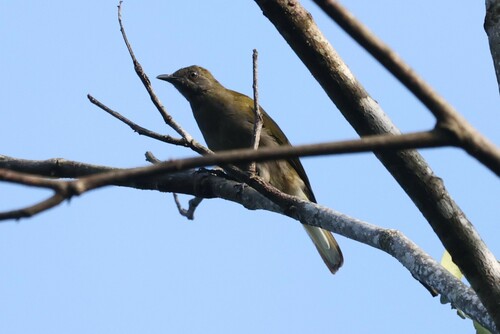 Honeyguide Greenbul
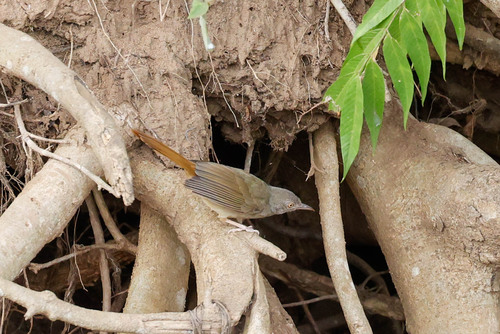 Grey-olive Greenbul
In short
The most reliable way to separate Honeyguide Greenbul from Grey-olive Greenbul is by focusing on tail and undertail coloration: Honeyguide Greenbul often shows a contrastingly pale or whitish tail tip (hence the alternate name 'white-tailed greenbul'), while Grey-olive Greenbul lacks this feature and has a more uniformly colored tail. Both species are greenbuls with generally similar size and shape, so structural differences are subtle. Habitat can help: Honeyguide Greenbul is a bird of dense African rainforest, while Grey-olive Greenbul favors drier forests and woodland edges in eastern and south-central Africa. If you see a greenbul with a distinctly pale tail tip in humid lowland forest, it's likely Honeyguide; if the tail is plain and the setting is drier woodland, Grey-olive is more probable.
Identification tips
- Tail tip color: Look for a pale or whitish tip to the tail on Honeyguide Greenbul; this is often visible when the bird fans its tail or in flight. Grey-olive Greenbul's tail is uniformly colored without a pale tip. This mark works for adults and likely for immatures as well.
- Underpart coloration: Honeyguide Greenbul often shows paler, sometimes yellowish underparts, while Grey-olive Greenbul has more muted, grey-olive or buffy underparts. Use this with caution, as lighting and wear can affect perception.
- Habitat context: If you are in dense, humid rainforest, prioritize Honeyguide Greenbul. In drier forests or woodland edge, Grey-olive Greenbul is more likely. This is especially helpful if plumage marks are ambiguous.
- Geographic range: Honeyguide Greenbul is widespread in the African tropical rainforest belt; Grey-olive Greenbul is more restricted to eastern and south-central Africa. Check your location if unsure.
- Tail pattern in flight: Watch for a flash of pale at the tail tip when the bird takes off or fans its tail; this is a quick field mark for Honeyguide Greenbul.
- Plumage uniformity: Grey-olive Greenbul tends to be more uniformly colored overall, with less contrast between upperparts and underparts or tail.
- Alternate names confusion: Be aware that 'white-tailed greenbul' can refer to Honeyguide Greenbul, but also to other species in some references. Always check for the actual tail pattern.
- No strong structural differences: Bill shape, tail length, and jizz are similar between these two; do not rely on structure alone.
- No documented age-specific upperwing marks: Unlike some greenbuls, neither species is known for distinctive juvenile wing patterns, so focus on tail and underpart color for all ages.
- Behavioral cues: Both species behave like typical greenbuls, so movement and foraging style are not reliable separators.
- Season and sex: No significant seasonal or sexual dimorphism is noted for either species; field marks are consistent year-round and for both sexes.
- Vocalizations: No comparative voice information is available in the sources; do not rely on song or call for separation unless you have local experience.
- Group association: Both species may join mixed-species flocks, so flock composition is not a safe separator.
- Lighting pitfalls: Pale tail tips can be obscured in poor light or if the tail is folded; always try for multiple views.
- Quiz context: If you mixed these up in a quiz, focus on tail tip color and habitat as your first checks, then underpart tone.
Size
Both species are medium-sized greenbuls in the Pycnonotidae family, and available sources do not indicate a significant difference in size or mass between Honeyguide Greenbul and Grey-olive Greenbul. In the field, size alone is not a reliable separator for these two.
Plumage
No detailed age-specific wing or upperwing pattern differences are documented for these species, so focus on tail and underpart coloration. Honeyguide Greenbul of all ages typically shows a pale or whitish tip to the tail, which can be conspicuous when perched or in flight; this is the source of its alternate name 'white-tailed greenbul.' Grey-olive Greenbul lacks this pale tail tip and has a more uniform olive or grey-olive tail. Underparts also differ subtly: Honeyguide Greenbul tends to have paler, sometimes yellowish underparts, while Grey-olive Greenbul is described as having more muted, grey-olive or buffy underparts. These differences are present in adults and likely in immatures as well, but no specific juvenile flight marks are described in the sources.
Behaviour
Both species behave much like typical greenbuls: they are active, often in the midstory or lower canopy, and can be seen foraging in pairs or small groups. No major behavioral differences are noted in the sources that would reliably separate them in the field.
Habitat
Habitat is a useful clue: Honeyguide Greenbul is found in dense, humid African tropical rainforest, often in the interior of lowland forests. In contrast, Grey-olive Greenbul prefers drier habitats, including subtropical or tropical dry forests, moist lowland forests, and moist shrubland, especially in eastern and south-central Africa. If you are birding in deep, humid rainforest, Honeyguide Greenbul is more likely; in drier or more open woodland, Grey-olive Greenbul is the expected species.