

Himalayan Snowcock vs Alpine Chough
Tetraogallus himalayensis versus Pyrrhocorax graculus
Play a quiz with Himalayan Snowcock and Alpine Chough
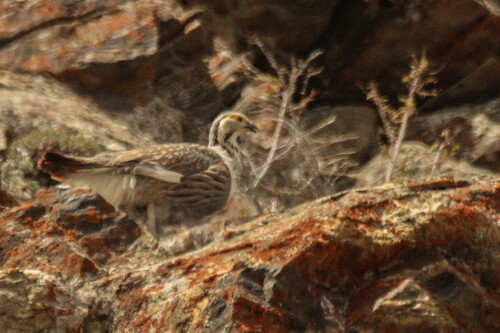 Himalayan Snowcock
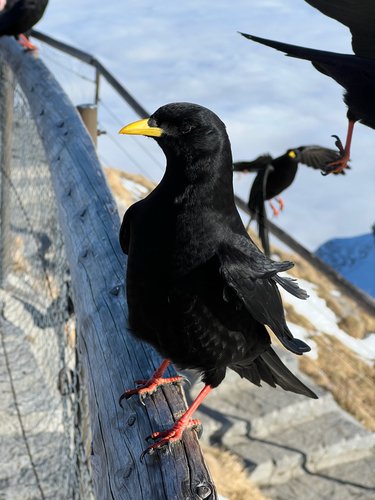 Alpine Chough
In short
The most reliable way to separate Himalayan Snowcock from Alpine Chough is by overall structure and flight style: the snowcock is a massive, ground-dwelling gamebird with broad wings and a short tail, while the Alpine Chough is a much smaller, slender, glossy-black crow with a long tail and acrobatic flight. In flight, the snowcock shows white primaries tipped in black and rufous outer tail feathers, while the chough is all black with no pale in the wings or tail. Perched, the snowcock's partridge-like build, white throat, and chestnut facial markings contrast sharply with the chough's uniform black plumage and bright yellow bill. Voice, habitat use, and flocking behavior also differ markedly.
Identification tips
- Size and bulk: Himalayan Snowcock is massive and partridge-like, much larger and heavier than Alpine Chough. If you see a bird the size of a small goose, it's a snowcock; choughs are only crow-sized.
- Flight pattern and structure: Snowcock flies with broad, rounded wings and a short tail, often gliding steeply downhill; chough is agile, with a long, fanned tail and deep, loose wingbeats, often soaring and maneuvering in updrafts.
- Wing and tail pattern in flight: Snowcock shows white primaries tipped in black and rufous outer tail feathers from above; Alpine Chough is all black with no pale or rufous in the wings or tail at any age.
- Bill color and shape: Chough has a slender, bright yellow bill (dull yellow in juveniles); snowcock has a stout, pale bill more like a partridge or chicken.
- Facial pattern: Snowcock has a white throat and face bordered by chestnut and a dark band from eye to collar; chough's face is plain black with no pattern.
- Leg color: Chough has red legs (brownish in juveniles); snowcock has yellow legs and orbital skin.
- Plumage texture and gloss: Chough is glossy black (duller in juveniles); snowcock is grey above with streaked flanks and rufous and white highlights.
- Perched posture: Snowcock sits upright, often on rocks, with a heavy, horizontal body and cocked tail; chough is slender, often perches on wires or buildings, and is more upright and alert.
- Habitat context: Snowcock is almost always on remote rocky slopes or alpine pastures, rarely near humans; chough is often seen near cliffs, meadows, and even human settlements at high altitude.
- Group behavior: Both can be gregarious, but snowcock groups are tight, wary, and terrestrial; chough flocks are loose, aerial, and social, often swirling together in flight.
- Vocalizations: Snowcock's loud, whistled calls are very different from the chough's high, rippling 'preep' and 'sweeeooo'.
- Seasonal variation: No major seasonal plumage changes in either, but snowcock is more vocal in spring; chough's bill and leg color is duller in juveniles but never approaches snowcock's pattern.
- Sex differences: Both sexes look similar, but female snowcock is slightly smaller and lacks the male's tarsal spur; chough sexes are indistinguishable in the field.
- Juvenile confusion: Juvenile choughs are duller and have brownish legs, but never show any pale or rufous in the wings or tail; juvenile snowcocks are similar to adults in pattern.
- Common pitfalls: At long range, a flying snowcock might appear dark, but look for the white and rufous in the wings and tail; a distant chough may seem bulky if seen head-on, but note the long tail and acrobatic flight.
Size
Himalayan Snowcock is enormous compared to Alpine Chough: 55–74 cm long and 2–3.1 kg in weight [wikipedia], dwarfing the chough's 37–39 cm length and 188–252 g mass [wikipedia]. The snowcock is a heavy, broad-bodied bird with a short tail and thick legs, while the chough is slim, with a long tail and delicate proportions. Even the largest Alpine Chough is less than a tenth the weight of a snowcock.
Plumage
No age or seasonal confusion: both species are adult-like in basic pattern from fledging. In flight, Himalayan Snowcock (all ages) shows a striking pattern: white primaries tipped in black and rufous outer tail feathers, with grey upperparts and a white undertail. Alpine Chough (all ages) is glossy black overall, with no pale in the wings or tail, and a yellow bill (duller in juveniles). Perched, snowcock has a white throat and face bordered by chestnut and a dark band from eye to collar, grey upperparts, and boldly streaked flanks; chough is plain black with no pale or rufous, and no facial pattern. Juvenile choughs are duller black with a dull yellow bill and brownish legs, but still lack any pale or rufous in wing or tail. Sexes are alike in both, but female snowcock is slightly smaller and lacks the male's tarsal spur.
Behaviour
Himalayan Snowcock is a wary, ground-dwelling bird, usually seen walking slowly uphill in small groups or flying powerfully down slopes when flushed. It prefers to run uphill when alarmed and only takes flight as a last resort, often gliding at speed down into valleys. Alpine Chough is highly aerial, often seen in flocks performing acrobatic, buoyant flight with deep wingbeats, fanning its long tail, and soaring on updrafts near cliffs. On the ground, choughs are agile and social, but rarely as wary or strictly terrestrial as snowcocks.
Habitat
Both species occur in high mountains, but their microhabitat use differs. Himalayan Snowcock keeps to open alpine pastures and steep rocky slopes, usually above treeline, and is almost always on the ground or perched on rocks. Alpine Chough is more versatile, foraging on cliffs, alpine meadows, and even near human habitation at ski resorts or villages, and is much more likely to be seen in flight or perched on buildings or wires. Snowcock is rarely seen away from wild, remote slopes.
Voice
Himalayan Snowcock gives a loud, three-part ascending whistle and a rising, shrill piping call, especially in spring; it is generally silent in winter. Alpine Chough has a high-pitched, rippling 'preep' and whistled 'sweeeooo', quite unlike the snowcock's calls, and also gives rolling churrs and soft warbles. The chough's calls are typical of crows and are higher-pitched than the related red-billed chough.