

Herring Gull vs Carrion Crow
Larus argentatus versus Corvus corone
Play a quiz with Herring Gull and Carrion Crow
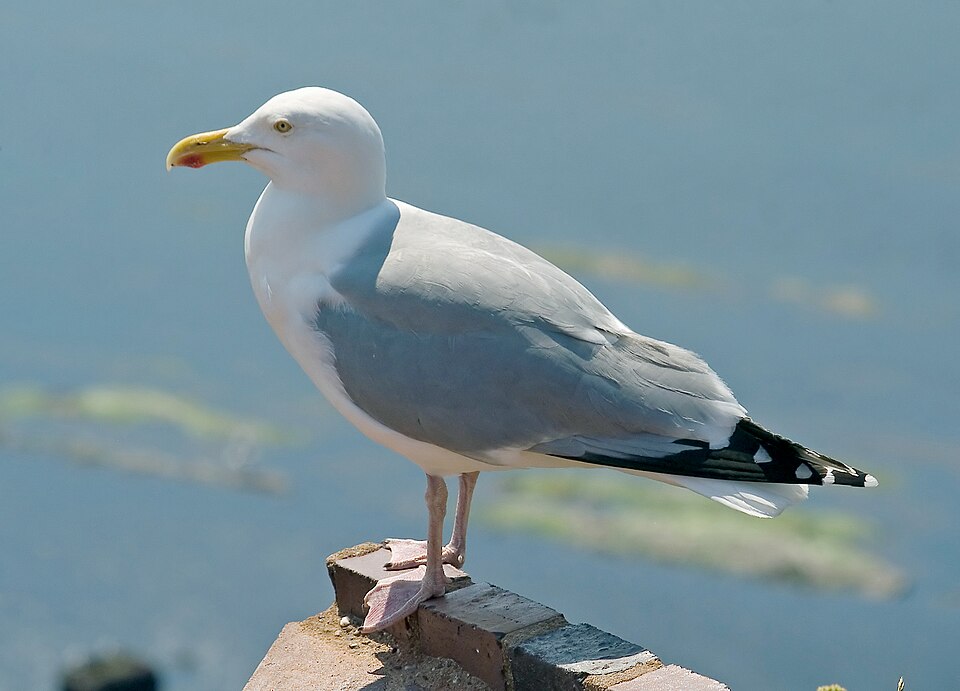 Herring Gull
 Carrion Crow
In short
The most reliable way to separate Herring Gull from Carrion Crow is by overall structure and plumage: Herring Gull is a large, broad-winged seabird with pale grey and white plumage and black wingtips, while Carrion Crow is a smaller, all-black bird with a stout bill and a greenish sheen. Juvenile and immature Herring Gulls are brown and streaky, but still show a bulkier build and longer wings compared to the uniformly black or brownish Carrion Crow. In flight, Herring Gulls have longer, broader wings and a more languid flight style, whereas Carrion Crows have shorter, rounder wings and a steadier, more direct flight. Voice is also distinctive: Herring Gulls have loud, laughing calls, while Carrion Crows give deep, croaked 'kraa' notes.
Identification tips
- Overall structure: Herring Gull is much larger and bulkier, with longer, broader wings and a heavier, hooked bill. Carrion Crow is smaller, with a stout, straight bill and shorter, rounder wings. This difference is visible at all ages.
- Plumage (adult): Adult Herring Gulls are pale grey above and white below, with black wingtips and white 'mirrors', yellow bill with a red spot, and pink legs. Carrion Crow is entirely black with a greenish or purplish sheen, black bill, and black legs.
- Plumage (immature/juvenile): Juvenile Herring Gulls are brown and streaky with a dark bill and eyes, gradually becoming greyer with age. Carrion Crow juveniles are brownish-black with blue eyes, but never show the streaked or mottled pattern of young gulls.
- Flight pattern: Herring Gulls have long, broad wings and a slow, buoyant flight, often soaring or gliding. Carrion Crows have steadier, more direct flight with slower, deliberate wingbeats, and rarely soar for long periods.
- Wing pattern in flight: Even young Herring Gulls show pale underwings and contrasting patterns, while Carrion Crow is uniformly dark above and below.
- Bill color and shape: Herring Gull adults have a yellow bill with a red spot; immatures have a dark bill. Carrion Crow always has a black, straight bill.
- Leg color: Herring Gull legs are usually pink, sometimes yellowish in Baltic birds. Carrion Crow legs are always black.
- Eye color: Adult Herring Gulls have pale eyes with a yellow orbital ring; Carrion Crow has dark brown eyes (blue in juveniles).
- Perched posture: Herring Gulls stand upright with a long, sloping back and often appear taller. Carrion Crows are more compact and squat.
- Habitat: Herring Gulls are common near water, coasts, and urban areas; Carrion Crows are more often found inland, in fields, woods, and parks.
- Group size: Herring Gulls often gather in large flocks, especially at food sources. Carrion Crows are usually solitary or in pairs, occasionally in small groups.
- Feeding behavior: Herring Gulls scavenge at dumps, beaches, and water, often dropping food to break it. Carrion Crows forage on the ground, rarely interact with water, and do not drop food from heights.
- Vocalization: Herring Gull gives loud, laughing calls; Carrion Crow gives a deep, croaked 'kraa'.
- Context: If the bird is seen swimming or loafing on water, it's almost certainly a gull. Crows do not swim.
- Confusion risk: In poor light, a juvenile Herring Gull may look dark, but will still show a bulkier build and longer wings than any crow. Carrion Crow is never as pale or as large as a Herring Gull.
Size
Herring Gull is substantially larger and heavier than Carrion Crow. Adult Herring Gulls measure 60–67 cm (male) or 55–62 cm (female) in length, with a wingspan of 125–155 cm and a weight of 710–1,525 g [wikipedia][avonet]. Carrion Crow is much smaller, at 48–52 cm in length, with a wingspan of 84–100 cm and a weight of 400–600 g [wikipedia][avonet]. Even a small female Herring Gull will look bulkier and longer-winged than the largest Carrion Crow. In the field, the gull's longer, more pointed wings and larger size are usually obvious when both are seen together.
Plumage
Juvenile and first-winter Herring Gulls are brown with darker streaks and a dark bill and eyes, gradually becoming greyer with age. By second winter, they show a whiter head and underparts, grey back, and less streaking; third-winter birds are mostly adult-like but may retain brown in the wings and dark bill markings. Adults are pale grey above, white below, with black wingtips and white 'mirrors' on the outer primaries, a yellow bill with a red spot, and pink (sometimes yellowish) legs [wikipedia]. In contrast, Carrion Crow of all ages is black overall, with a greenish or purplish sheen. Juvenile crows may be browner and have blue eyes, but never show the pale or streaked patterns of gulls. The crow's bill, legs, and feet are always black. In flight, even young Herring Gulls show pale underwings and a contrasting pattern, while Carrion Crow is uniformly dark.
Behaviour
Herring Gulls are often seen in flocks, especially near water, garbage dumps, or urban areas, and are highly opportunistic scavengers. They may be seen soaring, gliding, or floating on water, and often drop food items from a height to break them open. Carrion Crows are more often solitary or in pairs, though they may gather in small groups, especially at roosts. Their flight is steadier and more direct, with slower, more deliberate wingbeats than the similar rook. Crows are rarely seen swimming or loafing on water, and are more likely to perch on trees or buildings.
Habitat
Herring Gulls are most common along coasts, estuaries, and large inland water bodies, but also frequent urban areas, fields, and landfill sites [wikipedia][ebird]. Carrion Crows are highly adaptable but are more often found inland, in farmland, woods, parks, and cities, rarely venturing far out to sea or onto open beaches. If the bird is seen swimming or feeding at the water's edge, especially in a large group, Herring Gull is more likely; a solitary black bird in a field or perched in a tree is more likely a Carrion Crow.
Voice
Herring Gull gives loud, laughing or yelping calls, often in series, which are very different from any crow. Carrion Crow has a deep, guttural 'kraa' or 'caw', repeated several times in quick succession, with a croaked quality. The crow's call is lower-pitched and less nasal than the rook's. If you hear a classic gull 'laugh', it's Herring Gull; if you hear a deep, croaked 'kraa', it's Carrion Crow.