

Hazel Grouse vs Grey Partridge
Tetrastes bonasia versus Perdix perdix
Play a quiz with Hazel Grouse and Grey Partridge
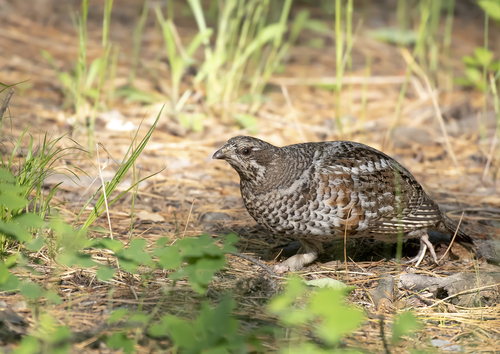 Hazel Grouse
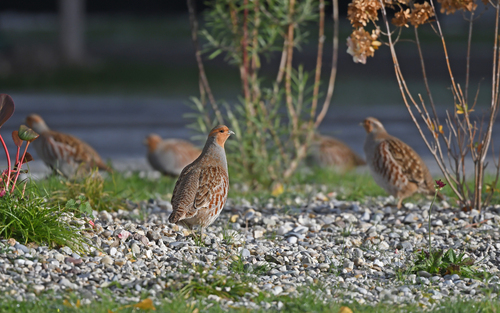 Grey Partridge
In short
The most reliable field separation between Hazel Grouse and Grey Partridge is the Hazel Grouse’s finely patterned, mostly grey upperparts and black-tipped grey tail (especially visible in flight), versus the Grey Partridge’s plainer brownish body and lack of a marked tail tip. Juvenile Grey Partridges are yellow-brown and lack the adult’s face and underpart markings, while Hazel Grouse juveniles closely resemble adults in their cryptic, intricately barred plumage. Structurally, Hazel Grouse is slightly larger-bodied but more compact and rounded, with a short crest in males, while Grey Partridge is longer-tailed and more upright. Habitat is also a strong clue: Hazel Grouse keeps to dense, damp mixed woodlands, whereas Grey Partridge is a bird of open fields and farmland.
Identification tips
- Juvenile plumage: A mostly yellow-brown, plain juvenile with no face or underpart markings is Grey Partridge; Hazel Grouse juveniles are already cryptically barred and patterned like adults.
- Tail in flight: Hazel Grouse shows a black-tipped grey tail in flight, which is lacking in Grey Partridge.
- Crest: Male Hazel Grouse has a short erectile crest and a white-bordered black throat; females have a shorter crest and lack the black throat. Grey Partridge lacks any crest.
- Upperparts: Hazel Grouse is finely patterned and mostly grey above; Grey Partridge is plainer and brownish.
- Belly patch: Adult male Grey Partridge has a dark belly patch; females have a smaller one. Hazel Grouse never shows a belly patch.
- Face color: Grey Partridge adults have an orange face; Hazel Grouse does not.
- 'Cross of Lorraine': Only visible in hand, but adult female Grey Partridge has two transverse bars on the tertiary coverts; males have one. Not visible in the field, but worth noting for close-up or photographic study.
- Size and shape: Hazel Grouse is more compact, rounded, and slightly larger in mass, but shorter-tailed; Grey Partridge is more elongated, with a longer wingspan and tail, and stands more upright.
- Habitat: Hazel Grouse is found only in dense, damp, mixed woodland; Grey Partridge is strictly a bird of open fields and farmland.
- Behavior: Hazel Grouse is shy and secretive, rarely seen in the open, and quickly disappears into cover. Grey Partridge is more likely to be seen running or foraging in open areas, and may flush and land in the open.
- Vocalizations: Hazel Grouse calls are high-pitched and whistled or liquid; Grey Partridge is harsh and rasping ('rick rick rick' or 'kieerr-ik').
- Flight style: Both flush explosively, but Hazel Grouse tends to vanish into cover, while Grey Partridge often lands in the open.
- Sex differences: Hazel Grouse males have a black throat and crest; Grey Partridge sexes are very similar, with only subtle differences in belly patch size and covert barring (not visible in the field).
- Underparts: Hazel Grouse has chestnut-flecked white underparts; Grey Partridge is plainer below, with the belly patch as the main feature.
- Context: If you see a small gamebird in thick spruce or mixed forest, think Hazel Grouse; in open farmland, Grey Partridge is far more likely.
Size
Hazel Grouse is slightly larger in body mass (average 369 g) but appears more compact and rounded, with a length of 35–39 cm. Grey Partridge is a bit shorter in length (29–31 cm) but can overlap in weight (320–455 g for the nominate race), and has a longer wingspan (45–48 cm), giving it a more elongated, upright look in the field. Both sexes are similar in size within each species. In flight, Hazel Grouse may look chunkier and shorter-tailed, while Grey Partridge appears longer-winged and more streamlined.
Plumage
- Juvenile/immature birds: Juvenile Grey Partridges are mostly yellow-brown, lacking the adult’s distinctive face and underpart markings, and do not show the adult’s belly patch or 'cross of Lorraine' on the wing coverts. Hazel Grouse juveniles are already cryptically barred and patterned, resembling adults, so a plain, warm-toned juvenile is Grey Partridge.
- Adults: Hazel Grouse has finely patterned grey upperparts, brown wings, and chestnut-flecked white underparts. The male Hazel Grouse shows a short erectile crest and a white-bordered black throat, while the female has a shorter crest and lacks the black throat patch. In flight, Hazel Grouse shows a black-tipped grey tail. Grey Partridge adults are plainer, with a brownish body, orange face, and (in males) a dark belly patch. The 'cross of Lorraine' (two transverse bars on the tertiary coverts) is diagnostic for adult female Grey Partridge, but only visible in the hand. Both sexes of Grey Partridge are similar in plumage, with females being slightly duller and having a smaller belly patch.
Behaviour
Hazel Grouse is extremely shy and secretive, often detected only by its call or the sound of its wings as it flushes from dense cover. It prefers to stay hidden in thick woodland and rarely ventures into the open. Grey Partridge, by contrast, is much more likely to be seen foraging in open fields or along field margins, and when flushed, it flies a short distance on rounded wings, often calling. Both species are ground-dwelling and may flush explosively, but Hazel Grouse is more likely to disappear quickly into cover, while Grey Partridge may run before flying and often lands in the open.
Habitat
Hazel Grouse is strictly a bird of dense, damp, mixed coniferous woodland, especially with spruce, and avoids open country. Grey Partridge is a classic farmland bird, found in open fields, grasslands, and agricultural areas, and is rarely if ever found in dense woods. If you find a small gamebird in thick forest, it is almost certainly Hazel Grouse; in open farmland, Grey Partridge is far more likely.
Voice
Hazel Grouse males give a high-pitched 'ti-ti-ti-ti-ti' call, while females make a liquid 'tettettettettet.' The wingbeats in flight produce a distinctive burr. Grey Partridge has a harsh, high-pitched 'kieerr-ik' song, and when flushed, calls 'rick rick rick.' Both are more often heard than seen, but the quality of the calls is quite different: Hazel Grouse is more whistled or liquid, Grey Partridge more rasping and harsh.