
Hazel Grouse vs Common Quail
Tetrastes bonasia versus Coturnix coturnix
Play a quiz with Hazel Grouse and Common Quail
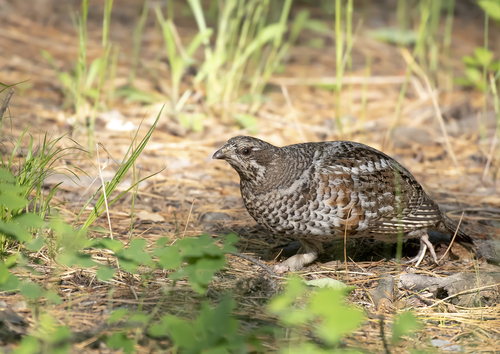 Hazel Grouse
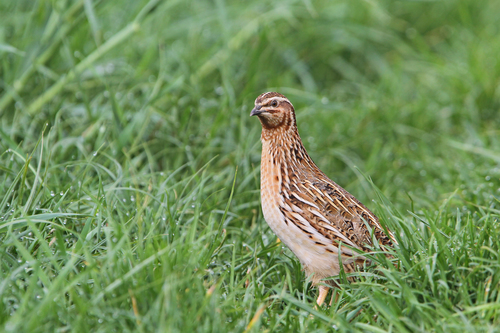 Common Quail
In short
The most reliable field mark to separate Hazel Grouse from Common Quail is overall structure and flight pattern: Hazel Grouse is a much larger, plumper, short-winged woodland bird with a black-tipped grey tail visible in flight, while Common Quail is a small, compact, long-winged migrant with a streaked brown body and no contrasting tail. Juvenile or flying birds can be tricky, but Hazel Grouse’s size, grey upperparts, and woodland habits contrast sharply with the quail’s smaller size, streaked appearance, and open-country behavior. Sex differences are subtle in both, but the Hazel Grouse male’s black-and-white throat patch is unique. Calls are very different and often the best clue when views are brief.
Identification tips
- Size and Structure: Hazel Grouse is much larger and bulkier than Common Quail. If the bird appears nearly pigeon-sized, it is a Hazel Grouse; if it is sparrow-sized, it is a quail.
- Tail Pattern in Flight: Hazel Grouse of all ages show a black-tipped grey tail in flight, which is absent in Common Quail. Look for this contrast when a bird flushes.
- Wing Shape: Common Quail has long, pointed wings (adapted for migration), while Hazel Grouse has shorter, rounded wings typical of woodland grouse. In flight, quail look more streamlined.
- Crest and Head Markings: Male Hazel Grouse has a short, erectile crest and a bold white-bordered black throat. Females have a shorter crest and lack the black throat. Common Quail lacks any crest and has a white eyestripe and, in males, a white chin.
- Plumage Texture: Hazel Grouse is finely patterned grey above with chestnut-flecked white below, blending into woodland. Common Quail is streaked brown and buff, blending into grassland.
- Habitat: Hazel Grouse is almost always in dense, damp woodland. Common Quail is found in open fields and grasslands. Habitat alone can often clinch the ID.
- Behavior When Flushed: Hazel Grouse explodes from cover with a whirring flight but quickly drops back into dense vegetation. Common Quail runs before flushing and, when it does fly, goes low and fast across open ground.
- Vocalizations: Hazel Grouse’s ti-ti-ti-ti-ti or tettettettettet calls are very different from the quail’s three-note 'chip-chip-chip' call. If you hear the call, ID is straightforward.
- Sex Differences: Only male Hazel Grouse has the black-and-white throat patch; both sexes of Common Quail have similar streaked faces, but only the male has a white chin.
- Seasonal Context: Common Quail is migratory and may be absent in winter, while Hazel Grouse is resident year-round in its range.
- Flight Jizz: Hazel Grouse’s flight is short, explosive, and ends quickly; Common Quail’s flight is longer, lower, and more direct, sometimes covering significant distance.
- Bill Shape: Both have short, stout bills, but Hazel Grouse’s is proportionally thicker and more curved, suited for woodland foraging.
- Local Abundance: In most of Europe, Hazel Grouse is rare and local in suitable woodland, while Common Quail can be abundant in farmland during migration and breeding.
- Pitfalls: Immature Hazel Grouse may lack strong throat contrast but will still show the grey and chestnut pattern and black-tipped tail. Immature Common Quail resemble adults but are always streaked and lack any crest or throat patch.
- When in Doubt: If you see a small, streaked bird in open country, it is almost always a quail. If you see a plump, greyish bird with a black-tipped tail in woods, it is Hazel Grouse.
Size
Hazel Grouse is much heavier (body mass ~369 g) and longer (35–39 cm) than Common Quail (16–18 cm, 70–140 g). Hazel Grouse is a robust, plump bird, while Common Quail is notably smaller and more compact. In the field, Hazel Grouse appears bulkier with a relatively short tail and wings, whereas Common Quail is a small, round-bodied bird with proportionally longer wings for its size. This size difference is usually obvious even at a distance or in flight.
Plumage
Juvenile and adult Hazel Grouse of both sexes have finely patterned grey upperparts, brown wings, and chestnut-flecked white underparts. In flight, all ages show a black-tipped grey tail, which is a key mark. Males have a short crest and a bold white-bordered black throat; females lack the black throat and have a shorter crest. Common Quail of all ages are streaked brown above with a white eyestripe and, in males, a white chin. Their wings are long and pointed, and there is no contrasting tail pattern. The quail’s streaked brown and buff plumage blends with grassland, while Hazel Grouse’s grey and chestnut tones suit woodland. Juvenile-specific wing patterns are not described for either species, but the tail pattern in Hazel Grouse is diagnostic in flight for all ages.
Behaviour
Hazel Grouse is sedentary, shy, and usually found in dense, damp, mixed coniferous woodland, often remaining hidden and flushing only at close range. It flies with a rapid, whirring burst but quickly drops back into cover. Common Quail is migratory, often found in open fields and grasslands, and is more likely to run than fly when disturbed. When it does fly, it rises abruptly and flies low and fast, sometimes covering long distances. The quail’s long wings are adapted for migration, while Hazel Grouse’s flight is more explosive and short-ranged.
Habitat
Hazel Grouse is a woodland specialist, preferring dense, damp, mixed forests with conifers and some spruce. It is rarely seen in open country. Common Quail, in contrast, is a bird of open habitats: fields, meadows, and grasslands, often far from trees. If you flush a small gamebird in deep woods, it is almost certainly Hazel Grouse; in open farmland or grass, Common Quail is far more likely.
Voice
Hazel Grouse males give a high-pitched ti-ti-ti-ti-ti call, while females produce a liquid tettettettettet. The flight produces a distinctive burr of the wings. Common Quail’s call is a repeated three-note 'chip-chip-chip' or 'wet-my-lips', repeated in quick succession and often heard at night or dawn. These vocalizations are very different and, when heard, are the easiest way to separate the two.