

Greylag Goose vs Garganey
Anser anser versus Spatula querquedula
Play a quiz with Greylag Goose and Garganey
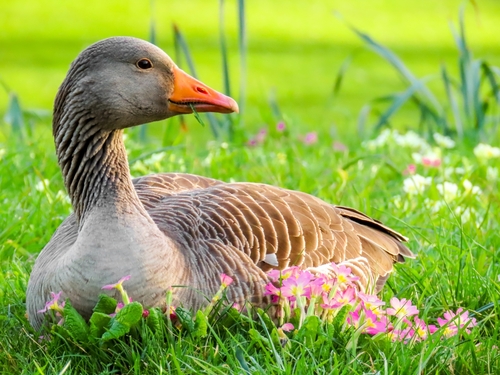 Greylag Goose
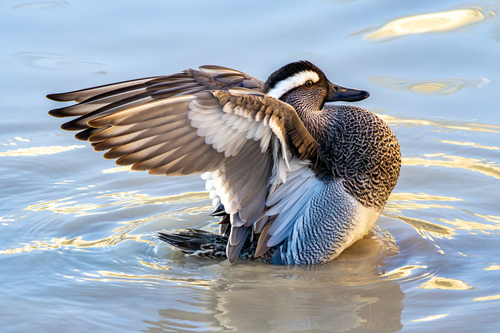 Garganey
In short
The most reliable field mark is size: Greylag Goose is a massive, heavy-bodied goose, while Garganey is a small, compact dabbling duck. In flight, Greylag shows pale grey forewings and rump with light wing coverts contrasting against dark flight feathers, whereas Garganey (especially males) flashes a pale blue speculum with a white border. Perched, Greylag’s orange bill and pink legs stand out, while Garganey males have a bold white supercilium (crescent over the eye) and a grey bill. Juvenile Greylags lack black belly spots and have greyish legs, but are still much larger than any Garganey. If you’re unsure, focus on overall bulk, bill color, and wing pattern in flight.
Identification tips
- Size is the first check: Greylag Goose is enormous compared to Garganey. If the bird looks goose-sized, it is not a Garganey.
- Bill color and shape: Greylag has a thick, orange bill; Garganey has a slender, grey bill (never orange or pink).
- Leg color: Greylag’s legs are pink (greyish in juveniles); Garganey’s are grey.
- Flight pattern (all ages): Greylag shows pale grey forewings and rump, with light coverts contrasting with dark flight feathers. Garganey (especially males) flashes a pale blue speculum with a white border.
- Perched head pattern (adult males): Garganey males have a bold white crescent above the eye and a dark crown, never seen in Greylag.
- Neck structure: Greylag has a long, thick neck with a 'concertina' pattern of feather folds; Garganey is short-necked and compact.
- Breast and belly: Adult Greylags have variable black spotting on the pale breast and belly; juveniles lack this but are still much larger than Garganey. Garganey shows no black spotting.
- Face pattern (female/juvenile Garganey): Look for strong facial markings—pale eyebrow, dark eye line, and pale lore spot bordered by a second dark line. Greylag never shows this.
- Scapulars and tertials: Garganey males have loose grey scapulars and prominent white edges on tertials when swimming; Greylag’s scapulars are not distinctive.
- Voice: If you hear loud, cackling honks, it’s Greylag. Garganey is mostly silent or gives a soft crackling call (male only).
- Habitat context: In the UK, Greylag is common in open fields and wetlands; Garganey is rare, usually found in quiet marshes during migration or breeding.
- Flock structure: Greylags often form large, noisy flocks; Garganey are more likely to be in small, quiet groups or mixed with other dabbling ducks.
- Behavior: Greylags graze or swim with slow, heavy movements; Garganey dabble actively and may shake their heads frequently when feeding.
- Season: Garganey is strictly migratory and unlikely in the UK outside spring and autumn passage or rare breeding sites; Greylag is present year-round.
- Common pitfalls: Juvenile Greylags lack black belly spots and can look plainer, but their size, structure, and pale forewing in flight remain distinctive. Female Garganey may be confused with teal, but not with Greylag if size and bill are checked.
Size
Greylag Goose is dramatically larger, averaging 3464.5 g in mass [wikidata] and measuring 74–91 cm in length [wikipedia]. Garganey is a small dabbling duck, much lighter and more compact (no precise mass given, but typical dabbling ducks are under 500 g). Even a juvenile Greylag dwarfs a Garganey. In the field, Greylags appear long-necked and heavy with a thick body, while Garganey is slim, short-necked, and delicate.
Plumage
- Juveniles: Juvenile Greylags lack the black spotting on the breast and belly seen in adults and have greyish legs, but still show the pale grey forewing and rump in flight, and a generally uniform grey-brown appearance. Juvenile Garganey females can be confused with Common Teal, but show stronger face markings: a pale eyebrow, dark eye line, and pale lore spot bordered by a second dark line.
- Adults in flight: Greylag shows a pale grey forewing and rump, with light wing coverts contrasting with darker flight feathers; the upper flanks are bordered by a white line. Garganey males show a pale blue speculum with a white border, visible in flight, and prominent white tertial edges when swimming.
- Adults perched: Greylag has mottled and barred grey and white plumage, an orange beak, pink legs, and a darker head with paler breast and belly (with variable black spotting). Garganey males have a brown head and breast with a broad white crescent over the eye, a dark crown, reddish-brown face, and mostly grey body; the bill and legs are grey. Females are brown with strong face markings and lack the male’s bold white crescent.
Behaviour
Greylag Geese are often seen grazing in open fields or swimming in large flocks on lakes and wetlands, moving slowly and deliberately. Garganey are dabbling ducks, typically feeding by upending or dabbling at the water’s surface, often shaking their heads. Greylags are social and noisy, while Garganey are quieter and more secretive, especially outside the breeding season.
Habitat
Greylag Goose favors open wetlands, lakes, and agricultural fields across the Palearctic, and is common in much of Europe. Garganey breeds in quiet marshes and shallow wetlands, especially in eastern England and parts of Ireland, and is strictly migratory, wintering in Africa and southern Asia. In the UK, Greylag is widespread and common, while Garganey is a rare breeder and mostly a passage migrant.
Voice
Greylag Goose gives a loud, cackling call, "aahng-ung-ung," both on the ground and in flight, often described as similar to domestic geese or the baying of hounds. Garganey males have a distinctive crackling mating call, but are generally much quieter; females can give a weak quack but are mostly silent. The constant, noisy honking of Greylag is a strong clue if heard.