

Greylag Goose vs Eurasian Wigeon
Anser anser versus Mareca penelope
Play a quiz with Greylag Goose and Eurasian Wigeon
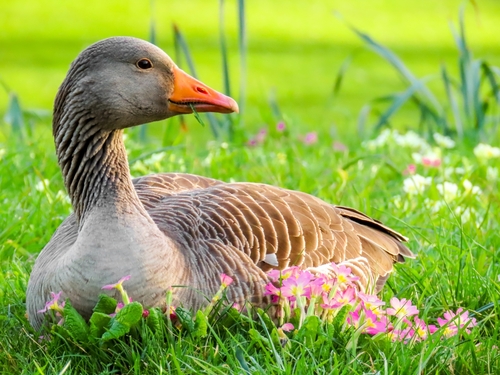 Greylag Goose
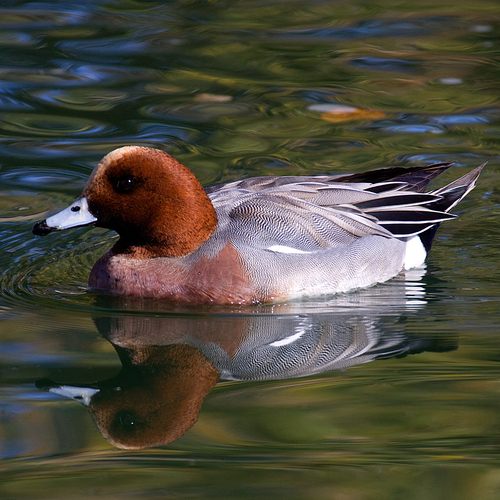 Eurasian Wigeon
In short
The most reliable way to separate Greylag Goose from Eurasian Wigeon is by size and structure: Greylag is a massive, heavy-bodied goose with a thick orange bill and pink legs, while Eurasian Wigeon is a much smaller, compact duck with a short bill and a very different flight profile. In flight, Greylag shows pale grey forewings and rump, while male Eurasian Wigeon flashes a brilliant white upperwing patch and dark green speculum. Juvenile Greylags lack black spotting on the belly and have greyish legs, but even young birds remain much larger and bulkier than any wigeon. If seen on water or land, focus on bill color and shape, leg color, and overall size for a quick separation.
Identification tips
- Size is the fastest check: Greylag Goose is several times larger than Eurasian Wigeon. If you see a goose-sized bird, it's not a wigeon. This holds for all ages and sexes.
- Bill color and shape: Greylag has a thick, orange bill (adults) or duller in juveniles, always much larger and broader than the short, greyish bill of Wigeon. Bill shape is diagnostic at any range.
- Leg color: Greylag shows pink legs (adults) or greyish (juveniles); Eurasian Wigeon has dark legs. This is visible when birds are walking or standing on land.
- Neck and body structure: Greylag has a long neck and heavy, deep-chested body, often with a 'concertina' pattern of feather folds on the neck (adults). Wigeon is compact, short-necked, and sits lower in the water.
- Wing pattern in flight: Greylag adults and juveniles show pale grey forewing and rump, with light wing coverts contrasting with darker flight feathers. Wigeon (especially males) shows a bold white upperwing patch and dark green speculum, never the Greylag's grey forewing.
- Plumage on ground: Greylag is overall greyish-brown with pale fringes and variable black spotting on the breast and belly (adults), lacking in juveniles. Wigeon males have a chestnut head with creamy crown, pink breast, and grey flanks; females are mottled brown but never as pale or barred as Greylag.
- Juvenile marks: Young Greylags lack black belly spots and have greyish legs, but remain much larger and bulkier than any wigeon. Juvenile wigeon are small, brown, and lack any grey or white barring.
- Voice: Greylag gives loud, honking calls; Wigeon males whistle. If you hear a clear whistle, it's not a Greylag.
- Flight style: Greylag flies with slow, deep wingbeats and a heavy, direct flight; Wigeon is fast, agile, and often in tight flocks.
- Feeding behavior: Greylag often grazes in open fields or on shore, standing upright; Wigeon is more likely to be seen dabbling or grazing in tight groups on short turf.
- Habitat context: In large open wetlands or fields, look for Greylag; in shallow lakes or estuaries with tight duck flocks, expect Wigeon.
- Sexual dimorphism: Wigeon males in breeding plumage are much brighter than any Greylag, but females and eclipse males are duller—still, structure and size are always reliable.
- Mixed flocks: If you see both together, Greylag will stand out by size and posture. Wigeon will be smaller, more compact, and often in denser groups.
- Confusion risk: At great distance, a lone Greylag on water might be mistaken for a duck, but size, neck length, and bill color will resolve the ID with a closer look. Conversely, a Wigeon will never appear as large or heavy as a Greylag.
- Seasonal variation: Wigeon males lose their bright head color in eclipse but retain the white upperwing patch; Greylag's plumage is less variable seasonally, but juveniles lack black belly spots.
Size
Greylag Goose is dramatically larger, with an average body mass of about 3465 g [wikidata] and a length of 74–91 cm [wikipedia]. Eurasian Wigeon is much smaller, weighing 500–1073 g and measuring 42–52 cm in length [wikipedia]. Even at a distance, Greylag's bulk, long neck, and hefty build are unmistakable compared to the compact, short-necked, and low-slung wigeon. In mixed flocks, Greylag towers over any wigeon present.
Plumage
Age-specific wing patterns are key in flight: adult Greylag Goose shows pale grey forewings and rump, with light-colored wing coverts contrasting against darker flight feathers; these pale areas are visible both in flight and when stretching wings on the ground. Juvenile Greylags lack black spotting on the belly and have greyish legs, but their wing pattern is similar to adults. Eurasian Wigeon males in breeding plumage have a striking white upperwing patch and a dark green speculum, with a chestnut head and creamy crown; these marks are visible both at rest and in flight. Females and eclipse males are browner, but still show the white upperwing patch in flight. Wigeon never show the Greylag's pale grey forewing or rump, nor the concertina neck feathering. On the ground, Greylag's orange bill and pink legs contrast with Wigeon's short, greyish bill and dark legs. Wigeon females can be variable in head color (rufous or gray morphs), but never approach the overall grey and white, barred look of Greylag.
Behaviour
Greylag Geese are often seen grazing on land in loose flocks or swimming in open water, moving with a slow, deliberate gait and often standing upright with long necks extended. Eurasian Wigeon are dabbling ducks, usually feeding by grazing short grass or dabbling at the water's edge, often in tight, compact groups. In flight, Greylag is heavy and slow with deep wingbeats, while Wigeon is quick, agile, and flies in tight, coordinated flocks. Greylag pairs are monogamous and may display strong pair bonds, while Wigeon social behavior is typical of dabbling ducks.
Habitat
Both species can be found in wetlands and open water, but Greylag Goose favors larger lakes, marshes, and open fields, often nesting among reeds or heather. Eurasian Wigeon prefers shallow lakes, flooded meadows, and estuaries, and is more likely to be seen in large flocks on water or grazing short turf. In mixed waterfowl flocks, Greylag tends to be in the open or on shore, while Wigeon often keeps to the water or grazes in tight groups.
Voice
Greylag Goose has a loud, cackling call—'aahng-ung-ung'—resembling the honking of domestic geese, and flocks can sound like baying hounds. Eurasian Wigeon has a very different voice: males give a clear, whistling 'whee-oo' call, especially in flight or when alarmed. The two are unlikely to be confused by sound alone.