

Grey Heron vs Great Blue Heron
Ardea cinerea versus Ardea herodias
Play a quiz with Grey Heron and Great Blue Heron
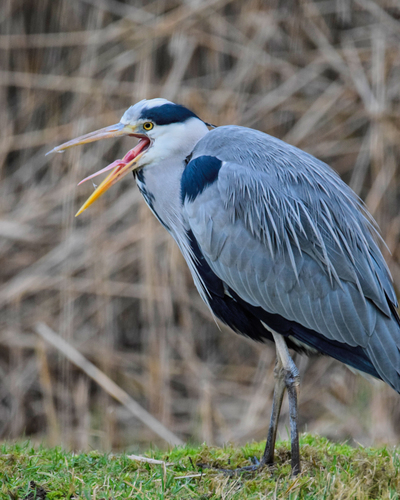 Grey Heron
 Great Blue Heron
In short
The most reliable field mark between Grey Heron and Great Blue Heron is the neck and head pattern: Grey Heron has a solidly pale grey neck and a bold black supercilium ending in a crest, while Great Blue Heron shows a rusty-grey neck with black-and-white streaking and paired black/slate plumes above the eye. Immature birds of both species are duller, but Great Blue Heron immatures lack the strong head pattern of Grey Heron and have a weakly defined flank pattern. In flight, both are large, long-necked herons, but Great Blue Heron is bulkier and heavier, with a more slaty overall tone and reddish thighs. Both species bend their necks in an S-shape during flight, so this is not a separator. Size overlaps, but Great Blue Heron is generally heavier and taller. Use head and neck pattern first, then overall bulk and subtle color differences.
Identification tips
- Head and neck pattern (all ages): Grey Heron has a white head with a bold black supercilium (eyebrow) that ends in a slender crest; the neck is solid pale grey with bluish-black streaks down the front. Great Blue Heron has a nearly white face with paired black/slate plumes above the eye, and the neck is rusty-grey with black-and-white streaking, not solid grey.
- Immature birds: Grey Heron juveniles are duller but still show a pale grey neck and a small, dark grey crest; the head stripe is grey, not black. Great Blue Heron immatures are very dull, with a blackish-gray crown, weak flank markings, and no plumes; their neck is rusty-gray, not pale grey.
- Flank pattern: Great Blue Heron adults show a paired red-brown and black stripe up the flanks; Grey Heron has some black on the flanks but lacks the paired, colorful stripes.
- Thigh color: Great Blue Heron has red-brown thighs, especially visible in flight or when perched; Grey Heron thighs are not distinctly colored.
- Overall color tone: Grey Heron is ashy-grey above and greyish-white below, giving a paler impression. Great Blue Heron is darker, with a slaty blue tone and rusty highlights.
- Bill color: Both species have long, straight bills. Grey Heron’s is pinkish-yellow, brighter in breeding adults; Great Blue Heron’s is dull yellowish, briefly orange in breeding season, and duller in immatures.
- Crest: Grey Heron adults have a slender, dangling crest; Great Blue Heron has paired black/slate plumes above the eye, but not a single trailing crest.
- Size and bulk: Great Blue Heron is larger and heavier (up to 3.6 kg), standing taller and appearing bulkier, but there is overlap—use size only as supporting evidence.
- In flight: Both fly with necks retracted in an S-shape and long legs trailing. Great Blue Heron appears bulkier and darker, with reddish thighs; Grey Heron is paler and slimmer.
- Habitat and range: If seen in Europe, it is almost always Grey Heron; in North America, almost always Great Blue Heron. Vagrancy is rare but possible—use plumage and structure for confirmation.
- Plumage seasonality: Both species show brighter bills and more plumes in breeding season, but the head and neck pattern differences persist year-round.
- Sex differences: Both species are sexually monomorphic in plumage; Great Blue Heron males are slightly larger, but this is not useful in the field.
- Leg color: Grey Heron has brown legs; Great Blue Heron’s lower legs are gray, becoming orangey in breeding season.
- Confusion risk: Immature birds are the most likely to be confused; focus on neck color (solid pale grey in Grey Heron, rusty-gray with streaks in Great Blue Heron) and head pattern (crest and supercilium in Grey Heron, paired plumes in Great Blue Heron).
- Not cranes: Both species bend their necks in flight; cranes fly with necks outstretched. This helps rule out crane confusion but not separate these two herons.
Size
Great Blue Heron is the larger of the two: adults average about 2.3 kg in mass ([wikidata]), compared to Grey Heron's range of 1.0–2.1 kg ([wikipedia]). Great Blue Heron stands taller (up to 138 cm vs. Grey Heron's 100 cm), is longer (91–137 cm vs. 84–102 cm), and has a broader wingspan (167–201 cm vs. 155–195 cm). In the field, this translates to Great Blue Heron looking bulkier and more imposing, especially when the two are side by side. However, there is overlap in length and wingspan, so size alone is not always diagnostic.
Plumage
Immature/juvenile birds: Grey Heron immatures have a duller version of the adult's plumage, with a grey (not black) head stripe, paler grey face, and a small, dark grey crest. Their overall appearance is muted, but the pale grey neck is still apparent. Great Blue Heron immatures are even duller, with a blackish-gray crown, weakly defined flank pattern, and no plumes. Their neck is rusty-gray with black-and-white streaking, not solid pale grey. The bill is dull gray-yellow in both, but Great Blue Heron juveniles lack the bold head pattern of Grey Heron.
Adults: Grey Heron shows ashy-grey upperparts, greyish-white underparts, a white head and neck with a broad black supercilium ending in a slender crest, and bluish-black streaks down the front of the neck. Great Blue Heron adults have slaty flight feathers, red-brown thighs, a paired red-brown and black stripe up the flanks, a rusty-gray neck with black-and-white streaking, and a nearly white face with paired black/slate plumes above the eye. Both have long, straight bills (yellowish, brighter in breeding season), but Great Blue Heron's bill is duller except briefly in breeding. In flight, Great Blue Heron looks darker and more blue-toned, with reddish thighs, while Grey Heron is paler and more ashy-grey.
Behaviour
Both species are long-legged, slow-moving waders that hunt by standing still or stalking prey in shallow water. Their flight is similar: both fly with necks retracted in an S-shape and long legs trailing. Great Blue Heron may appear heavier and more ponderous in flight, with deeper wingbeats. Both species breed in colonies (heronries), often in trees near water, and both reuse nests. Courtship behaviors are similar, involving stretching and snapping displays. There are no strong behavioral differences for field separation.
Habitat
Grey Heron is native to Europe, Asia, and most of Africa, found around lakes, rivers, ponds, marshes, and coastal areas. Great Blue Heron is widespread in North and Central America, the Caribbean, and parts of South America, and is only a rare vagrant to Europe. Both occupy similar wetland habitats and ecological niches in their respective ranges. If seen in Europe, a large heron is almost always Grey Heron; in North America, it is almost always Great Blue Heron. Overlap is rare and usually limited to vagrant individuals.