

Grey Gull vs Dolphin Gull
Leucophaeus modestus versus Leucophaeus scoresbii
Play a quiz with Grey Gull and Dolphin Gull
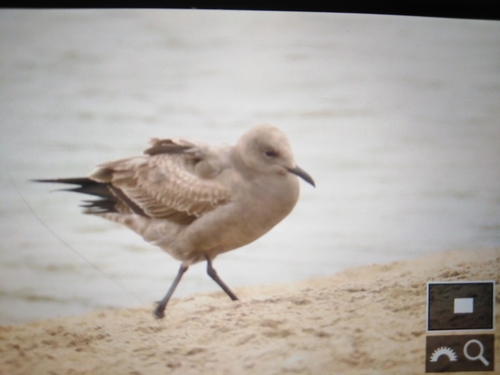 Grey Gull
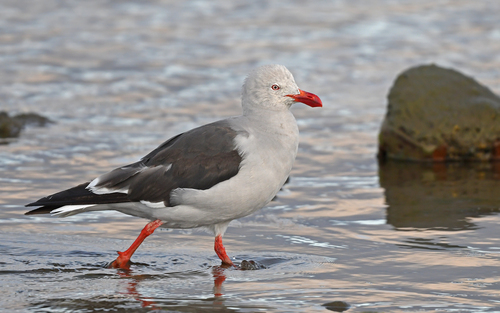 Dolphin Gull
In short
The most reliable field mark between Grey Gull and Dolphin Gull is the bill and leg color: Grey Gull has a black bill and legs, while Dolphin Gull has a distinctly red bill and legs. In flight, Grey Gull adults show black flight feathers with white tips on the inner primaries and secondaries, and a black tail band with a white trailing edge—features not described for Dolphin Gull. Grey Gull's head is white in summer but turns brownish-grey in winter, while Dolphin Gull's head remains greyish. Habitat can also help: Grey Gull breeds inland in the Atacama Desert and is coastal as a non-breeder, while Dolphin Gull is strictly coastal in southern South America and the Falklands. Both are medium-sized, grey-plumaged gulls, but careful attention to bare parts and wing pattern is key.
Identification tips
- Bill color: Grey Gull always has a black bill; Dolphin Gull's bill is bright red. This is the single most reliable field mark at close range.
- Leg color: Grey Gull has black legs; Dolphin Gull has red legs. Use this in combination with bill color.
- Head color (seasonal): In summer, Grey Gull's head is white, contrasting with its grey body. In winter, the head becomes brownish-grey. Dolphin Gull's head is always greyish, matching the body and never white.
- Flight feathers and wing pattern: Grey Gull adults show black flight feathers with white tips on the inner primaries and secondaries, visible in flight. Dolphin Gull lacks this pattern (no white-tipped primaries described).
- Tail pattern: Grey Gull has a black tail band with a white trailing edge, visible in flight. No such tail pattern is described for Dolphin Gull.
- Overall plumage tone: Both are grey, but Grey Gull's dorsal side is darker than the ventral, and the head can be strikingly white in summer. Dolphin Gull is more uniformly greyish, with wings darker than the body.
- Habitat context: If seen breeding far inland (Atacama Desert), it is Grey Gull. Dolphin Gull is strictly coastal and never breeds inland.
- Geographic range: Grey Gull is found along the Pacific coast of South America (mainly northern Chile), while Dolphin Gull is southern, found in southern Chile, Argentina, and the Falklands.
- Behavior at seabird colonies: Dolphin Gull is often seen scavenging at seabird colonies; Grey Gull is not specifically noted for this behavior.
- Voice: Only Grey Gull's call is described (like Laughing Gull); do not rely on voice for separation.
- Size: Both are medium-sized gulls; size is not a reliable separator.
- Sex differences: Both species have similar plumage in both sexes; do not use sex for identification.
- Juvenile/immature birds: No specific information is available; focus on bare part color (bill and legs) and, if visible, Grey Gull's wing and tail pattern.
- Pitfalls: In poor light or at distance, the red of Dolphin Gull's bill and legs may appear dark, so do not rely on color alone unless clearly seen.
- Seasonal confusion: Remember Grey Gull's head is only white in summer; in winter, it can look more similar to Dolphin Gull, so check multiple features.
Size
Grey Gull is a medium-sized gull, weighing about 380g and reaching about 45 cm in length. No direct mass or length data is available for Dolphin Gull in the provided sources, but both are described as medium-sized gulls. In the field, size alone is unlikely to be a reliable separator between these two species.
Plumage
- Adults (all seasons): Grey Gull has a grey body and wings, with the dorsal side darker than the ventral. Its flight feathers are black, with white tips on the inner primaries and secondaries, visible in flight. The tail has a black band with a white trailing edge. In summer, the head is white; in winter, it turns brownish-grey. Legs and bill are black.
- Dolphin Gull adults: Have greyish body and wings, with the wings a darker shade than the body. No mention of white-tipped primaries or a tail band. The bill and legs are red, which is unique and conspicuous. The head remains greyish, not white in any season.
- Juvenile/immature plumage: No specific information provided for either species, so caution is needed with young birds. Focus on bare part color and wing pattern when visible.
Behaviour
Both species are typical gulls in their general behavior, but Dolphin Gull is noted for its opportunistic and varied diet, often scavenging around seabird colonies and feeding on mussels and carrion. Grey Gull is unusual in breeding far inland in the Atacama Desert, but as a non-breeder, its behavior along the coast is likely similar to other gulls. No distinctive flight or foraging behavior is described that would reliably separate them in the field.
Habitat
Habitat is a useful clue. Grey Gull breeds inland in the Atacama Desert of northern Chile, which is highly unusual for a gull, but is found along much of the Pacific coast of South America as a non-breeder. Dolphin Gull, by contrast, is strictly coastal, found on rocky, muddy, and sandy shores in southern Chile, Argentina, and the Falkland Islands, often near seabird colonies. If you are far inland in the Atacama, only Grey Gull is expected; if you are in the far south or the Falklands, especially around seabird colonies, Dolphin Gull is more likely.
Voice
Grey Gull's call is described as similar to Laughing Gull (Leucophaeus atricilla), but no vocal description is given for Dolphin Gull. Voice is not a reliable separator based on available information.