

Motmot

Grey Crowned-Crane vs Blue Crane

Balearica regulorum versus Grus paradiseus

Play a quiz with Grey Crowned-Crane and Blue Crane
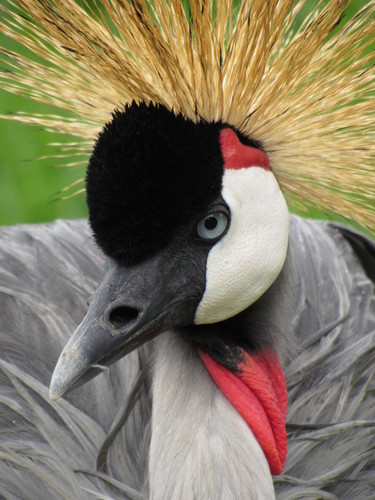
Grey Crowned-Crane (Balearica regulorum) Grey Crowned-Crane
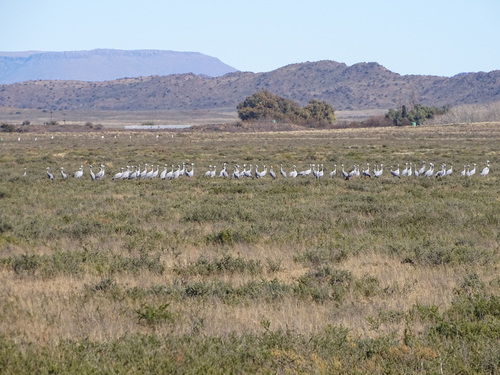
Blue Crane (Grus paradiseus) Blue Crane

Media

Loading…

In short

The most reliable field mark is the golden crown of stiff feathers on the Grey Crowned-Crane's head, which is never present on the Blue Crane. Juvenile and adult Grey Crowned-Cranes also show a bold white cheek patch and a bright red throat pouch, while Blue Cranes have a uniformly pale blue-gray head with no such facial contrast. In flight or at rest, Grey Crowned-Cranes display a complex mix of grey, white, dark red, and golden yellow in the wings, while Blue Cranes are much plainer, with pale blue-gray plumage and long trailing dark wing plumes. Structure also helps: Blue Cranes are more slender with a proportionately thin neck and small head, and lack the Grey Crowned-Crane's tree-roosting adaptations. Both are large, long-legged birds, but the Grey Crowned-Crane's ornate head and face are unmistakable.

Identification tips

  1. Golden Crown: Only Grey Crowned-Crane has a stiff golden crown of feathers on the head, visible at all ages. Blue Crane never shows this feature.
  2. White Cheek Patch and Red Throat Pouch: Grey Crowned-Crane has bold white cheeks and a bright red, inflatable throat pouch. Blue Crane's face is uniformly pale blue-gray to whitish, with no cheek patch or pouch.
  3. Juvenile Plumage: Juvenile Grey Crowned-Crane is greyer with a buff face but still shows the crown and cheek contrast. Juvenile Blue Crane is pale blue-gray with a tawny head, lacking any face patches or crown.
  4. Wing Pattern in Flight: Grey Crowned-Crane shows a mix of white, dark grey, dark red, and golden yellow in the wings; Blue Crane is plainer, with black/slate primaries and long trailing plumes (adults only).
  5. Long Trailing Wing Plumes: Adult Blue Cranes have long, dark, trailing wingtip feathers that reach the ground at rest and trail behind in flight. Grey Crowned-Crane lacks these plumes.
  6. Bill Color and Shape: Grey Crowned-Crane has a short, grey bill; Blue Crane's bill is longer, ochre to greyish with a pink tinge.
  7. Neck and Head Structure: Blue Crane has a proportionately thin neck and small head; Grey Crowned-Crane is stockier with a more robust head.
  8. Tree Roosting: Only Grey Crowned-Crane regularly roosts in trees, thanks to a long hind toe. Blue Crane is strictly ground-dwelling.
  9. Behavioral Displays: Both species dance, but only Grey Crowned-Crane inflates its red throat pouch and bows with the golden crown on display.
  10. Habitat: Grey Crowned-Crane is widespread in Sub-Saharan Africa, often near water or in cultivated lands; Blue Crane is almost entirely in South African grasslands.
  11. Vocalization: If you hear a booming call with visible throat pouch inflation, it's Grey Crowned-Crane. Blue Crane does not display this behavior.
  12. Size and Build: Both are large, but Blue Crane is more slender and can be slightly taller and heavier. In the field, this is subtle and less reliable than head and face marks.
  13. Flock Size: Large flocks (30–150) are more typical of Grey Crowned-Crane. Blue Cranes are social but less so, and become territorial in breeding season.
  14. Aggression at Nest: Blue Cranes are notably aggressive near nests, attacking even large mammals; Grey Crowned-Crane is less aggressive.
  15. National Bird Context: If seen on Ugandan iconography or in Uganda, it's Grey Crowned-Crane; in South African national symbols, it's Blue Crane.

Size

Both species are similar in height (about 1 m / 3 ft 3 in), but the Blue Crane can be slightly taller (up to 120 cm) and heavier (3.6–6.2 kg vs. 3.5 kg for Grey Crowned-Crane) [wikipedia][avonet]. Wingspans overlap (Grey Crowned-Crane: 2 m; Blue Crane: 1.8–2 m). However, the Blue Crane appears more slender and elongated, with a thinner neck and smaller head, while the Grey Crowned-Crane is stockier with a more robust build. In the field, these differences are subtle and less reliable than plumage or head features.

Plumage

Juvenile Grey Crowned-Cranes are greyer overall than adults, with a feathered buff face, but still show the beginnings of the golden crown and white cheek patch. Juvenile Blue Cranes are slightly lighter than adults, with a tawny head and lack the long trailing wing plumes of adults, but never show any crown or facial patch.

Adult Grey Crowned-Cranes have a striking golden crown, white cheeks, a bright red throat pouch, and a complex wing pattern: mostly grey body, white, dark grey, and dark red in the wings, with a golden yellow patch. Blue Cranes are uniformly pale blue-gray, slightly darker on the head, neck, and nape, with a lighter (sometimes whitish) crown to lores, and long dark trailing wing plumes. The Blue Crane's bill is ochre to greyish with a pink tinge, while the Grey Crowned-Crane's bill is short and grey. In flight, Grey Crowned-Cranes show white and golden in the wings, while Blue Cranes are plainer with black to slate primaries and dark coverts, and the long trailing plumes are distinctive in adults.

Behaviour

Grey Crowned-Cranes are highly social, often forming flocks of 30–150, and are famous for their elaborate dancing displays involving bowing, jumping, and inflating their red throat pouch. They are unique among cranes in regularly roosting in trees, thanks to a long hind toe. Blue Cranes are also social outside the breeding season but less so, with a strict hierarchy in groups. They are ground-dwelling and never roost in trees. During breeding, Blue Cranes are notably aggressive in defending their nests, even attacking large mammals and humans. Both species perform courtship dances, but only Grey Crowned-Crane has the elaborate golden crown display and tree-roosting behavior.

Habitat

Grey Crowned-Cranes are found in a variety of habitats across Sub-Saharan Africa, preferring dry savannah but also using marshes, cultivated lands, and grassy flatlands near water. They are generally sedentary, especially in the tropics, but may make localized movements in arid regions. Blue Cranes have a much more restricted range, almost entirely in South Africa, and are found in open grasslands and farmlands. They are migratory (mainly altitudinal), moving seasonally within their limited range. In the field, finding a crane in a tree or in East Africa strongly favors Grey Crowned-Crane; in open South African grassland, Blue Crane is more likely.

Voice

Grey Crowned-Crane gives a distinctive booming call involving inflation of its red gular sac, and also honks—a sound quite different from the typical trumpeting of other cranes. Blue Crane vocalizations are not described in detail in the provided notes, but they do not have the booming display involving a throat pouch. If you see a crane inflating a red throat sac while calling, it is a Grey Crowned-Crane.

Submit a better description

Use the same sections as the comparison. Your text is published immediately.

The most reliable field mark is the golden crown of stiff feathers on the Grey Crowned-Crane's head, which is never present on the Blue Crane. Juvenile and adult Grey Crowned-Cranes also show a bold white cheek patch and a bright red throat pouch, while Blue Cranes have a uniformly pale blue-gray head with no such facial contrast. In flight or at rest, Grey Crowned-Cranes display a complex mix of grey, white, dark red, and golden yellow in the wings, while Blue Cranes are much plainer, with pale blue-gray plumage and long trailing dark wing plumes. Structure also helps: Blue Cranes are more slender with a proportionately thin neck and small head, and lack the Grey Crowned-Crane's tree-roosting adaptations. Both are large, long-legged birds, but the Grey Crowned-Crane's ornate head and face are unmistakable.

  1. Golden Crown: Only Grey Crowned-Crane has a stiff golden crown of feathers on the head, visible at all ages. Blue Crane never shows this feature.
  2. White Cheek Patch and Red Throat Pouch: Grey Crowned-Crane has bold white cheeks and a bright red, inflatable throat pouch. Blue Crane's face is uniformly pale blue-gray to whitish, with no cheek patch or pouch.
  3. Juvenile Plumage: Juvenile Grey Crowned-Crane is greyer with a buff face but still shows the crown and cheek contrast. Juvenile Blue Crane is pale blue-gray with a tawny head, lacking any face patches or crown.
  4. Wing Pattern in Flight: Grey Crowned-Crane shows a mix of white, dark grey, dark red, and golden yellow in the wings; Blue Crane is plainer, with black/slate primaries and long trailing plumes (adults only).
  5. Long Trailing Wing Plumes: Adult Blue Cranes have long, dark, trailing wingtip feathers that reach the ground at rest and trail behind in flight. Grey Crowned-Crane lacks these plumes.
  6. Bill Color and Shape: Grey Crowned-Crane has a short, grey bill; Blue Crane's bill is longer, ochre to greyish with a pink tinge.
  7. Neck and Head Structure: Blue Crane has a proportionately thin neck and small head; Grey Crowned-Crane is stockier with a more robust head.
  8. Tree Roosting: Only Grey Crowned-Crane regularly roosts in trees, thanks to a long hind toe. Blue Crane is strictly ground-dwelling.
  9. Behavioral Displays: Both species dance, but only Grey Crowned-Crane inflates its red throat pouch and bows with the golden crown on display.
  10. Habitat: Grey Crowned-Crane is widespread in Sub-Saharan Africa, often near water or in cultivated lands; Blue Crane is almost entirely in South African grasslands.
  11. Vocalization: If you hear a booming call with visible throat pouch inflation, it's Grey Crowned-Crane. Blue Crane does not display this behavior.
  12. Size and Build: Both are large, but Blue Crane is more slender and can be slightly taller and heavier. In the field, this is subtle and less reliable than head and face marks.
  13. Flock Size: Large flocks (30–150) are more typical of Grey Crowned-Crane. Blue Cranes are social but less so, and become territorial in breeding season.
  14. Aggression at Nest: Blue Cranes are notably aggressive near nests, attacking even large mammals; Grey Crowned-Crane is less aggressive.
  15. National Bird Context: If seen on Ugandan iconography or in Uganda, it's Grey Crowned-Crane; in South African national symbols, it's Blue Crane.

Both species are similar in height (about 1 m / 3 ft 3 in), but the Blue Crane can be slightly taller (up to 120 cm) and heavier (3.6–6.2 kg vs. 3.5 kg for Grey Crowned-Crane) [wikipedia][avonet]. Wingspans overlap (Grey Crowned-Crane: 2 m; Blue Crane: 1.8–2 m). However, the Blue Crane appears more slender and elongated, with a thinner neck and smaller head, while the Grey Crowned-Crane is stockier with a more robust build. In the field, these differences are subtle and less reliable than plumage or head features.

Juvenile Grey Crowned-Cranes are greyer overall than adults, with a feathered buff face, but still show the beginnings of the golden crown and white cheek patch. Juvenile Blue Cranes are slightly lighter than adults, with a tawny head and lack the long trailing wing plumes of adults, but never show any crown or facial patch.

Adult Grey Crowned-Cranes have a striking golden crown, white cheeks, a bright red throat pouch, and a complex wing pattern: mostly grey body, white, dark grey, and dark red in the wings, with a golden yellow patch. Blue Cranes are uniformly pale blue-gray, slightly darker on the head, neck, and nape, with a lighter (sometimes whitish) crown to lores, and long dark trailing wing plumes. The Blue Crane's bill is ochre to greyish with a pink tinge, while the Grey Crowned-Crane's bill is short and grey. In flight, Grey Crowned-Cranes show white and golden in the wings, while Blue Cranes are plainer with black to slate primaries and dark coverts, and the long trailing plumes are distinctive in adults.

Grey Crowned-Cranes are highly social, often forming flocks of 30–150, and are famous for their elaborate dancing displays involving bowing, jumping, and inflating their red throat pouch. They are unique among cranes in regularly roosting in trees, thanks to a long hind toe. Blue Cranes are also social outside the breeding season but less so, with a strict hierarchy in groups. They are ground-dwelling and never roost in trees. During breeding, Blue Cranes are notably aggressive in defending their nests, even attacking large mammals and humans. Both species perform courtship dances, but only Grey Crowned-Crane has the elaborate golden crown display and tree-roosting behavior.

Grey Crowned-Cranes are found in a variety of habitats across Sub-Saharan Africa, preferring dry savannah but also using marshes, cultivated lands, and grassy flatlands near water. They are generally sedentary, especially in the tropics, but may make localized movements in arid regions. Blue Cranes have a much more restricted range, almost entirely in South Africa, and are found in open grasslands and farmlands. They are migratory (mainly altitudinal), moving seasonally within their limited range. In the field, finding a crane in a tree or in East Africa strongly favors Grey Crowned-Crane; in open South African grassland, Blue Crane is more likely.

Grey Crowned-Crane gives a distinctive booming call involving inflation of its red gular sac, and also honks—a sound quite different from the typical trumpeting of other cranes. Blue Crane vocalizations are not described in detail in the provided notes, but they do not have the booming display involving a throat pouch. If you see a crane inflating a red throat sac while calling, it is a Grey Crowned-Crane.

Discard your changes?

You have unsaved edits. If you leave now, those changes will be lost.

Grey Crowned-Crane · Blue Crane · My Tricky Birds