

Greater White-fronted Goose vs Eurasian Wigeon
Anser albifrons versus Mareca penelope
Play a quiz with Greater White-fronted Goose and Eurasian Wigeon
 Greater White-fronted Goose
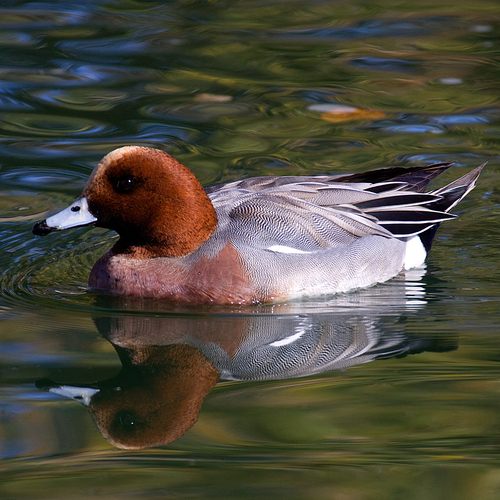 Eurasian Wigeon
In short
The most reliable field mark to separate Greater White-fronted Goose from Eurasian Wigeon is overall structure and size: the goose is a much larger, heavier-bodied bird with a thick neck and a pinkish or orange bill, while the wigeon is a compact, short-necked duck with a small, blue-grey bill. In flight or at rest, adult wigeon (especially males) show a bold white upperwing patch and a green speculum, while the goose has broad white wing bars and a white facial blaze. Juvenile and female wigeon can be trickier, but they never show the goose's heavy bill, orange legs, or extensive white on the face. Both species can be found together in winter wetlands, but their structure, wing pattern, and bill color are consistently diagnostic.
Identification tips
- Size and structure: The goose is much larger and bulkier, with a long neck and heavy body. Wigeon are compact, short-necked, and duck-shaped. This is obvious even at a distance.
- Bill color and shape: Greater White-fronted Goose has a thick, pinkish or orange bill (sometimes with a dark nail), while Eurasian Wigeon always has a small, blue-grey bill. This is a key mark at any age or season.
- Leg color: The goose has bright orange legs, which are visible when walking or landing. Wigeon legs are dull and never orange.
- Facial blaze: Only the goose has a white blaze at the base of the bill, extending up onto the face. Wigeon never show this, regardless of age or sex.
- Wing pattern (in flight or at rest): Adult geese show broad white bars across the upperwing coverts; in most subspecies, these are bold and obvious. Wigeon (especially adult males) have a white upperwing patch and green speculum, but the white is in a different position and shape—never forming a bar across the coverts.
- Tail pattern: The goose has a dark tail with a broad white tip and sides; wigeon have a plainer tail, lacking such strong contrast.
- Body and breast pattern: Geese are grey-brown with variable dark barring on the belly (more extensive in some subspecies and ages), while wigeon males have a pink breast and white belly, and females are plain brown.
- Head pattern (adult males): Wigeon males have a chestnut head with a creamy crown; geese have a plain brownish head with a white blaze.
- Sex/age confusion: Female and juvenile wigeon can be confused with small ducks, but never show the goose's heavy bill, orange legs, or facial blaze. Juvenile geese are similar to adults but may have less belly barring.
- Flight style: Geese fly with strong, deep wingbeats and a long neck extended; wigeon fly with rapid, shallow wingbeats and a compact profile.
- Vocalizations: Listen for the goose's cackling 'he-he' calls versus the wigeon's whistling 'whee-oo.'
- Habitat context: If the bird is grazing far from water, it's more likely a goose; if it's in a dense flock on water, it's likely wigeon.
- Group composition: Geese often mix with other geese, while wigeon flock with other dabbling ducks.
- Subspecies variation: Greenland white-fronted geese may have a yellower bill base, but still show the same structure and facial blaze.
- Pitfalls: Do not rely solely on belly barring for geese, as this is variable. Always check bill color, facial blaze, and overall size/structure.
Size
Greater White-fronted Goose is dramatically larger: 64–81 cm in length, 130–165 cm wingspan, and 1.93–3.31 kg in weight [wikipedia][avonet]. Eurasian Wigeon is much smaller: 42–52 cm long, 71–80 cm wingspan, and 500–1,073 g [wikipedia][avonet]. Even at a distance, the goose appears bulkier, with a longer neck and a more robust body, while the wigeon is compact and duck-like.
Plumage
- Juvenile/immature and adult geese: Greater White-fronted Goose shows broad white wing bars (especially on the greater coverts), a white facial blaze at the bill base, and orange legs. The upperwing coverts are mouse-grey with prominent white tips in most subspecies, forming a clear bar in flight or at rest. The belly is dappled with dark blotches and bars (variable by age and individual), and the tail has a broad white tip and sides.
- Adult male Eurasian Wigeon: Striking white upperwing patch and green speculum, pink breast, white belly, chestnut head with a creamy crown. In flight, the white patch is very bold and diagnostic among ducks, but not as extensive or in the same pattern as the goose's wing bars. The bill is blue-grey, never pink or orange.
- Female/immature wigeon: Overall brownish, with a less distinct white upperwing patch and a small, blue-grey bill. Never shows a white facial blaze or orange legs. The wing pattern is not as bold as in males, but still lacks the broad white bars of the goose.
- Key contrast: Only the goose has a white blaze on the face, orange legs, and a heavy pinkish/orange bill. Only the wigeon (especially males) has a white upperwing patch and green speculum. The goose's wing bars are broader and more extensive than any white on the wigeon's wing.
Behaviour
Greater White-fronted Goose typically feeds by grazing on land or dabbling in shallow water, often in large, noisy flocks. Their movements are slower and more deliberate, and they spend more time walking or standing upright. Eurasian Wigeon is a dabbling duck, usually seen swimming, tipping up to feed, or grazing close to water's edge. Wigeon flocks are more compact and active on water, and their flight is faster and more agile, with rapid wingbeats compared to the slower, deeper wingbeats of geese.
Habitat
Both species can occur together in winter on lakes, marshes, and wet grasslands, but Greater White-fronted Goose is more likely to be found grazing in open fields or on the edges of large wetlands, while Eurasian Wigeon prefers shallow lakes, flooded meadows, and estuaries, often in larger, denser flocks on water. Wigeon are rarely seen far from water, while geese may wander into agricultural fields.
Voice
Greater White-fronted Goose gives a high-pitched, laughing cackle ('he-he'), often in series, with a distinct break between notes. Eurasian Wigeon has a distinctive whistling call, especially from males—a clear, two-note 'whee-oo' or 'wee-yoo'—which is very different from any goose sound. If you hear a whistling flock, it's wigeon; if you hear cackling, it's likely the goose.
Greater White-fronted Goose · Eurasian Wigeon · My Tricky Birds