

Motmot

Great Reed Warbler vs Common Grasshopper Warbler

Acrocephalus arundinaceus versus Locustella naevia

Play a quiz with Great Reed Warbler and Common Grasshopper Warbler
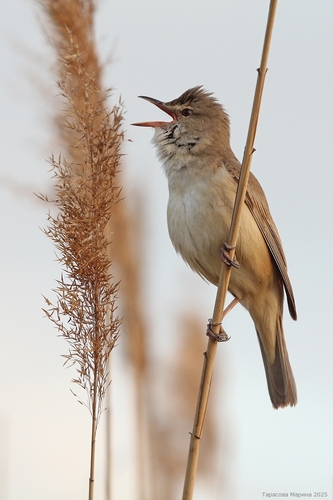
Great Reed Warbler (Acrocephalus arundinaceus) Great Reed Warbler
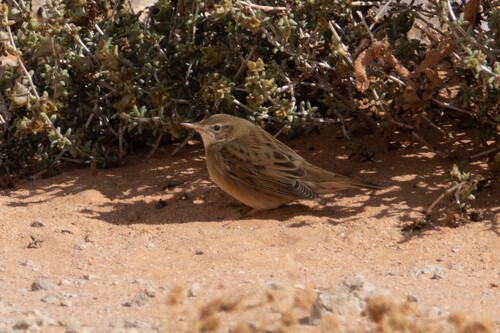
Common Grasshopper Warbler (Locustella naevia) Common Grasshopper Warbler

Media

Loading…

In short

The most reliable field mark to separate Great Reed Warbler from Common Grasshopper Warbler is overall size and structure: Great Reed Warbler is much larger, with a heavy bill, flattened forehead, and robust, thrush-like proportions, while Grasshopper Warbler is noticeably smaller, slimmer, and more delicate, with a fine bill and a long, rounded tail. In all plumages, Great Reed Warbler shows plain, unstreaked brown upperparts and a strong pale supercilium, whereas Grasshopper Warbler is distinctly streaked above and below, with a faint eye-stripe and streaked undertail coverts. In flight, Grasshopper Warbler often fans its tail to reveal streaked undertail coverts, a feature never shown by Great Reed Warbler. Their songs are completely different: Great Reed Warbler delivers a loud, varied chattering song, while Grasshopper Warbler produces a continuous, insect-like reeling trill.

Identification tips

  1. Size is the first check: Great Reed Warbler is much larger and bulkier than Grasshopper Warbler. If the bird looks thrush-sized or larger than a Reed Warbler, it's not a Grasshopper Warbler.
  2. Bill structure: Great Reed Warbler has a strong, long, pointed bill; Grasshopper Warbler's bill is fine and delicate. This is visible even at a distance with good binoculars.
  3. Supercilium (eyebrow): Great Reed Warbler shows a strong, pale supercilium extending well behind the eye, visible in all plumages. Grasshopper Warbler has at most a faint eye-stripe, much less obvious.
  4. Upperpart streaking: Grasshopper Warbler is heavily streaked above (dark streaks on olive-brown back and crown) in all ages. Great Reed Warbler is plain brown above, never streaked.
  5. Underpart streaking: Grasshopper Warbler shows dark spots and streaks on the breast and flanks, and streaked undertail coverts. Great Reed Warbler is plain below, sometimes with a buff wash in juveniles, but never streaked.
  6. Tail pattern: Grasshopper Warbler has reddish-brown tail feathers with faint bars and always shows streaked undertail coverts, especially when fanned. Great Reed Warbler has a plain tail and undertail coverts.
  7. Jizz and posture: Great Reed Warbler is upright and robust, often perching high and singing loudly. Grasshopper Warbler is slender, with a long, rounded tail, and is almost always low in cover, often creeping or running with a high-stepping gait.
  8. Flight behavior: Grasshopper Warbler flies weakly, low, and briefly, quickly diving back into cover, sometimes fanning its tail. Great Reed Warbler flies more strongly and is less secretive.
  9. Song: Great Reed Warbler's song is loud, chattering, and varied, delivered from an exposed perch. Grasshopper Warbler's song is a continuous, high-pitched reeling trill, often from deep cover and very difficult to locate.
  10. Alarm call: Grasshopper Warbler gives a repeated ticking 'twkit-twkit-twkit'; Great Reed Warbler does not give a similar call.
  11. Habitat context: In large reedbeds, expect Great Reed Warbler; in rough grass, bramble, or low bushy areas, expect Grasshopper Warbler. Overlap is rare.
  12. Visibility: Great Reed Warbler is often conspicuous and visible; Grasshopper Warbler is extremely skulking and rarely seen in the open.
  13. Juvenile confusion: Even young Great Reed Warblers are plain above and below, never streaked, while juvenile Grasshopper Warblers are streaked in the same pattern as adults.
  14. Sex and season: Both species are sexually monomorphic; these marks work year-round, but Grasshopper Warbler is especially secretive outside the breeding season.
  15. Pitfalls: Never rely on just the presence of a pale eyebrow—check for streaking, size, and structure. If you see a streaked back or undertail, rule out Great Reed Warbler.

Size

Great Reed Warbler is by far the largest European warbler, measuring 16–21 cm in length and weighing 22–38 g, with a wingspan of 25–30 cm [wikipedia][avonet]. In contrast, Common Grasshopper Warbler is much smaller, at about 12.5 cm in length and 11.5–16 g in weight [wikipedia][avonet]. The size difference is immediately obvious in the field, with Great Reed Warbler approaching the size of a small thrush, while Grasshopper Warbler is closer to a chiffchaff or wren. Bill size also differs: Great Reed Warbler has a strong, long, and pointed bill, while Grasshopper Warbler's bill is fine and delicate.

Plumage

Juvenile and adult Great Reed Warblers are plain above, with unstreaked brown upperparts and a strong, pale supercilium; the underparts are dull buffish-white, with young birds showing a richer buff below [wikipedia]. There is no streaking on the back, breast, or undertail coverts at any age. In contrast, all ages of Grasshopper Warbler are distinctly streaked above: the pale olive-brown upperparts have dark brown central streaks on each feather, and the underparts are cream or yellowish-buff with dark brown spots and streaks on the breast and flanks [wikipedia]. The undertail coverts are always streaked, and the tail feathers are reddish-brown with faint bars. Grasshopper Warbler also shows a faint eye-stripe behind the eye, but it is much weaker than the bold supercilium of Great Reed Warbler. In flight or when fanning the tail, Grasshopper Warbler's streaked undertail coverts are often visible—a key mark. Great Reed Warbler never shows any streaking or barring in these areas.

Behaviour

Great Reed Warbler is typically seen clambering up reed stems, often perching high and conspicuously atop reeds, singing loudly and defending its territory. It is relatively bold and visible compared to most reedbed warblers. Grasshopper Warbler, on the other hand, is extremely skulking and secretive, rarely seen in the open. It spends most of its time creeping through dense grass or low vegetation, often running or flitting from twig to twig with a high-stepping gait. When flushed, it flies weakly and quickly dives back into cover, sometimes raising and fanning its tail to show the streaked undertail coverts. Grasshopper Warbler seldom perches high or sings from exposed positions.

Habitat

Great Reed Warbler is strongly tied to reedbeds, especially large stands of common reed (Phragmites), during the breeding season [wikipedia]. It may also use bush thickets and rice fields in winter. Grasshopper Warbler prefers rough grassland, damp or dry areas with dense grass, brambles, or low bushes, such as fen edges, heaths, upland moors, neglected hedgerows, and young plantations [wikipedia]. It avoids large reedbeds and is rarely found in the same dense reed habitat as Great Reed Warbler. If you are in a pure reedbed, Great Reed Warbler is much more likely; in rough grass or bramble, Grasshopper Warbler is the default.

Voice

Great Reed Warbler has a very loud, far-carrying, and varied song, consisting of chattering, croaking, and whistling phrases, often described as 'carr-carr-cree-cree-cree-jet-jet' [wikipedia]. The song is delivered from an exposed perch and is highly variable in length and complexity. Grasshopper Warbler's song is completely different: a long, high-pitched, insect-like reeling trill, often lasting several minutes without pause [wikipedia]. It is ventriloquial and can be very difficult to locate, usually delivered from deep cover. The alarm call of Grasshopper Warbler is a repeated ticking 'twkit-twkit-twkit', unlike anything given by Great Reed Warbler.

Submit a better description

Use the same sections as the comparison. Your text is published immediately.

The most reliable field mark to separate Great Reed Warbler from Common Grasshopper Warbler is overall size and structure: Great Reed Warbler is much larger, with a heavy bill, flattened forehead, and robust, thrush-like proportions, while Grasshopper Warbler is noticeably smaller, slimmer, and more delicate, with a fine bill and a long, rounded tail. In all plumages, Great Reed Warbler shows plain, unstreaked brown upperparts and a strong pale supercilium, whereas Grasshopper Warbler is distinctly streaked above and below, with a faint eye-stripe and streaked undertail coverts. In flight, Grasshopper Warbler often fans its tail to reveal streaked undertail coverts, a feature never shown by Great Reed Warbler. Their songs are completely different: Great Reed Warbler delivers a loud, varied chattering song, while Grasshopper Warbler produces a continuous, insect-like reeling trill.

  1. Size is the first check: Great Reed Warbler is much larger and bulkier than Grasshopper Warbler. If the bird looks thrush-sized or larger than a Reed Warbler, it's not a Grasshopper Warbler.
  2. Bill structure: Great Reed Warbler has a strong, long, pointed bill; Grasshopper Warbler's bill is fine and delicate. This is visible even at a distance with good binoculars.
  3. Supercilium (eyebrow): Great Reed Warbler shows a strong, pale supercilium extending well behind the eye, visible in all plumages. Grasshopper Warbler has at most a faint eye-stripe, much less obvious.
  4. Upperpart streaking: Grasshopper Warbler is heavily streaked above (dark streaks on olive-brown back and crown) in all ages. Great Reed Warbler is plain brown above, never streaked.
  5. Underpart streaking: Grasshopper Warbler shows dark spots and streaks on the breast and flanks, and streaked undertail coverts. Great Reed Warbler is plain below, sometimes with a buff wash in juveniles, but never streaked.
  6. Tail pattern: Grasshopper Warbler has reddish-brown tail feathers with faint bars and always shows streaked undertail coverts, especially when fanned. Great Reed Warbler has a plain tail and undertail coverts.
  7. Jizz and posture: Great Reed Warbler is upright and robust, often perching high and singing loudly. Grasshopper Warbler is slender, with a long, rounded tail, and is almost always low in cover, often creeping or running with a high-stepping gait.
  8. Flight behavior: Grasshopper Warbler flies weakly, low, and briefly, quickly diving back into cover, sometimes fanning its tail. Great Reed Warbler flies more strongly and is less secretive.
  9. Song: Great Reed Warbler's song is loud, chattering, and varied, delivered from an exposed perch. Grasshopper Warbler's song is a continuous, high-pitched reeling trill, often from deep cover and very difficult to locate.
  10. Alarm call: Grasshopper Warbler gives a repeated ticking 'twkit-twkit-twkit'; Great Reed Warbler does not give a similar call.
  11. Habitat context: In large reedbeds, expect Great Reed Warbler; in rough grass, bramble, or low bushy areas, expect Grasshopper Warbler. Overlap is rare.
  12. Visibility: Great Reed Warbler is often conspicuous and visible; Grasshopper Warbler is extremely skulking and rarely seen in the open.
  13. Juvenile confusion: Even young Great Reed Warblers are plain above and below, never streaked, while juvenile Grasshopper Warblers are streaked in the same pattern as adults.
  14. Sex and season: Both species are sexually monomorphic; these marks work year-round, but Grasshopper Warbler is especially secretive outside the breeding season.
  15. Pitfalls: Never rely on just the presence of a pale eyebrow—check for streaking, size, and structure. If you see a streaked back or undertail, rule out Great Reed Warbler.

Great Reed Warbler is by far the largest European warbler, measuring 16–21 cm in length and weighing 22–38 g, with a wingspan of 25–30 cm [wikipedia][avonet]. In contrast, Common Grasshopper Warbler is much smaller, at about 12.5 cm in length and 11.5–16 g in weight [wikipedia][avonet]. The size difference is immediately obvious in the field, with Great Reed Warbler approaching the size of a small thrush, while Grasshopper Warbler is closer to a chiffchaff or wren. Bill size also differs: Great Reed Warbler has a strong, long, and pointed bill, while Grasshopper Warbler's bill is fine and delicate.

Juvenile and adult Great Reed Warblers are plain above, with unstreaked brown upperparts and a strong, pale supercilium; the underparts are dull buffish-white, with young birds showing a richer buff below [wikipedia]. There is no streaking on the back, breast, or undertail coverts at any age. In contrast, all ages of Grasshopper Warbler are distinctly streaked above: the pale olive-brown upperparts have dark brown central streaks on each feather, and the underparts are cream or yellowish-buff with dark brown spots and streaks on the breast and flanks [wikipedia]. The undertail coverts are always streaked, and the tail feathers are reddish-brown with faint bars. Grasshopper Warbler also shows a faint eye-stripe behind the eye, but it is much weaker than the bold supercilium of Great Reed Warbler. In flight or when fanning the tail, Grasshopper Warbler's streaked undertail coverts are often visible—a key mark. Great Reed Warbler never shows any streaking or barring in these areas.

Great Reed Warbler is typically seen clambering up reed stems, often perching high and conspicuously atop reeds, singing loudly and defending its territory. It is relatively bold and visible compared to most reedbed warblers. Grasshopper Warbler, on the other hand, is extremely skulking and secretive, rarely seen in the open. It spends most of its time creeping through dense grass or low vegetation, often running or flitting from twig to twig with a high-stepping gait. When flushed, it flies weakly and quickly dives back into cover, sometimes raising and fanning its tail to show the streaked undertail coverts. Grasshopper Warbler seldom perches high or sings from exposed positions.

Great Reed Warbler is strongly tied to reedbeds, especially large stands of common reed (Phragmites), during the breeding season [wikipedia]. It may also use bush thickets and rice fields in winter. Grasshopper Warbler prefers rough grassland, damp or dry areas with dense grass, brambles, or low bushes, such as fen edges, heaths, upland moors, neglected hedgerows, and young plantations [wikipedia]. It avoids large reedbeds and is rarely found in the same dense reed habitat as Great Reed Warbler. If you are in a pure reedbed, Great Reed Warbler is much more likely; in rough grass or bramble, Grasshopper Warbler is the default.

Great Reed Warbler has a very loud, far-carrying, and varied song, consisting of chattering, croaking, and whistling phrases, often described as 'carr-carr-cree-cree-cree-jet-jet' [wikipedia]. The song is delivered from an exposed perch and is highly variable in length and complexity. Grasshopper Warbler's song is completely different: a long, high-pitched, insect-like reeling trill, often lasting several minutes without pause [wikipedia]. It is ventriloquial and can be very difficult to locate, usually delivered from deep cover. The alarm call of Grasshopper Warbler is a repeated ticking 'twkit-twkit-twkit', unlike anything given by Great Reed Warbler.

Discard your changes?

You have unsaved edits. If you leave now, those changes will be lost.

Great Reed Warbler · Common Grasshopper Warbler · My Tricky Birds