

Motmot

Great Indian Bustard vs Bengal Florican

Ardeotis nigriceps versus Houbaropsis bengalensis

Play a quiz with Great Indian Bustard and Bengal Florican
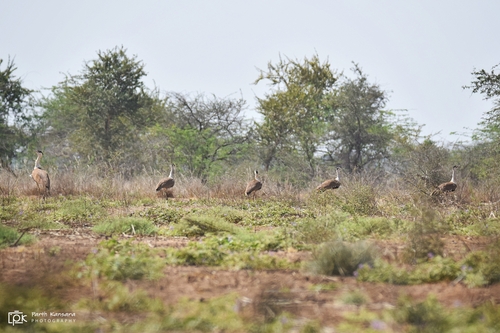
Great Indian Bustard (Ardeotis nigriceps) Great Indian Bustard
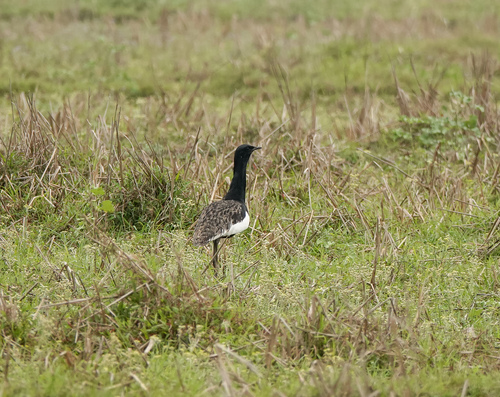
Bengal Florican (Houbaropsis bengalensis) Bengal Florican

Media

Loading…

In short

The most reliable field mark for separating Great Indian Bustard from Bengal Florican is the striking difference in adult male plumage: Bengal Florican males show a bold black head, neck, and underparts with a large white wing patch, while Great Indian Bustard males are sandy-buff overall with a black crown and white neck, lacking any black on the underparts. In flight, male Bengal Florican's wings look almost entirely white except for dark primaries, a sharp contrast to the Great Indian Bustard's less contrasting, more uniformly pale wings. Females and immatures of both species are more subtly marked, but Great Indian Bustard is much larger and bulkier, with a heavier, horizontal build and longer bare legs. Habitat also helps: Great Indian Bustard prefers arid grasslands, while Bengal Florican is found in tall, moist grasslands. If you see a bustard with a black neck and white wings, it's a male Bengal Florican; a sandy, massive bustard with a white neck and black crown is Great Indian Bustard.

Identification tips

  1. Adult male Bengal Florican is black from head to belly, with a long crest and white wings (except for dark primaries); Great Indian Bustard never shows this pattern.
  2. In flight, male Bengal Florican's wings appear almost entirely white with dark primaries, while Great Indian Bustard's wings are broad, pale, and lack sharp contrast.
  3. Female and immature Bengal Florican are buff-brown with fine dark streaks and barring, and lighter wing coverts than remiges; Great Indian Bustard females and young are sandy-buff above, paler below, with a white neck and black crown, lacking fine barring.
  4. Great Indian Bustard is much larger and bulkier, with a horizontal, heavy build and long bare legs; Bengal Florican is medium-sized, more upright, and slimmer.
  5. Great Indian Bustard males display by inflating fluffy white breast and neck feathers and a gular sac, cocking the tail over the back; Bengal Florican males display by leaping and croaking, showing off their black-and-white plumage.
  6. Great Indian Bustard is found in dry, open grassland and semi-desert, while Bengal Florican is restricted to tall, moist grassland with scattered bushes.
  7. If you see a bustard in lush, tall grass (especially with sugarcane or Imperata), Bengal Florican is likely; in arid, open country, expect Great Indian Bustard.
  8. Great Indian Bustard's booming call is deep and far-carrying; Bengal Florican's calls are metallic 'chik-chik-chik' when flushed, and croaking/humming during display.
  9. When flushed, Bengal Florican often explodes from cover and flies low; Great Indian Bustard tends to walk or run before taking off, with a slower, heavier flight.
  10. Great Indian Bustard's white neck and black crown are visible at distance, especially when the bird is alert; Bengal Florican males have a black head and neck, but females/immatures do not.
  11. Juvenile Bengal Florican can be confused with female Lesser Florican (not covered here), but Great Indian Bustard juveniles are always much larger and paler.
  12. If you see a bustard with a massive, almost goose-like presence, it's Great Indian Bustard; Bengal Florican is never that large.
  13. Great Indian Bustard is critically endangered and extremely rare, now mostly confined to a few reserves in India; Bengal Florican is also critically endangered, but its habitat is more restricted to tall grasslands.
  14. Plumage differences are most obvious in adult males; females and immatures require careful attention to size, structure, and habitat.
  15. If in doubt, use a combination of size, habitat, and wing pattern in flight to separate these two species, especially for non-breeding or immature birds.

Size

Great Indian Bustard is among the heaviest flying birds, with a massive, horizontal body and long bare legs, making it much larger and bulkier than Bengal Florican. Bengal Florican is a medium-sized bustard, with females weighing around 1.7–1.9 kg and males 1.2–1.5 kg [wikidata]. The size difference is obvious in the field: Great Indian Bustard towers over Bengal Florican, standing much taller and appearing far more robust. If you see a bustard that looks goose-sized or larger, it's likely Great Indian Bustard; Bengal Florican is closer to a large chicken or small turkey in bulk.

Plumage

Adult male Bengal Florican is unmistakable: black from head to underparts, with a long, lanky crest and elongated neck plumes, and a huge white patch on the upperwing extending from coverts to remiges. In flight, the male's wings look almost entirely white except for the dark primaries. Females and immatures are buff-brown with fine dark streaks and barring, and have lighter wing coverts than remiges, but lack the male's black and white contrast. Great Indian Bustard, in all plumages, is sandy-buff above with a white neck and black crown; males show a fluffy white breast and neck during display, but never have the black underparts or white wing of male Bengal Florican. Juvenile and female Great Indian Bustards are also sandy-buff, blending into dry grass, and lack the crisp barring and streaking of Bengal Florican females. In flight, Great Indian Bustard shows broad, pale wings without the sharp white/black contrast of male Bengal Florican. Immature Bengal Florican resembles the female, so beware confusion with female Lesser Florican (not covered here), but Great Indian Bustard is always much larger and paler overall.

Behaviour

Great Indian Bustard is usually solitary or in small flocks outside the breeding season, walking slowly and deliberately with a horizontal posture, often in open, arid grassland. During display, males inflate their white breast feathers and gular sac, producing a deep booming call and cocking the tail over the back. Bengal Florican is more secretive, especially females and immatures, which prefer to stay hidden in tall grass; males become conspicuous during display, leaping and croaking in open patches. Bengal Florican is more likely to flush explosively from cover, while Great Indian Bustard tends to walk away or run before taking flight. Both species are ground-dwelling, but Great Indian Bustard's size and gait are noticeably heavier and slower.

Habitat

Great Indian Bustard is found in dry grasslands and semi-desert shrublands of the Indian subcontinent, favoring open, arid landscapes with sparse vegetation. Bengal Florican inhabits tall, moist grasslands with scattered bushes, especially in the Terai and floodplains of northern India, Nepal, and Southeast Asia. If you are birding in lush, tall grassland (often with sugarcane or Imperata), Bengal Florican is much more likely; in dry, open, and sandy grassland, expect Great Indian Bustard. The two species rarely overlap in habitat preference.

Voice

Great Indian Bustard males produce a deep, resonant booming call during courtship, audible up to 500 meters, and give a sharp barking alarm call when disturbed. Bengal Florican is usually silent, but when disturbed gives a metallic 'chik-chik-chik' call; displaying males croak and emit a deep humming sound. The Great Indian Bustard's booming call is much lower and carries further than any Bengal Florican vocalization.

Submit a better description

Use the same sections as the comparison. Your text is published immediately.

The most reliable field mark for separating Great Indian Bustard from Bengal Florican is the striking difference in adult male plumage: Bengal Florican males show a bold black head, neck, and underparts with a large white wing patch, while Great Indian Bustard males are sandy-buff overall with a black crown and white neck, lacking any black on the underparts. In flight, male Bengal Florican's wings look almost entirely white except for dark primaries, a sharp contrast to the Great Indian Bustard's less contrasting, more uniformly pale wings. Females and immatures of both species are more subtly marked, but Great Indian Bustard is much larger and bulkier, with a heavier, horizontal build and longer bare legs. Habitat also helps: Great Indian Bustard prefers arid grasslands, while Bengal Florican is found in tall, moist grasslands. If you see a bustard with a black neck and white wings, it's a male Bengal Florican; a sandy, massive bustard with a white neck and black crown is Great Indian Bustard.

  1. Adult male Bengal Florican is black from head to belly, with a long crest and white wings (except for dark primaries); Great Indian Bustard never shows this pattern.
  2. In flight, male Bengal Florican's wings appear almost entirely white with dark primaries, while Great Indian Bustard's wings are broad, pale, and lack sharp contrast.
  3. Female and immature Bengal Florican are buff-brown with fine dark streaks and barring, and lighter wing coverts than remiges; Great Indian Bustard females and young are sandy-buff above, paler below, with a white neck and black crown, lacking fine barring.
  4. Great Indian Bustard is much larger and bulkier, with a horizontal, heavy build and long bare legs; Bengal Florican is medium-sized, more upright, and slimmer.
  5. Great Indian Bustard males display by inflating fluffy white breast and neck feathers and a gular sac, cocking the tail over the back; Bengal Florican males display by leaping and croaking, showing off their black-and-white plumage.
  6. Great Indian Bustard is found in dry, open grassland and semi-desert, while Bengal Florican is restricted to tall, moist grassland with scattered bushes.
  7. If you see a bustard in lush, tall grass (especially with sugarcane or Imperata), Bengal Florican is likely; in arid, open country, expect Great Indian Bustard.
  8. Great Indian Bustard's booming call is deep and far-carrying; Bengal Florican's calls are metallic 'chik-chik-chik' when flushed, and croaking/humming during display.
  9. When flushed, Bengal Florican often explodes from cover and flies low; Great Indian Bustard tends to walk or run before taking off, with a slower, heavier flight.
  10. Great Indian Bustard's white neck and black crown are visible at distance, especially when the bird is alert; Bengal Florican males have a black head and neck, but females/immatures do not.
  11. Juvenile Bengal Florican can be confused with female Lesser Florican (not covered here), but Great Indian Bustard juveniles are always much larger and paler.
  12. If you see a bustard with a massive, almost goose-like presence, it's Great Indian Bustard; Bengal Florican is never that large.
  13. Great Indian Bustard is critically endangered and extremely rare, now mostly confined to a few reserves in India; Bengal Florican is also critically endangered, but its habitat is more restricted to tall grasslands.
  14. Plumage differences are most obvious in adult males; females and immatures require careful attention to size, structure, and habitat.
  15. If in doubt, use a combination of size, habitat, and wing pattern in flight to separate these two species, especially for non-breeding or immature birds.

Great Indian Bustard is among the heaviest flying birds, with a massive, horizontal body and long bare legs, making it much larger and bulkier than Bengal Florican. Bengal Florican is a medium-sized bustard, with females weighing around 1.7–1.9 kg and males 1.2–1.5 kg [wikidata]. The size difference is obvious in the field: Great Indian Bustard towers over Bengal Florican, standing much taller and appearing far more robust. If you see a bustard that looks goose-sized or larger, it's likely Great Indian Bustard; Bengal Florican is closer to a large chicken or small turkey in bulk.

Adult male Bengal Florican is unmistakable: black from head to underparts, with a long, lanky crest and elongated neck plumes, and a huge white patch on the upperwing extending from coverts to remiges. In flight, the male's wings look almost entirely white except for the dark primaries. Females and immatures are buff-brown with fine dark streaks and barring, and have lighter wing coverts than remiges, but lack the male's black and white contrast. Great Indian Bustard, in all plumages, is sandy-buff above with a white neck and black crown; males show a fluffy white breast and neck during display, but never have the black underparts or white wing of male Bengal Florican. Juvenile and female Great Indian Bustards are also sandy-buff, blending into dry grass, and lack the crisp barring and streaking of Bengal Florican females. In flight, Great Indian Bustard shows broad, pale wings without the sharp white/black contrast of male Bengal Florican. Immature Bengal Florican resembles the female, so beware confusion with female Lesser Florican (not covered here), but Great Indian Bustard is always much larger and paler overall.

Great Indian Bustard is usually solitary or in small flocks outside the breeding season, walking slowly and deliberately with a horizontal posture, often in open, arid grassland. During display, males inflate their white breast feathers and gular sac, producing a deep booming call and cocking the tail over the back. Bengal Florican is more secretive, especially females and immatures, which prefer to stay hidden in tall grass; males become conspicuous during display, leaping and croaking in open patches. Bengal Florican is more likely to flush explosively from cover, while Great Indian Bustard tends to walk away or run before taking flight. Both species are ground-dwelling, but Great Indian Bustard's size and gait are noticeably heavier and slower.

Great Indian Bustard is found in dry grasslands and semi-desert shrublands of the Indian subcontinent, favoring open, arid landscapes with sparse vegetation. Bengal Florican inhabits tall, moist grasslands with scattered bushes, especially in the Terai and floodplains of northern India, Nepal, and Southeast Asia. If you are birding in lush, tall grassland (often with sugarcane or Imperata), Bengal Florican is much more likely; in dry, open, and sandy grassland, expect Great Indian Bustard. The two species rarely overlap in habitat preference.

Great Indian Bustard males produce a deep, resonant booming call during courtship, audible up to 500 meters, and give a sharp barking alarm call when disturbed. Bengal Florican is usually silent, but when disturbed gives a metallic 'chik-chik-chik' call; displaying males croak and emit a deep humming sound. The Great Indian Bustard's booming call is much lower and carries further than any Bengal Florican vocalization.

Discard your changes?

You have unsaved edits. If you leave now, those changes will be lost.

Great Indian Bustard · Bengal Florican · My Tricky Birds