
Goosander vs Red-breasted Merganser
Mergus merganser versus Mergus serrator
Play a quiz with Goosander and Red-breasted Merganser
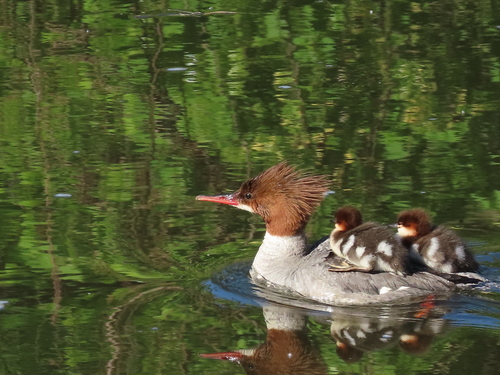 Goosander
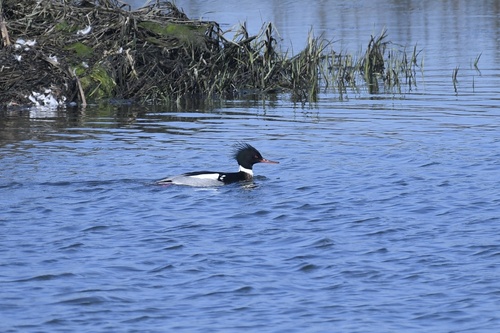 Red-breasted Merganser
In short
The most reliable field mark between Goosander (Common Merganser) and Red-breasted Merganser is the difference in head crest and breast color in adult males: Goosander males have a smoothly rounded, dark greenish-black head and a white (sometimes salmon-tinged) body, while Red-breasted Merganser males show a spiky crest, a distinct white neck band, and a rusty breast. For females and immatures, separation is trickier: Goosander females have a sharply contrasting white chin patch and a more sharply demarcated reddish-brown head, while Red-breasted Merganser females lack the white chin and have a more diffuse rusty head blending into a greyer body. In flight, both species show white wing patches, but the Red-breasted's is slightly smaller. Goosander is substantially heavier and bulkier, with a thicker bill and a less spiky crest. Habitat can help: Goosander favors freshwater, Red-breasted is more often on saltwater, but overlap is common.
Identification tips
- Adult male Goosander (breeding): Look for a smoothly rounded, dark greenish-black head, white (sometimes salmon-tinged) body, and a thick, straight red bill. The crest lies flat and is not spiky. The breast is white, not rusty.
- Adult male Red-breasted Merganser (breeding): Shows a spiky, shaggy crest, a white neck ring, a distinct rusty breast, and a thinner, longer red bill. The head is dark with a green sheen, but the crest is always more pronounced and messy than Goosander.
- Females (all ages): Goosander females have a sharply defined white chin patch and a more contrasting reddish-brown head, with a clear demarcation from the paler neck and breast. Red-breasted Merganser females lack the white chin and have a rusty head that blends more gradually into the greyish-brown body.
- Juveniles: Juvenile Goosander shows a short black-edged white stripe between the eye and bill, a feature not present in Red-breasted Merganser. Juvenile Red-breasted has a shorter crest and smaller white wing patches than adults, but otherwise resembles the female.
- Crest shape: Goosander's crest is usually smooth and rounded, rarely raised; Red-breasted's is always spiky and messy, especially obvious in males but also present in females and juveniles.
- Bill structure: Goosander has a thicker, heavier bill; Red-breasted's bill is thinner, longer, and more delicate, with a slightly upturned look in some views.
- Wing pattern in flight: Both have white wing patches, but Red-breasted's is marginally smaller and less striking. This is subtle and best used in combination with other marks.
- Body shape and jizz: Goosander is bulkier, with a deeper chest and thicker neck. Red-breasted appears more slender and elongated, especially in the neck and bill.
- Size: Goosander is significantly larger and heavier (see mass and length above). In mixed flocks, Goosander stands out as the bigger bird.
- Habitat context: Goosander is more likely on freshwater (rivers, lakes), Red-breasted on saltwater (coasts, estuaries), but both can overlap, especially in winter or migration.
- Behavior: Goosander often floats downstream and returns by swimming or flying, sometimes perching on rocks or ice. Red-breasted is more marine, often seen in rapid, direct flight over open water.
- Plumage pitfalls: Non-breeding males of both species resemble females, but Goosander retains the white chin and stronger head contrast. Red-breasted's head and neck colors are more blended.
- Courtship display: Only Red-breasted Merganser males perform the metronomic neck-stretching display with spiky crests fanned and straightened, often in groups.
- On land: Both are awkward, but Goosander is especially upright and penguin-like when running.
- Voice: Both are generally quiet; Goosander gives a harsh croak or a soft whistle in breeding season, but voice is rarely diagnostic in the field.
Size
Goosander is the larger and heavier bird: average adult mass is about 1470.5g for Goosander versus 1021.5g for Red-breasted Merganser. Goosander also has a longer body (58–72 cm vs. 51–64 cm) and a broader wingspan (78–97 cm vs. 66–74 cm). In the field, Goosander appears bulkier and more robust, with a thicker neck and bill, while Red-breasted Merganser is slimmer and more elongated, especially in the neck and bill.
Plumage
Juveniles and females of both species are similar, but Goosander (all ages) shows a sharply defined white chin patch and a more contrasting reddish-brown head, while Red-breasted Merganser females and juveniles lack the white chin and have a rusty head that fades more gradually into the greyish body. Juvenile Goosanders also show a short black-edged white stripe between the eye and bill, which Red-breasted lacks. In flight, both species show white wing patches, but Red-breasted's is marginally smaller and less conspicuous. Adult male Goosander in breeding plumage is white-bodied with a dark greenish-black head and a smoothly rounded crest; Red-breasted Merganser males have a spiky crest, a white neck ring, and a rusty breast, with a thinner, longer bill. Non-breeding (eclipse) males of both species resemble females but Goosander retains the white chin and stronger head contrast.
Behaviour
Both species dive for fish and have serrated bills, but Goosander is more likely to be seen floating on rivers and lakes, sometimes resting on rocks or ice, and often returns upstream by swimming or flying after drifting downstream. Red-breasted Merganser is more frequently encountered in coastal or estuarine waters and is noted for its rapid, direct flight and elaborate courtship displays with spiky crests fanned and straightened. On land, both are clumsy, but Goosander is particularly upright and penguin-like when running.
Habitat
Goosander is primarily a freshwater species, preferring rivers and lakes in forested regions, though it can be found in saltwater in winter. Red-breasted Merganser is more marine, commonly found in coastal and estuarine habitats, especially outside the breeding season, but also breeds on freshwater lakes and rivers. Where ranges overlap, habitat preference can be a clue but is not definitive, as both species can occur together, especially in migration and winter.
Voice
Goosander's typical call is a low, harsh croak, with males and juveniles giving a soft, plaintive whistle during breeding season. Red-breasted Merganser's vocalizations are not described in detail in the sources, but both species are generally quiet and not easily separated by voice in the field.