

Motmot

Golden-spangled Piculet vs Arrowhead Piculet

Picumnus exilis versus Picumnus minutissimus

Play a quiz with Golden-spangled Piculet and Arrowhead Piculet
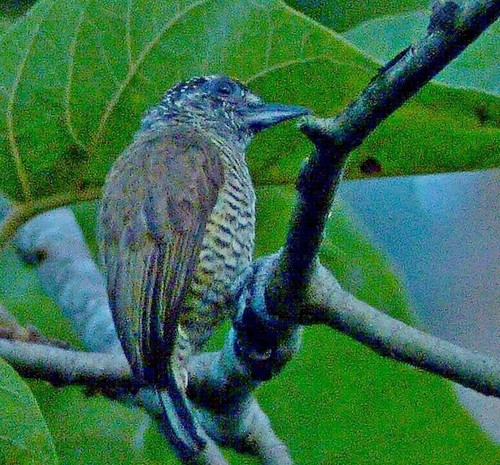
Golden-spangled Piculet (Picumnus exilis) Golden-spangled Piculet
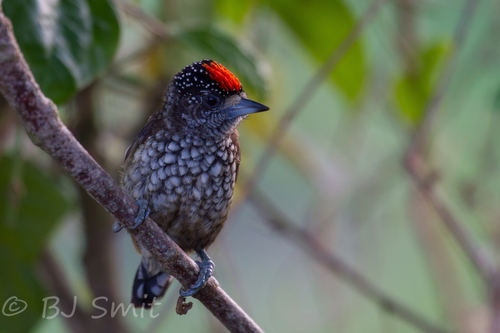
Arrowhead Piculet (Picumnus minutissimus) Arrowhead Piculet

Media

Loading…

In short

The most reliable field mark to separate Golden-spangled Piculet from Arrowhead Piculet is the pattern and color of the upperparts and wing coverts in all ages, with Arrowhead showing distinctive blackish wedge-shaped feather centers and white spots on the upperparts, while Golden-spangled is more olive-green with less sharply defined markings. Juveniles are especially separable by crown and upperpart pattern: juvenile Arrowhead Piculet has a plain brown crown and blackish-barred upperparts, while juvenile Golden-spangled is duller olive with a streaked crown and diffuse underpart barring. Both species are tiny, short-tailed piculets, but Arrowhead is noticeably heavier. Adult males of both have red on the forehead, but females differ in crown pattern. Careful attention to upperpart and underpart pattern, especially in perched birds, is key to separating these two in the field.

Identification tips

  1. Juvenile crown pattern: Juvenile Arrowhead Piculet has a plain brown crown, while juvenile Golden-spangled has an olive crown with pale streaking. This is the best mark for immatures.
  2. Juvenile upperparts: Juvenile Arrowhead is browner above with blackish bars, while Golden-spangled is dull olive with less distinct markings.
  3. Adult upperparts: Arrowhead Piculet adults show olive-brown upperparts with blackish wedge-shaped feather centers, thin black bars at the tips, and a white spot just inside the tip, creating a crisp, 'arrowhead' pattern. Golden-spangled is more olive-green above with less sharply defined dark centers and more uniform feather edges.
  4. Wing coverts: Golden-spangled has olive-green coverts with narrow white edges and black-edged white tips; Arrowhead's coverts blend into the 'arrowhead' upperpart pattern, with less contrast in the tips but more sharply marked feather centers and spots.
  5. Underparts: Arrowhead has white underparts with a brownish buff tinge and a scaly appearance from brownish-black feather fringes. Golden-spangled is pale yellowish below with blackish bars, which are more spot-like on the belly.
  6. Facial pattern: Arrowhead's face is mostly dark brown with white tips to some feathers and a white line behind the eye, giving a darker, more contrasting look. Golden-spangled has a yellowish-white face with dark speckles and a pale post-ocular stripe, appearing paler and less contrasting.
  7. Crown pattern (adult males): Both have a black cap with red on the forehead and white spots elsewhere, but the overall impression is similar; not reliably diagnostic unless combined with other marks.
  8. Crown pattern (adult females): Female Golden-spangled has white spots across the entire crown; female Arrowhead lacks red on the forehead but otherwise matches the male.
  9. Tail pattern: Both have dark tails with white patches, but the pattern is not reliably different between the two.
  10. Weight/bulk: Arrowhead is heavier (11–16 g) than Golden-spangled (8.5–10 g), but this is subtle and not a field mark unless both are seen together.
  11. Range: If outside Suriname or adjacent regions, Arrowhead is unlikely; Golden-spangled is much more widespread.
  12. Rump and undertail coverts: Arrowhead's rump is plainer, but undertail coverts may have dark bars; Golden-spangled's rump and undertail are not strongly marked.
  13. Bill, tail, and structure: No reliable differences in bill shape, tail length, or overall structure; both are typical short-tailed, small piculets.
  14. Flight views: No distinctive upperwing or tail pattern differences in flight; rely on perched views for separation.
  15. Sex differences: Both species' females differ from males mainly in crown pattern (see above); otherwise, sexes are similar.

Size

Both species are very small woodpeckers, 9–10 cm in length, but Arrowhead Piculet is distinctly heavier (11–16 g) than Golden-spangled Piculet (8.5–10 g) [wikipedia]. This difference may be subtle in the field but could be apparent if both are seen side by side, with Arrowhead appearing slightly bulkier. Bill, tail, and overall proportions are similar and not reliably separable at a distance.

Plumage

Juvenile Arrowhead Piculet is best told by its plain brown crown and browner, blackish-barred upperparts, while juvenile Golden-spangled is duller than adults but keeps an olive crown with pale streaks and more diffuse underpart barring. Adult male Golden-spangled has a black cap and nape with red spots only on the forehead, white spots elsewhere, and olive-green upperparts with dark feather centers; wing coverts are olive with narrow white edges and black-edged white tips. Arrowhead Piculet adult males have a black cap with a red forehead patch and white spots, but the face is darker brown, and the upperparts are olive-brown with blackish wedge-shaped centers, thin black terminal bars, and a white spot just inside the tip of each feather, giving a more sharply marked, 'arrowhead' look. The rump is plainer in Arrowhead, and the underparts are white with a brownish buff tinge and a scaly look from brownish-black feather fringes, while Golden-spangled is pale yellowish with blackish bars, more spot-like on the belly. Females of both are similar to males but Golden-spangled has white spots on the entire crown, while Arrowhead lacks red on the forehead. In flight, both show dark tails with white patches, but the pattern is not diagnostic between them.

Behaviour

Both species behave much like other piculets: active, often foraging on thin branches or trunks, and frequently moving through the lower to mid-levels of forest and edge. There is no strong behavioral difference noted in the sources to separate them reliably in the field.

Habitat

Golden-spangled Piculet has a broader range, found in Brazil, Colombia, French Guiana, Guyana, Suriname, and Venezuela, while Arrowhead Piculet is much more restricted, reliably found only in Suriname and possibly adjacent French Guiana and Guyana [wikipedia]. In areas where both could occur (Suriname, possibly French Guiana/Guyana), careful identification is needed. Both use similar habitats, so range is the main context clue.

Submit a better description

Use the same sections as the comparison. Your text is published immediately.

The most reliable field mark to separate Golden-spangled Piculet from Arrowhead Piculet is the pattern and color of the upperparts and wing coverts in all ages, with Arrowhead showing distinctive blackish wedge-shaped feather centers and white spots on the upperparts, while Golden-spangled is more olive-green with less sharply defined markings. Juveniles are especially separable by crown and upperpart pattern: juvenile Arrowhead Piculet has a plain brown crown and blackish-barred upperparts, while juvenile Golden-spangled is duller olive with a streaked crown and diffuse underpart barring. Both species are tiny, short-tailed piculets, but Arrowhead is noticeably heavier. Adult males of both have red on the forehead, but females differ in crown pattern. Careful attention to upperpart and underpart pattern, especially in perched birds, is key to separating these two in the field.

  1. Juvenile crown pattern: Juvenile Arrowhead Piculet has a plain brown crown, while juvenile Golden-spangled has an olive crown with pale streaking. This is the best mark for immatures.
  2. Juvenile upperparts: Juvenile Arrowhead is browner above with blackish bars, while Golden-spangled is dull olive with less distinct markings.
  3. Adult upperparts: Arrowhead Piculet adults show olive-brown upperparts with blackish wedge-shaped feather centers, thin black bars at the tips, and a white spot just inside the tip, creating a crisp, 'arrowhead' pattern. Golden-spangled is more olive-green above with less sharply defined dark centers and more uniform feather edges.
  4. Wing coverts: Golden-spangled has olive-green coverts with narrow white edges and black-edged white tips; Arrowhead's coverts blend into the 'arrowhead' upperpart pattern, with less contrast in the tips but more sharply marked feather centers and spots.
  5. Underparts: Arrowhead has white underparts with a brownish buff tinge and a scaly appearance from brownish-black feather fringes. Golden-spangled is pale yellowish below with blackish bars, which are more spot-like on the belly.
  6. Facial pattern: Arrowhead's face is mostly dark brown with white tips to some feathers and a white line behind the eye, giving a darker, more contrasting look. Golden-spangled has a yellowish-white face with dark speckles and a pale post-ocular stripe, appearing paler and less contrasting.
  7. Crown pattern (adult males): Both have a black cap with red on the forehead and white spots elsewhere, but the overall impression is similar; not reliably diagnostic unless combined with other marks.
  8. Crown pattern (adult females): Female Golden-spangled has white spots across the entire crown; female Arrowhead lacks red on the forehead but otherwise matches the male.
  9. Tail pattern: Both have dark tails with white patches, but the pattern is not reliably different between the two.
  10. Weight/bulk: Arrowhead is heavier (11–16 g) than Golden-spangled (8.5–10 g), but this is subtle and not a field mark unless both are seen together.
  11. Range: If outside Suriname or adjacent regions, Arrowhead is unlikely; Golden-spangled is much more widespread.
  12. Rump and undertail coverts: Arrowhead's rump is plainer, but undertail coverts may have dark bars; Golden-spangled's rump and undertail are not strongly marked.
  13. Bill, tail, and structure: No reliable differences in bill shape, tail length, or overall structure; both are typical short-tailed, small piculets.
  14. Flight views: No distinctive upperwing or tail pattern differences in flight; rely on perched views for separation.
  15. Sex differences: Both species' females differ from males mainly in crown pattern (see above); otherwise, sexes are similar.

Both species are very small woodpeckers, 9–10 cm in length, but Arrowhead Piculet is distinctly heavier (11–16 g) than Golden-spangled Piculet (8.5–10 g) [wikipedia]. This difference may be subtle in the field but could be apparent if both are seen side by side, with Arrowhead appearing slightly bulkier. Bill, tail, and overall proportions are similar and not reliably separable at a distance.

Juvenile Arrowhead Piculet is best told by its plain brown crown and browner, blackish-barred upperparts, while juvenile Golden-spangled is duller than adults but keeps an olive crown with pale streaks and more diffuse underpart barring. Adult male Golden-spangled has a black cap and nape with red spots only on the forehead, white spots elsewhere, and olive-green upperparts with dark feather centers; wing coverts are olive with narrow white edges and black-edged white tips. Arrowhead Piculet adult males have a black cap with a red forehead patch and white spots, but the face is darker brown, and the upperparts are olive-brown with blackish wedge-shaped centers, thin black terminal bars, and a white spot just inside the tip of each feather, giving a more sharply marked, 'arrowhead' look. The rump is plainer in Arrowhead, and the underparts are white with a brownish buff tinge and a scaly look from brownish-black feather fringes, while Golden-spangled is pale yellowish with blackish bars, more spot-like on the belly. Females of both are similar to males but Golden-spangled has white spots on the entire crown, while Arrowhead lacks red on the forehead. In flight, both show dark tails with white patches, but the pattern is not diagnostic between them.

Both species behave much like other piculets: active, often foraging on thin branches or trunks, and frequently moving through the lower to mid-levels of forest and edge. There is no strong behavioral difference noted in the sources to separate them reliably in the field.

Golden-spangled Piculet has a broader range, found in Brazil, Colombia, French Guiana, Guyana, Suriname, and Venezuela, while Arrowhead Piculet is much more restricted, reliably found only in Suriname and possibly adjacent French Guiana and Guyana [wikipedia]. In areas where both could occur (Suriname, possibly French Guiana/Guyana), careful identification is needed. Both use similar habitats, so range is the main context clue.

Discard your changes?

You have unsaved edits. If you leave now, those changes will be lost.

Golden-spangled Piculet · Arrowhead Piculet · My Tricky Birds