
Garganey vs Gadwall
Spatula querquedula versus Mareca strepera
Play a quiz with Garganey and Gadwall
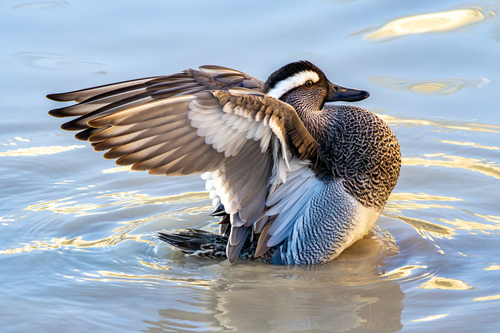 Garganey
 Gadwall
In short
The most reliable way to separate Garganey from Gadwall in the field is by their wing pattern in flight: Garganey of all ages shows a pale blue forewing (speculum) with a white border, while Gadwall has a brilliant white speculum without blue, often with chestnut on the wing. Adult male Garganey is unmistakable with its bold white supercilium (eyebrow) and brown head, but females and juveniles can be confused with female Gadwall, especially at a distance or in poor light. Bill shape and face pattern are key structural clues: Garganey has a more slender bill and a stronger, more contrasting facial pattern. Both species are dabbling ducks, but Garganey is much less common and more strictly migratory in most of Europe.
Identification tips
- Wing pattern in flight (all ages/sexes): Garganey always shows a pale blue speculum with a white border; Gadwall has a white speculum, sometimes with chestnut, but never blue. This is the single most reliable mark for birds in flight or flapping on water.
- Adult male Garganey: Look for the bold white supercilium (eyebrow) and brown head, with a grey body and loose grey scapulars. No other duck in Europe shows this combination. Gadwall males are grey with a black rear and lack any strong face pattern.
- Female/immature face pattern: Garganey females and immatures have a sharply defined pale eyebrow, dark eye line, and a pale spot on the lore bordered by a second dark line. Gadwall females are plainer-faced, with a more uniform brown head and a dark orange-edged bill.
- Bill shape: Garganey has a more slender, slightly longer bill compared to the broader, orange-edged bill of the female Gadwall. This is subtle but useful at close range.
- Body size and shape: Gadwall is noticeably larger and bulkier, with a longer neck and bigger head. Garganey is more compact and daintier overall.
- Speculum at rest: Even when perched or swimming, Garganey often shows the pale blue speculum and white-edged tertials; Gadwall shows a white speculum, sometimes with chestnut, but never blue.
- Plumage confusion in eclipse/non-breeding: Gadwall males in eclipse look more like females but retain the white speculum and are generally greyer above. Garganey males in eclipse still show the face pattern and blue speculum.
- Behavior: Garganey often feeds by dabbling with frequent head-shaking; Gadwall may dive for food and is more likely to be seen stealing from coots.
- Habitat and season: Garganey is rare and strictly migratory in most of Europe, absent in winter; Gadwall is common and widespread, present year-round in many areas.
- Vocalizations: Garganey males have a crackling call; Gadwall males give a grunt and whistle, and females give a higher-pitched quack. Calls are rarely diagnostic in the field but can help if heard well.
- Flock size/context: Garganey is more likely to be seen in larger migratory flocks, especially in spring and autumn. Gadwall is usually in smaller groups outside the breeding season.
- Leg color (if seen): Blue-winged Teal (not Gadwall) has yellow legs, but note that Garganey and Gadwall both have grey legs, so this is not a separator for these two.
- Common pitfalls: Female Garganey and Gadwall can look similar at a distance; always try to see the wing pattern or face detail. Juvenile and eclipse birds are best separated by the speculum color in flight or at rest.
- When marks fail: In poor light or at great distance, size and flock context may be the only clues; avoid relying solely on general brownness or dabbling behavior.
Size
Gadwall is the larger duck, measuring 47–58 cm in length with a 78–85 cm wingspan and weighing 850–990 g depending on sex [wikipedia]. Garganey is smaller and lighter, but precise measurements are not given in the notes. In the field, Gadwall appears noticeably bulkier and longer-necked, with a slightly larger head and longer body compared to the more compact Garganey.
Plumage
- Juvenile/immature/first-winter in flight: Garganey of all ages shows a pale blue forewing (speculum) with a white border, visible both at rest and in flight. Gadwall, regardless of age or sex, has a white speculum, sometimes with chestnut on the wing, but never blue. This is the most reliable separation in flight, especially for immatures and females.
- Adult male breeding plumage: Garganey male is unmistakable with a rich brown head, broad white supercilium, and grey body. Gadwall male is patterned grey with a black rear, white speculum, and chestnut wing patches, lacking any strong face pattern.
- Adult female/immature perched: Female Garganey is brown with a strong pale eyebrow, dark eye line, and pale lore spot bordered by a second dark line. Female Gadwall is light brown, similar to a female Mallard, with a less contrasting face and a dark orange-edged bill. Both can look similar at a distance, but Garganey's face pattern is more sharply defined.
- Eclipse (non-breeding) males: Gadwall males in eclipse resemble females but retain the white speculum and are usually greyer above. Garganey males lose some contrast but still show the face pattern and blue speculum.
Behaviour
Both are dabbling ducks, but Garganey is more likely to be seen in flocks during migration and is generally shyer, often feeding by dabbling with frequent head-shaking. Gadwall is less gregarious outside the breeding season, often in small groups, and is more likely to dive for food or even steal food from coots. Garganey is more strictly migratory, while Gadwall is more resident or only partially migratory in much of its range.
Habitat
Garganey breeds in quiet marshes and wetlands, often in more secluded or seasonal habitats, and is rare in the British Isles except for a few localities. Gadwall is much more widespread and common, found in open wetlands, lakes, and marshes with dense fringing vegetation. In winter, Garganey migrates entirely out of Europe to Africa and Asia, while Gadwall is present year-round in many areas.
Voice
Garganey male has a distinctive crackling mating call, while the female is mostly silent, with only a weak quack. Gadwall is generally quiet except during courtship; the female gives a higher-pitched quack (gag-ag-ag-ag), and the male gives a grunt (mep) and a whistle, especially during display. In most field situations, neither species is very vocal, so calls are rarely the primary means of separation.