
Gadwall vs Mallard
Mareca strepera versus Anas platyrhynchos
Play a quiz with Gadwall and Mallard
 Gadwall
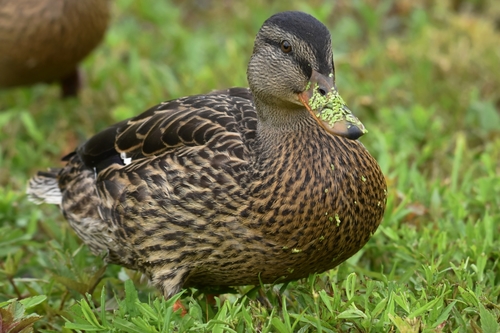 Mallard
In short
The most reliable field mark for separating Gadwall from Mallard—especially in flight or among females and immatures—is the wing pattern: Gadwall of all ages and sexes shows a brilliant white speculum (the wing patch), while Mallard has a metallic blue or purple speculum bordered with white, never fully white. Gadwall is a bit smaller and slimmer, with a more subdued, finely patterned plumage, while Mallard is bulkier and shows bolder contrasts, especially in males. Female Gadwall can be confused with female Mallard, but Gadwall's orange-edged bill and white belly are key clues. Careful attention to wing pattern, bill color, and overall structure will resolve most field confusion, even at a distance or in mixed flocks.
Identification tips
- Speculum color in flight (all ages/sexes): Gadwall always shows a bright white speculum; Mallard's is metallic blue or purple with white borders. This is the single most reliable mark, especially on flying or flapping birds.
- Speculum at rest: Even on perched or swimming birds, Gadwall often shows a white square on the wing, while Mallard shows the blue/purple speculum with white edges.
- Female/immature bill color: Gadwall females have a dark bill with orange edges; Mallard females have a more uniformly orange-and-black bill. On close views, this is a strong clue.
- Belly color: Gadwall females and immatures have a white belly, contrasting with the rest of the body; Mallard females are more uniformly brown below.
- Overall structure: Gadwall is slimmer, with a slightly longer neck and more pointed rear end; Mallard is bulkier, with a rounder body and thicker neck.
- Male breeding plumage: Mallard drake has a green head, white neck ring, and chestnut breast—never seen in Gadwall. Gadwall drake is finely patterned gray with a black rear and chestnut wing patches.
- Eclipse males: Gadwall males in eclipse are still greyer and show the white speculum; Mallard males in eclipse look like females but may show a yellow bill and curled tail feather.
- Tail feather (drake feather): Adult male Mallards have a curled central tail feather; Gadwall never shows this feature.
- Size: Mallard is larger and heavier, but this is subtle and best used with other marks.
- Vocalizations: Mallard females give classic loud quacks; Gadwall females are higher-pitched and softer. Males of both are quieter, but Gadwall gives a soft mep or whistle.
- Habitat: Mallard is more likely in city parks and urban ponds; Gadwall prefers quieter, more vegetated wetlands.
- Group size: Mallard flocks are often larger and more tightly packed; Gadwall tends to be in smaller, looser groups.
- Feeding behavior: Gadwall may dive for food or steal from coots; Mallard almost always dabbles.
- Juvenile plumage: Both are mottled brown, but Gadwall juveniles show the white speculum and white belly from an early age; Mallard juveniles do not.
- Pitfall: Female Gadwall and Mallard can look very similar at a distance; always check the speculum in flight or on perched birds, and use bill and belly color as supporting clues.
Size
Mallard is the larger, heavier duck: adult Mallards measure 50–65 cm in length with an 81–98 cm wingspan, and weigh 0.7–1.6 kg. Gadwall is slightly smaller and lighter, at 47–58 cm long, 78–85 cm wingspan, and 850–990 g. In the field, Mallards often look bulkier and more barrel-chested, while Gadwalls appear slimmer and more streamlined. The difference is subtle but can be noticeable in direct comparison or mixed groups.
Plumage
-
Juvenile/immature and female plumage: Both species have mottled brown females and juveniles, but Gadwall females and immatures show a white belly and a white speculum (the wing patch), while Mallards have a blue/purple speculum bordered with white and lack the clear white belly. Gadwall's bill is orange-edged, while Mallard's is more uniformly orange-and-black (female) or yellow (male juvenile/adult).
-
Adult male breeding plumage: Mallard drake is unmistakable with a glossy green head, white neck ring, and chestnut breast; Gadwall drake is much more subdued, with finely patterned gray body, black rear end, and chestnut on the wings. The Gadwall's white speculum stands out in flight or at rest, while Mallard's is blue/purple.
-
Eclipse/non-breeding males: Gadwall males in eclipse resemble females but keep the white speculum and are generally greyer above; Mallard males in eclipse look much like females but may show some retained male features (bill color, curled tail feather).
-
In flight: Gadwall always shows a white speculum (all ages/sexes), while Mallard shows a blue/purple speculum with white borders (all ages/sexes). This is the most consistent field mark.
Behaviour
Both are dabbling ducks, but Gadwall is less gregarious outside the breeding season, often seen in smaller, looser flocks, while Mallard is highly social and forms larger groups. Gadwall can dive for food more proficiently than Mallard and sometimes steals food from diving birds like coots. Mallard tends to be more approachable and visible in urban and park settings, while Gadwall is often a bit more wary and sticks to denser vegetation or quieter wetlands.
Habitat
Both species use open wetlands, lakes, and marshes, but Mallard is more adaptable to urban parks, city ponds, and a wider range of habitats, including heavily human-modified areas. Gadwall prefers wetlands with dense fringing vegetation and is less likely to be found in highly urbanized settings. Both can overlap in many natural wetland habitats.
Voice
Gadwall is generally quieter than Mallard. Female Gadwall gives a higher-pitched quack (gag-ag-ag-ag) compared to the classic loud Mallard quack. Male Gadwall gives a soft grunt (mep) and a whistle, especially during courtship, while male Mallard gives a quieter rasping or whistling call. In mixed flocks, the louder, deeper quacks are almost always from Mallards.