

Motmot

Fire-tailed Sunbird vs Black-throated Sunbird

Aethopyga ignicauda versus Aethopyga saturata

Play a quiz with Fire-tailed Sunbird and Black-throated Sunbird
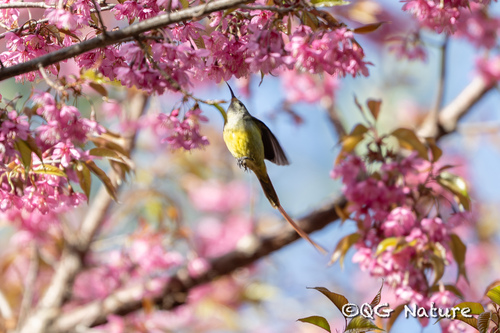
Fire-tailed Sunbird (Aethopyga ignicauda) Fire-tailed Sunbird
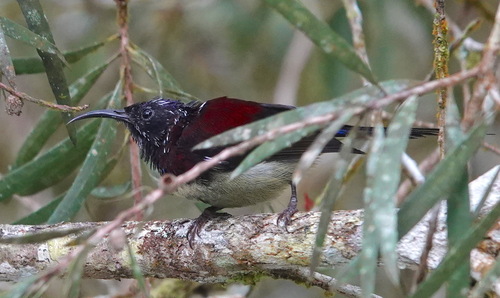
Black-throated Sunbird (Aethopyga saturata) Black-throated Sunbird

Media

Loading…

In short

The most reliable field mark between Fire-tailed Sunbird and Black-throated Sunbird is the striking scarlet tail and nape of the adult male Fire-tailed, especially visible when perched or in flight. Female Fire-tailed Sunbirds are best separated by their squarer tail (lacking white tips), straighter bill, and more olive-yellow rump, while female Black-throated Sunbirds are plainer with less contrast. Both species overlap in much of the Himalayas and Southeast Asia, but Fire-tailed is more restricted to higher elevations and coniferous forests. Immature and eclipse Fire-tailed Sunbirds can be confused with female Black-throated, but careful attention to tail shape, rump color, and bill structure will help.

Identification tips

  1. Adult male Fire-tailed Sunbird is unique: Look for the long, bright scarlet tail and scarlet nape/mantle—no Black-throated Sunbird shows this combination. If you see a sunbird with a long red tail, it's Fire-tailed.
  2. Female Fire-tailed vs. Black-throated: Female Fire-tailed has a straighter bill, squarer tail (no white tips), and a more olive-yellow rump. Black-throated females are plainer, with less contrast and no bright rump or tail color.
  3. Tail shape and color: Fire-tailed Sunbird's tail is longer and squarer in both sexes, with a trace of brownish-orange on the sides in females and eclipse males. Black-throated Sunbird's tail is shorter, more rounded, and lacks these colors.
  4. Rump color: Fire-tailed shows more noticeable olive-yellow on the rump, especially in females and eclipse males. Black-throated lacks this feature.
  5. Bill shape: Fire-tailed Sunbird has a straighter bill, especially in females, compared to the slightly more decurved bill of Black-throated.
  6. Eclipse/immature males: Fire-tailed eclipse males resemble females but show brighter yellow bellies, scarlet uppertail coverts, and scarlet tail sides—never shown by Black-throated.
  7. Habitat context: If you are in high-elevation coniferous forest or rhododendron shrub (especially above 3,000m), Fire-tailed is much more likely. In lowland or mixed forests, especially below 2,000m, Black-throated is more likely.
  8. Perched vs. in flight: The long scarlet tail of Fire-tailed is visible both perched and in flight. Black-throated never shows this feature.
  9. Breast and belly color: Fire-tailed males have a yellow-orange breast and olive-green belly; females have a yellow belly. Black-throated males (not fully described here) have a black throat, and females are less colorful below.
  10. No white tail tips in Fire-tailed: Female Fire-tailed lacks the white tail tips sometimes seen in other sunbirds, making this a useful check.
  11. Both species can occur together: In overlapping ranges, especially in the Himalayas, check all features—females and immatures are the most likely to be confused.
  12. Feeding behavior is not diagnostic: Both species feed on nectar and insects and can be seen foraging actively.
  13. No vocal differences described: Use visual marks for separation.
  14. Size is not a strong separator: Both are similar in bulk; only the long tail of male Fire-tailed creates a strong size impression.
  15. Be cautious with eclipse and immature birds: Focus on tail shape/color and rump coloration, as these are the most reliable marks across ages and sexes.

Size

Direct size comparison is limited by available data. Black-throated Sunbird has a reported body mass of 5.3g [wikidata], but no mass is given for Fire-tailed. However, Fire-tailed Sunbird males reach about 15 cm in length (including the long tail), while females are about two-thirds that length [wikipedia]. In the field, Fire-tailed males appear longer and more elongated due to their tail, but overall body bulk is similar. Females of both species are closer in size, with Fire-tailed females being slightly smaller and more compact than males.

Plumage

Adult male Fire-tailed Sunbirds are unmistakable: they show a vivid scarlet nape, mantle, and a long scarlet tail, with a yellow-orange breast and olive-green belly. In contrast, male Black-throated Sunbirds (not described in detail here) lack the scarlet tail and nape, and are named for their black throat, which is absent in Fire-tailed. Female Fire-tailed Sunbirds have a grey-olive head and throat, yellow belly, and a squarer tail with a trace of brownish-orange on the sides, lacking white tips. Female Black-throated Sunbirds are plainer, with less contrast and no bright rump or tail coloration. Eclipse male Fire-tailed Sunbirds resemble females but retain brighter yellow bellies, scarlet uppertail coverts, and scarlet tail sides, which are never shown by Black-throated. Juvenile and immature plumages are not described in detail, but the tail and rump coloration remain key for separating these species at all ages.

Behaviour

Both species feed on insects and nectar and are active, agile foragers. Fire-tailed Sunbirds are often seen in conifer forests at higher elevations, sometimes descending to lower broadleaved forests in winter. Both parents feed the young in Fire-tailed. There are no specific behavioral differences noted between the two species that are diagnostic in the field.

Habitat

Fire-tailed Sunbird is most often found in temperate and subtropical moist montane forests, especially coniferous forests in the Himalayas, breeding in rhododendron shrub at high altitudes (up to 4,000m) and descending to lower broadleaved forests in winter [wikipedia]. Black-throated Sunbird has a broader range, occurring in both subtropical/tropical moist lowland and montane forests across a wider swath of South and Southeast Asia, including more lowland and mixed forests. If you are in dense coniferous forest above 3,000m in the Himalayas, Fire-tailed is much more likely; in lower elevation or mixed forests, both can occur, but Black-throated is more common.

Submit a better description

Use the same sections as the comparison. Your text is published immediately.

The most reliable field mark between Fire-tailed Sunbird and Black-throated Sunbird is the striking scarlet tail and nape of the adult male Fire-tailed, especially visible when perched or in flight. Female Fire-tailed Sunbirds are best separated by their squarer tail (lacking white tips), straighter bill, and more olive-yellow rump, while female Black-throated Sunbirds are plainer with less contrast. Both species overlap in much of the Himalayas and Southeast Asia, but Fire-tailed is more restricted to higher elevations and coniferous forests. Immature and eclipse Fire-tailed Sunbirds can be confused with female Black-throated, but careful attention to tail shape, rump color, and bill structure will help.

  1. Adult male Fire-tailed Sunbird is unique: Look for the long, bright scarlet tail and scarlet nape/mantle—no Black-throated Sunbird shows this combination. If you see a sunbird with a long red tail, it's Fire-tailed.
  2. Female Fire-tailed vs. Black-throated: Female Fire-tailed has a straighter bill, squarer tail (no white tips), and a more olive-yellow rump. Black-throated females are plainer, with less contrast and no bright rump or tail color.
  3. Tail shape and color: Fire-tailed Sunbird's tail is longer and squarer in both sexes, with a trace of brownish-orange on the sides in females and eclipse males. Black-throated Sunbird's tail is shorter, more rounded, and lacks these colors.
  4. Rump color: Fire-tailed shows more noticeable olive-yellow on the rump, especially in females and eclipse males. Black-throated lacks this feature.
  5. Bill shape: Fire-tailed Sunbird has a straighter bill, especially in females, compared to the slightly more decurved bill of Black-throated.
  6. Eclipse/immature males: Fire-tailed eclipse males resemble females but show brighter yellow bellies, scarlet uppertail coverts, and scarlet tail sides—never shown by Black-throated.
  7. Habitat context: If you are in high-elevation coniferous forest or rhododendron shrub (especially above 3,000m), Fire-tailed is much more likely. In lowland or mixed forests, especially below 2,000m, Black-throated is more likely.
  8. Perched vs. in flight: The long scarlet tail of Fire-tailed is visible both perched and in flight. Black-throated never shows this feature.
  9. Breast and belly color: Fire-tailed males have a yellow-orange breast and olive-green belly; females have a yellow belly. Black-throated males (not fully described here) have a black throat, and females are less colorful below.
  10. No white tail tips in Fire-tailed: Female Fire-tailed lacks the white tail tips sometimes seen in other sunbirds, making this a useful check.
  11. Both species can occur together: In overlapping ranges, especially in the Himalayas, check all features—females and immatures are the most likely to be confused.
  12. Feeding behavior is not diagnostic: Both species feed on nectar and insects and can be seen foraging actively.
  13. No vocal differences described: Use visual marks for separation.
  14. Size is not a strong separator: Both are similar in bulk; only the long tail of male Fire-tailed creates a strong size impression.
  15. Be cautious with eclipse and immature birds: Focus on tail shape/color and rump coloration, as these are the most reliable marks across ages and sexes.

Direct size comparison is limited by available data. Black-throated Sunbird has a reported body mass of 5.3g [wikidata], but no mass is given for Fire-tailed. However, Fire-tailed Sunbird males reach about 15 cm in length (including the long tail), while females are about two-thirds that length [wikipedia]. In the field, Fire-tailed males appear longer and more elongated due to their tail, but overall body bulk is similar. Females of both species are closer in size, with Fire-tailed females being slightly smaller and more compact than males.

Adult male Fire-tailed Sunbirds are unmistakable: they show a vivid scarlet nape, mantle, and a long scarlet tail, with a yellow-orange breast and olive-green belly. In contrast, male Black-throated Sunbirds (not described in detail here) lack the scarlet tail and nape, and are named for their black throat, which is absent in Fire-tailed. Female Fire-tailed Sunbirds have a grey-olive head and throat, yellow belly, and a squarer tail with a trace of brownish-orange on the sides, lacking white tips. Female Black-throated Sunbirds are plainer, with less contrast and no bright rump or tail coloration. Eclipse male Fire-tailed Sunbirds resemble females but retain brighter yellow bellies, scarlet uppertail coverts, and scarlet tail sides, which are never shown by Black-throated. Juvenile and immature plumages are not described in detail, but the tail and rump coloration remain key for separating these species at all ages.

Both species feed on insects and nectar and are active, agile foragers. Fire-tailed Sunbirds are often seen in conifer forests at higher elevations, sometimes descending to lower broadleaved forests in winter. Both parents feed the young in Fire-tailed. There are no specific behavioral differences noted between the two species that are diagnostic in the field.

Fire-tailed Sunbird is most often found in temperate and subtropical moist montane forests, especially coniferous forests in the Himalayas, breeding in rhododendron shrub at high altitudes (up to 4,000m) and descending to lower broadleaved forests in winter [wikipedia]. Black-throated Sunbird has a broader range, occurring in both subtropical/tropical moist lowland and montane forests across a wider swath of South and Southeast Asia, including more lowland and mixed forests. If you are in dense coniferous forest above 3,000m in the Himalayas, Fire-tailed is much more likely; in lower elevation or mixed forests, both can occur, but Black-throated is more common.

Discard your changes?

You have unsaved edits. If you leave now, those changes will be lost.

Fire-tailed Sunbird · Black-throated Sunbird · My Tricky Birds