

Fiery-necked Nightjar vs Freckled Nightjar
Caprimulgus pectoralis versus Caprimulgus tristigma
Play a quiz with Fiery-necked Nightjar and Freckled Nightjar
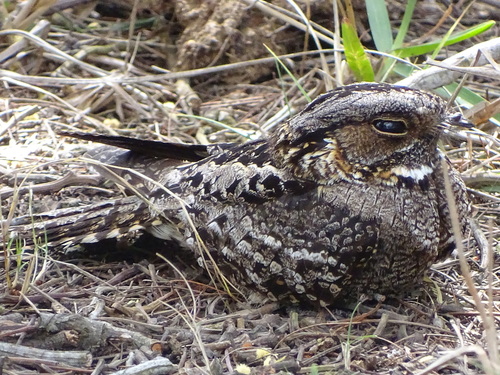 Fiery-necked Nightjar
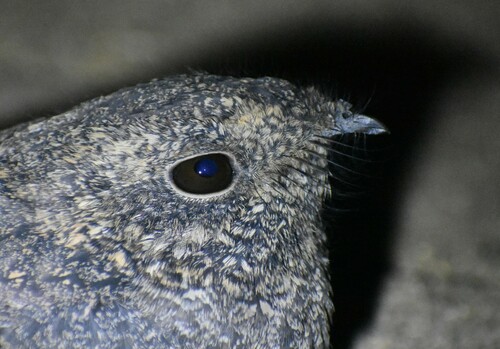 Freckled Nightjar
In short
The most reliable field mark to separate Fiery-necked Nightjar from Freckled Nightjar is the presence of a distinct rufous or tawny collar on the Fiery-necked, which is completely absent in Freckled. In flight, both species can show white spots on the outer primaries and tail, but the pattern and extent differ by sex and species. Structurally, Freckled Nightjar is noticeably larger and more robust, with longer wings and a shorter tail, while Fiery-necked is smaller and squarer-tailed. Habitat is also a strong clue: Fiery-necked is found in woodland savanna, while Freckled Nightjar prefers rocky outcrops and boulder fields. Both species are cryptically patterned, but close views reveal the Fiery-necked’s warmer tones and collar versus the Freckled’s overall darker, more freckled appearance.
Identification tips
- Rufous/tawny collar (Fiery-necked only): Look for a warm, tawny or rufous band across the nape and hindneck. Freckled Nightjar never shows this mark; if present, you have a Fiery-necked.
- Overall color and pattern: Fiery-necked is warmer and more variegated, with chestnut and tawny tones, a pale crown, and black scapular spots. Freckled is darker, more gray-black, with fine pale freckling and no warm tones or collar.
- White throat patch (Fiery-necked): A large, conspicuous white patch on the throat is typical of Fiery-necked and absent or much less distinct in Freckled.
- Facial markings: Fiery-necked has chestnut around the eyes and a pale crown with a dark central spot; Freckled’s face is plainer, blending into the rest of the plumage.
- Tail shape: Fiery-necked has a roughly square tail; Freckled’s tail is shorter relative to wing length, giving a more blunt-tailed look.
- White in wings and tail (sex-specific): Both species’ males have white spots on the four outer primaries and white tips to the two outer tail feathers, but in Fiery-necked these are larger and more obvious. Females of both have smaller, buffier or fewer white spots, but only Fiery-necked females show any white in the tail; Freckled females lack tail white entirely.
- Perched wing pattern: When perched, the white wing spots are generally hidden in both species, so do not rely on this mark unless the bird is in flight or stretching.
- Habitat context: On bare rock, boulders, or rocky slopes, suspect Freckled; in woodland leaf litter or under trees, suspect Fiery-necked.
- Size and structure: Freckled is noticeably larger and more robust, with longer wings and a shorter tail. Fiery-necked is smaller, lighter, and more evenly proportioned.
- Camouflage style: Freckled blends perfectly with rocks due to its freckled, gray-black plumage; Fiery-necked is better camouflaged in leaf litter, with its warmer, mottled tones.
- Behavior: Freckled often perches in exposed, open rocky sites and makes short sallies; Fiery-necked is more secretive and ground-dwelling in woodland.
- Bill and rictal bristles: Fiery-necked has long, pale-based rictal bristles around the bill, but this is rarely diagnostic in the field unless seen very close.
- Sexual dimorphism: If you can see the extent of white in the wings and tail, remember that females of both species have less white, but only Fiery-necked females show any tail white.
- Juvenile plumage: No field-diagnostic juvenile upperwing patterns are described for either species, so focus on adult marks.
- Vocalization: Not described in the provided notes, so do not rely on voice for separation here.
Size
Freckled Nightjar is substantially heavier (79g vs 54g) and appears larger and more powerfully built than Fiery-necked Nightjar. Freckled also has longer wings and a relatively shorter tail, giving it a more broad-winged, short-tailed look in flight or at rest. Fiery-necked is smaller overall, with a more balanced, square-tailed silhouette. If you see two nightjars together, the size and bulk difference is obvious, but beware of lone birds where size is harder to judge.
Plumage
No distinctive juvenile or immature upperwing patterns are described for either species, so focus is on adult plumage. Fiery-necked Nightjar has a unique rufous or tawny collar at the nape, a large white throat patch, and chestnut brown feathering around the eyes and shoulders. Its plumage is variegated gray-brown with black spots along the scapulars and a pale crown with a central dark spot. Males have white spots on the four outer primaries and white tips on the two outer tail feathers; females have smaller, buffier spots and less white in the tail. Freckled Nightjar lacks any collar or strong facial markings, appearing dark gray or nearly black at a distance, with fine white, cinnamon, and buff freckling on the upperparts. Underparts are dark brown with pale barring. In flight, males show small white spots on the four outer primaries and white tips on the two outer tail feathers; females have 3–4 smaller white spots on the primaries and no white in the tail. When perched, the white spots are usually hidden. Freckled Nightjar’s plumage is adapted for camouflage on rocks, while Fiery-necked blends into woodland leaf litter.
Behaviour
Freckled Nightjar is typically seen perched on rocks or boulders, often in open, exposed sites, and forages by making short sallies from these perches. Its flight is strong and direct, suited for open rocky landscapes. Fiery-necked Nightjar is more likely to be found on the ground in woodland or at the edge of clearings, and its behavior is less tied to rocky habitats. Both are crepuscular and nocturnal, but their choice of perching substrate and foraging style can be a clue.
Habitat
Fiery-necked Nightjar is found in woodland savannas and deciduous woodlands, rarely venturing into rocky or open ground. Freckled Nightjar, by contrast, is a specialist of rocky outcrops, boulder fields, and stony hillsides, often far from dense woodland. If you find a nightjar on bare rock or boulders, Freckled is far more likely; if in leaf litter or wooded ground, Fiery-necked is the default.