

Fairy Prion vs Antarctic Prion
Pachyptila turtur versus Pachyptila desolata
Play a quiz with Fairy Prion and Antarctic Prion
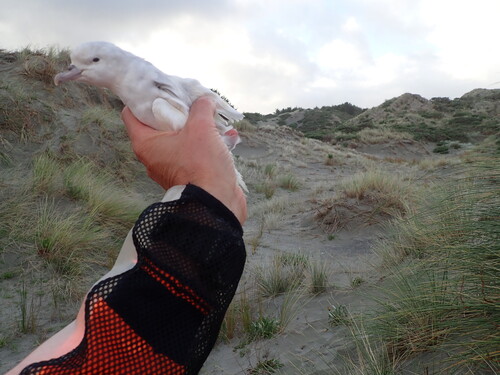 Fairy Prion
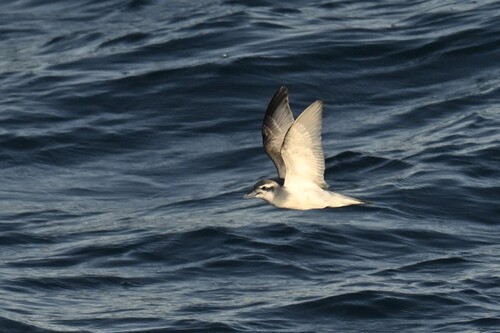 Antarctic Prion
In short
Fairy Prion and Antarctic Prion are extremely similar at sea, both showing blue-grey upperparts with a dark 'M' marking and white underparts, and both sexes look alike. The most reliable field mark is size: Antarctic Prion is distinctly larger and heavier, with a longer wingspan and slightly bulkier build. In direct comparison, Antarctic Prion also has darker greater coverts on the upperwing, but this is subtle and not always visible. Bill color and tail shape are nearly identical, and both species can be impossible to separate on brief or distant views. Separation is most feasible with prolonged, close observation or when size can be judged against known species.
Identification tips
- Size is the best field clue: Antarctic Prion is noticeably larger and heavier than Fairy Prion, with a longer wingspan. Use this only when you have a direct comparison or a good sense of scale.
- Upperwing contrast: Antarctic Prion's greater coverts are described as near black, which can make the upperwing look slightly more contrasting than Fairy Prion. This is subtle and may not be visible except in excellent light or close views.
- Bill color and shape: Both have pale blue or blue-grey bills of similar shape; this is not a useful field mark.
- Tail shape and pattern: Both species have a wedge-shaped tail with a dark tip. No difference here.
- Underparts: Both show clean white underparts with no distinctive marks to separate them.
- Facial markings: Antarctic Prion is said to have a white eyebrow, but this is not emphasized as a separation feature from Fairy Prion in the sources and may be present in both.
- Flight style: Both species have similar buoyant, gliding flight and often occur together in mixed flocks.
- Sex and age: Sexes are alike in both species. No age-specific field marks are described that separate juveniles or immatures.
- At sea, beware of confusion: Both species are so similar that even experts may not be able to separate them at sea except by size in direct comparison.
- Plumage pitfalls: Do not rely on the 'M' pattern, tail tip, or bill color—these are shared by both species.
- Context is not helpful: Both species overlap extensively in range and habitat, and both breed on remote southern islands.
- In photographs: Use size relative to other birds or objects if possible, but be cautious as angle and distance can mislead.
- Voice is not a field mark: No vocal differences are described or useful for separation at sea.
- If in doubt: If you cannot judge size or see the upperwing coverts well, it is safest to leave the bird as 'prion sp.' or note the uncertainty in your record.
- Comparison with other prions: Both are more similar to each other than to other prion species; do not confuse with Salvin's or Fulmar Prion, which have their own subtle differences.
Size
Antarctic Prion is the largest prion, averaging 156 g in body mass and measuring about 27 cm in length with a wingspan of 61–66 cm. Fairy Prion is smaller and lighter at 139 g, about 25 cm long with a 56 cm wingspan. In mixed flocks or side-by-side, Antarctic Prion appears noticeably bulkier and longer-winged, but alone, size can be deceptive due to posture and distance.
Plumage
Both species show the classic prion pattern: blue-grey upperparts with a dark 'M' extending across the back and wings, white underparts, and a wedge-shaped tail with a dark tip. Antarctic Prion's greater coverts are described as near black, which can give the upperwing a slightly more contrasting look, but this is subtle and not always apparent in the field. Both have a pale blue or blue-grey bill and blue feet. There are no described age-specific wing or tail patterns that reliably separate juveniles or immatures of these two species; both look similar at all ages. Sexes are alike in both species.
Behaviour
Both species feed by seizing planktonic crustaceans and small fish from the surface or by dipping their bills while flying. Their flight style is similar: buoyant, gliding low over the waves, often in large flocks. There are no behavioral differences noted that aid field identification between these two prions.
Habitat
Both Fairy and Antarctic Prions are pelagic, frequenting subantarctic and southern ocean waters. Both breed colonially on remote islands and are widespread within their ranges. Habitat overlap is extensive, and context is not helpful for separation.