

Eyebrowed Thrush vs Naumann's Thrush
Turdus obscurus versus Turdus naumanni
Play a quiz with Eyebrowed Thrush and Naumann's Thrush
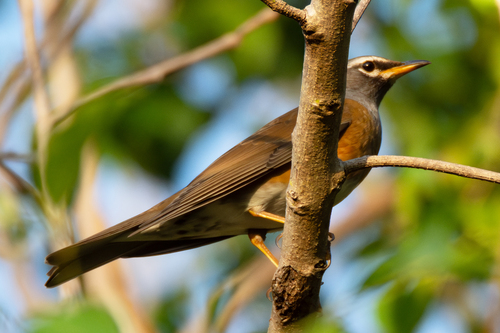 Eyebrowed Thrush
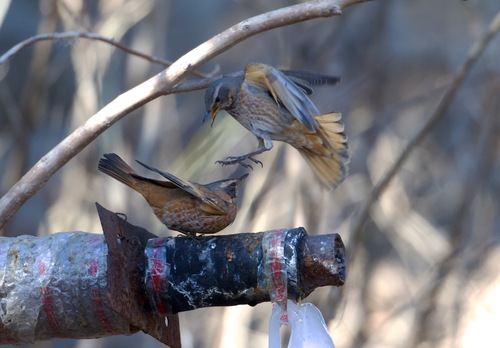 Naumann's Thrush
In short
The most reliable field mark between Eyebrowed Thrush and Naumann's Thrush is the color and pattern of the head and breast: Eyebrowed Thrush shows a grey head with a sharp black eyeline bordered by white, and a bright orange breast and flanks, while Naumann's Thrush has a pale brown head and back, with reddish face, breast, and flank spots. Both species have white bellies, but the distribution and intensity of orange or reddish tones on the underparts are key. Immature birds of both species are less distinctly marked, but Eyebrowed Thrush immatures are generally browner above. In flight or at rest, look for the presence or absence of a strong supercilium and the color of the underwing and rump for additional clues.
Identification tips
- Head pattern is key: Eyebrowed Thrush has a grey head with a sharp black eyeline, bordered by white above and below, creating a strong 'eyebrowed' look. Naumann's Thrush has a pale brown head and a less contrasting pale supercilium.
- Breast and flank color: Eyebrowed Thrush shows bright orange on the breast and flanks, sharply set off from the white belly. Naumann's Thrush has reddish (not orange) tones on the face, breast, and flank spots, which may appear patchier and less extensive than the solid orange of Eyebrowed.
- Back and rump: Eyebrowed Thrush has a grey back, while Naumann's is pale brown. Naumann's also shows reddish on the rump, absent in Eyebrowed.
- Underwing color in flight: Naumann's Thrush has reddish-brown underwings, which can be visible in flight or when the bird flicks its wings. This is not noted for Eyebrowed Thrush.
- Supercilium: Both species have a pale supercilium, but it is more pronounced and longer in Naumann's Thrush, often extending well behind the eye.
- Immature birds: Young Eyebrowed Thrushes are browner above and have a less crisp head pattern, but still show some orange on the flanks. Immature Naumann's Thrushes have weaker patterning overall, with less distinct reddish tones.
- Belly and undertail: Both have white bellies and undertail coverts, but Naumann's often shows a cleaner white with reddish spots or patches above, while Eyebrowed's orange is more confined to the breast and flanks.
- Structure and posture: Naumann's Thrush is described as stocky and reminiscent of a small fieldfare, but this is subtle and not always apparent in the field.
- Habitat context: In breeding season, Eyebrowed prefers dense coniferous forests, while Naumann's is more likely in open woodland. In winter, both can occur together, so do not rely on habitat alone.
- Sex differences: Both species show little sexual dimorphism in plumage; males and females are similar, so sex is not a useful separator.
- Song and calls: Eyebrowed Thrush has a simple whistling song; Naumann's song is not detailed here, so do not rely on voice for separation.
- Pitfalls: In poor light or at distance, the orange of Eyebrowed Thrush can appear reddish, and the reddish of Naumann's can look orange-brown. Always check the head pattern and underwing color if possible.
- Flock composition: Both species may join mixed thrush flocks in winter, so check each individual carefully, especially in East Asia.
- Seasonal variation: Both species are migratory and may appear outside their breeding ranges in winter; immature birds are more likely to be misidentified due to duller and less distinct markings.
- No strong size difference: Do not rely on size or bulk to separate these two; both are similar in overall dimensions.
Size
Eyebrowed Thrush averages 63g in body mass, which is typical for a medium-sized thrush. Naumann's Thrush is described as a medium-sized but stocky thrush, similar in structure to a small fieldfare, but no direct mass figure is available. In the field, size differences are subtle and not reliable for separation; both are similar in overall bulk and length.
Plumage
For adults, Eyebrowed Thrush is distinctive with its grey back and head, a sharp black eyeline bordered by white above and below, and bright orange on the breast and flanks. The belly is white. Naumann's Thrush, by contrast, has a pale brown back and head, with reddish tones on the face, breast, flank spots, and rump, and a white belly and undertail. Both have a pale supercilium, but it is more pronounced in Naumann's. Immature Eyebrowed Thrushes have a browner back and less crisp head pattern, while immature Naumann's show weaker patterning overall. In flight, Naumann's Thrush shows reddish-brown underwings, which is not noted for Eyebrowed Thrush. No distinctive juvenile upperwing patterns are described for either species, so focus on head and underpart color for all ages.
Behaviour
Both species are migratory and may be seen in flocks during migration or winter. Naumann's Thrush is described as stocky and reminiscent of a small fieldfare, which may translate to a slightly chunkier appearance and posture. Both species forage on the ground and in trees, often in mixed flocks with other thrushes in winter. Behavioral differences are not strongly diagnostic in the field.
Habitat
Eyebrowed Thrush breeds in dense coniferous forests and taiga from Siberia and Mongolia to Japan, while Naumann's Thrush breeds in open woodland areas from central Siberia to North Manchuria, Amurland, and Sakhalin. Both winter in East and Southeast Asia, especially China. In winter, both may occur in similar lowland habitats, so habitat is not a reliable separator outside the breeding season.
Voice
Eyebrowed Thrush males have a simple whistling song, similar to mistle thrush. Naumann's Thrush's song is not described in detail here, but is noted to differ from the simple fluted or whistling song of the closely related Dusky Thrush. Vocalizations are not diagnostic with the information available.