

Motmot

Evening Grosbeak vs Hawfinch

Hesperiphona vespertina versus Coccothraustes coccothraustes

Play a quiz with Evening Grosbeak and Hawfinch
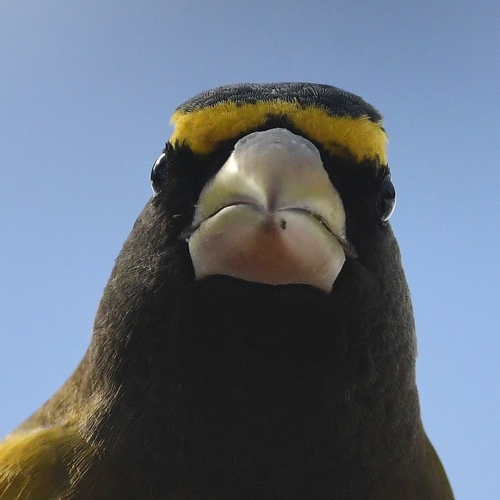
Evening Grosbeak (Hesperiphona vespertina) Evening Grosbeak
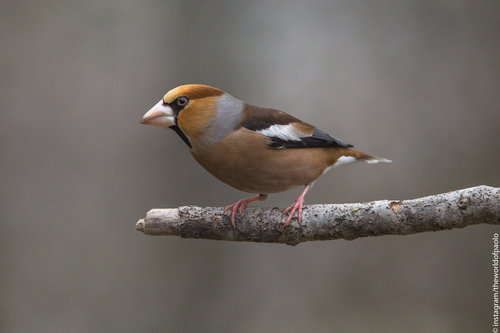
Hawfinch (Coccothraustes coccothraustes) Hawfinch

Media

Loading…

In short

The most reliable field mark to separate Evening Grosbeak from Hawfinch is the presence of a bright yellow forehead and body (male Evening Grosbeak) or olive-brown tones with white wing patches (female Evening Grosbeak), versus the Hawfinch’s orange-brown head with a black eyestripe and bib, and overall light brown body. Both are bulky finches with massive bills and short tails, but the Evening Grosbeak is generally bulkier and shows more striking white in the wings, especially in flight. Hawfinch has a distinctive black mask and bib, and its wing pattern includes a combination of white, brown, and blue stripes. Sexes are more similar in Hawfinch, while male Evening Grosbeak is much brighter than the female. Both species may be confused in silhouette or structure, but careful attention to head pattern and wing markings will resolve most field encounters.

Identification tips

  1. Head pattern is key: Evening Grosbeak males have a bright yellow forehead and brown head, while Hawfinch has a uniform orange-brown head with a bold black eyestripe and bib—never yellow. Female Evening Grosbeak is olive-brown with a pale bill and lacks the black mask of Hawfinch.
  2. Wing markings in flight: Evening Grosbeak shows a large, bold white patch in the wing (both sexes), while Hawfinch has a white wing bar plus brown and blue stripes—look for the multi-colored effect in Hawfinch versus the single white patch in Evening Grosbeak.
  3. Bill color and shape: Both have massive bills, but Evening Grosbeak’s is always pale and slightly more swollen, while Hawfinch’s is metallic and turns paler only in winter. In summer, Hawfinch’s bill is blackish.
  4. Body color: Male Evening Grosbeak is bright yellow on the body; Hawfinch is never yellow, always light brown to orange-brown. Female Evening Grosbeak is olive-brown, while female Hawfinch is paler brown but still has the black mask and bib.
  5. Tail length and shape: Both have short tails, but Hawfinch’s tail appears even shorter and is tipped white in flight. Evening Grosbeak’s tail is black and less obviously tipped.
  6. Sexual dimorphism: Evening Grosbeak shows strong sexual dimorphism (male bright, female dull), while Hawfinch sexes are similar, with females only slightly paler.
  7. Eye color and facial markings: Hawfinch has brown eyes with a black circle around them, forming a mask; Evening Grosbeak lacks this feature.
  8. Voice: Listen for the loud 'chew' of Evening Grosbeak versus the hard 'chick' and quiet song of Hawfinch.
  9. Habitat context: In North America, Hawfinch is a vagrant; in Europe/Asia, Evening Grosbeak does not occur. If you are in North America, a bulky finch with a black mask is almost certainly not a Hawfinch.
  10. Behavior at feeders: Evening Grosbeak is much more likely to visit feeders in winter, often in large flocks; Hawfinch is rarely seen at feeders and prefers the canopy.
  11. Flight style: Both are direct and heavy in flight, but Hawfinch may appear even more compact due to its shorter tail.
  12. Plumage pitfalls: Female Evening Grosbeak and female Hawfinch can be confused at a distance, but only Hawfinch has the black mask and bib; only Evening Grosbeak shows a strong white wing patch without the multi-color effect.
  13. Seasonal changes: Hawfinch’s bill color changes with season (blackish in summer, pale in winter); Evening Grosbeak’s bill remains pale year-round.
  14. Group size: Evening Grosbeak often in larger, noisier flocks; Hawfinch usually in pairs or small, quiet groups.
  15. Geographic range: Use range as a final check—Hawfinch is absent from North America except as an extreme rarity, Evening Grosbeak does not occur in Europe/Asia.

Size

Both species are robust, large-billed finches with short tails and a heavy, bull-headed look. Evening Grosbeak averages slightly heavier (body mass ~59 g [wikidata]) than Hawfinch (46–70 g [wikipedia]), and is a bit longer (16–22 cm Evening Grosbeak vs. 16.5–18 cm Hawfinch). In the hand or with experience, Evening Grosbeak often feels bulkier, but in the field, size overlap is substantial. Both have similar wingspans (Evening Grosbeak 30–36 cm, Hawfinch 29–33 cm). Bill size is massive in both, but Hawfinch’s bill is more conical and metallic, turning paler in winter, while Evening Grosbeak’s is always pale and slightly more swollen at the base.

Plumage

No age-specific juvenile or first-winter upperwing patterns are described for either species, so focus is on adult and female/immature contrasts. Adult male Evening Grosbeak is unmistakable with a bright yellow forehead and body, brown head, and large white wing patches. Adult female Evening Grosbeak is olive-brown above, greyer below, with white wing patches—less vivid but still showing strong contrast in the wings. Hawfinch of both sexes has an orange-brown head with a black eyestripe and bib, light brown body, and a complex wing pattern: deep black primaries with white, brown, and blue stripes, plus a white tail tip. The Hawfinch’s head pattern is diagnostic: black mask and bib, grey nape, and brown eyes. In flight, both show white in the wings, but Evening Grosbeak’s is a bold patch, while Hawfinch’s is a bar plus additional color stripes. Female Hawfinch is paler but still shows the same head pattern. Immature birds are not described in detail, but no unique upperwing marks are noted for either species.

Behaviour

Both species are typically seen in pairs or small groups, often foraging in trees for seeds and fruits. Evening Grosbeak can form larger winter flocks, especially at feeders, and is more likely to be seen in mixed coniferous forests. Hawfinch tends to be more secretive, often staying high in the canopy and less likely to visit feeders. Both have a heavy, direct flight with short tails appearing even shorter in flight. Hawfinch is generally more solitary or in small groups, while Evening Grosbeak can be quite gregarious in winter.

Habitat

Evening Grosbeak is found in coniferous and mixed forests of North America, often venturing into towns and suburbs in winter, especially where feeders are present. Hawfinch is a bird of deciduous and mixed woodlands across Europe and temperate Asia, favoring areas with large trees (especially hornbeam) and is rarely found outside mature woodland or parkland. While both can be seen in mixed forests, their ranges do not overlap except as rare vagrants, and Hawfinch is not a regular visitor to North American habitats.

Voice

Evening Grosbeak gives a loud, distinctive 'chew' call, which is sharper and more metallic than a House Sparrow’s. Hawfinch’s call is a hard 'chick', and its song is a quiet, mumbled series of notes, often difficult to hear. The Evening Grosbeak’s call is more likely to draw attention, while Hawfinch is generally quieter and less vocal, especially outside the breeding season.

Submit a better description

Use the same sections as the comparison. Your text is published immediately.

The most reliable field mark to separate Evening Grosbeak from Hawfinch is the presence of a bright yellow forehead and body (male Evening Grosbeak) or olive-brown tones with white wing patches (female Evening Grosbeak), versus the Hawfinch’s orange-brown head with a black eyestripe and bib, and overall light brown body. Both are bulky finches with massive bills and short tails, but the Evening Grosbeak is generally bulkier and shows more striking white in the wings, especially in flight. Hawfinch has a distinctive black mask and bib, and its wing pattern includes a combination of white, brown, and blue stripes. Sexes are more similar in Hawfinch, while male Evening Grosbeak is much brighter than the female. Both species may be confused in silhouette or structure, but careful attention to head pattern and wing markings will resolve most field encounters.

  1. Head pattern is key: Evening Grosbeak males have a bright yellow forehead and brown head, while Hawfinch has a uniform orange-brown head with a bold black eyestripe and bib—never yellow. Female Evening Grosbeak is olive-brown with a pale bill and lacks the black mask of Hawfinch.
  2. Wing markings in flight: Evening Grosbeak shows a large, bold white patch in the wing (both sexes), while Hawfinch has a white wing bar plus brown and blue stripes—look for the multi-colored effect in Hawfinch versus the single white patch in Evening Grosbeak.
  3. Bill color and shape: Both have massive bills, but Evening Grosbeak’s is always pale and slightly more swollen, while Hawfinch’s is metallic and turns paler only in winter. In summer, Hawfinch’s bill is blackish.
  4. Body color: Male Evening Grosbeak is bright yellow on the body; Hawfinch is never yellow, always light brown to orange-brown. Female Evening Grosbeak is olive-brown, while female Hawfinch is paler brown but still has the black mask and bib.
  5. Tail length and shape: Both have short tails, but Hawfinch’s tail appears even shorter and is tipped white in flight. Evening Grosbeak’s tail is black and less obviously tipped.
  6. Sexual dimorphism: Evening Grosbeak shows strong sexual dimorphism (male bright, female dull), while Hawfinch sexes are similar, with females only slightly paler.
  7. Eye color and facial markings: Hawfinch has brown eyes with a black circle around them, forming a mask; Evening Grosbeak lacks this feature.
  8. Voice: Listen for the loud 'chew' of Evening Grosbeak versus the hard 'chick' and quiet song of Hawfinch.
  9. Habitat context: In North America, Hawfinch is a vagrant; in Europe/Asia, Evening Grosbeak does not occur. If you are in North America, a bulky finch with a black mask is almost certainly not a Hawfinch.
  10. Behavior at feeders: Evening Grosbeak is much more likely to visit feeders in winter, often in large flocks; Hawfinch is rarely seen at feeders and prefers the canopy.
  11. Flight style: Both are direct and heavy in flight, but Hawfinch may appear even more compact due to its shorter tail.
  12. Plumage pitfalls: Female Evening Grosbeak and female Hawfinch can be confused at a distance, but only Hawfinch has the black mask and bib; only Evening Grosbeak shows a strong white wing patch without the multi-color effect.
  13. Seasonal changes: Hawfinch’s bill color changes with season (blackish in summer, pale in winter); Evening Grosbeak’s bill remains pale year-round.
  14. Group size: Evening Grosbeak often in larger, noisier flocks; Hawfinch usually in pairs or small, quiet groups.
  15. Geographic range: Use range as a final check—Hawfinch is absent from North America except as an extreme rarity, Evening Grosbeak does not occur in Europe/Asia.

Both species are robust, large-billed finches with short tails and a heavy, bull-headed look. Evening Grosbeak averages slightly heavier (body mass ~59 g [wikidata]) than Hawfinch (46–70 g [wikipedia]), and is a bit longer (16–22 cm Evening Grosbeak vs. 16.5–18 cm Hawfinch). In the hand or with experience, Evening Grosbeak often feels bulkier, but in the field, size overlap is substantial. Both have similar wingspans (Evening Grosbeak 30–36 cm, Hawfinch 29–33 cm). Bill size is massive in both, but Hawfinch’s bill is more conical and metallic, turning paler in winter, while Evening Grosbeak’s is always pale and slightly more swollen at the base.

No age-specific juvenile or first-winter upperwing patterns are described for either species, so focus is on adult and female/immature contrasts. Adult male Evening Grosbeak is unmistakable with a bright yellow forehead and body, brown head, and large white wing patches. Adult female Evening Grosbeak is olive-brown above, greyer below, with white wing patches—less vivid but still showing strong contrast in the wings. Hawfinch of both sexes has an orange-brown head with a black eyestripe and bib, light brown body, and a complex wing pattern: deep black primaries with white, brown, and blue stripes, plus a white tail tip. The Hawfinch’s head pattern is diagnostic: black mask and bib, grey nape, and brown eyes. In flight, both show white in the wings, but Evening Grosbeak’s is a bold patch, while Hawfinch’s is a bar plus additional color stripes. Female Hawfinch is paler but still shows the same head pattern. Immature birds are not described in detail, but no unique upperwing marks are noted for either species.

Both species are typically seen in pairs or small groups, often foraging in trees for seeds and fruits. Evening Grosbeak can form larger winter flocks, especially at feeders, and is more likely to be seen in mixed coniferous forests. Hawfinch tends to be more secretive, often staying high in the canopy and less likely to visit feeders. Both have a heavy, direct flight with short tails appearing even shorter in flight. Hawfinch is generally more solitary or in small groups, while Evening Grosbeak can be quite gregarious in winter.

Evening Grosbeak is found in coniferous and mixed forests of North America, often venturing into towns and suburbs in winter, especially where feeders are present. Hawfinch is a bird of deciduous and mixed woodlands across Europe and temperate Asia, favoring areas with large trees (especially hornbeam) and is rarely found outside mature woodland or parkland. While both can be seen in mixed forests, their ranges do not overlap except as rare vagrants, and Hawfinch is not a regular visitor to North American habitats.

Evening Grosbeak gives a loud, distinctive 'chew' call, which is sharper and more metallic than a House Sparrow’s. Hawfinch’s call is a hard 'chick', and its song is a quiet, mumbled series of notes, often difficult to hear. The Evening Grosbeak’s call is more likely to draw attention, while Hawfinch is generally quieter and less vocal, especially outside the breeding season.

Discard your changes?

You have unsaved edits. If you leave now, those changes will be lost.

Evening Grosbeak · Hawfinch · My Tricky Birds