

European Turtle Dove vs Atlantic Canary
Streptopelia turtur versus Serinus canaria
Play a quiz with European Turtle Dove and Atlantic Canary
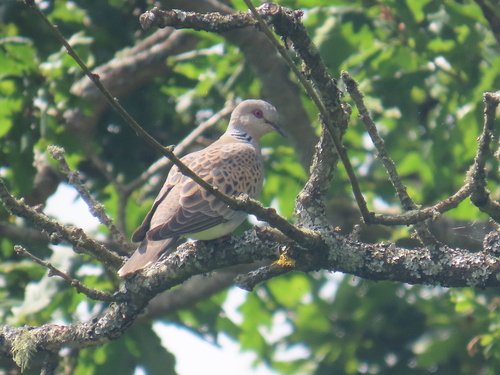 European Turtle Dove
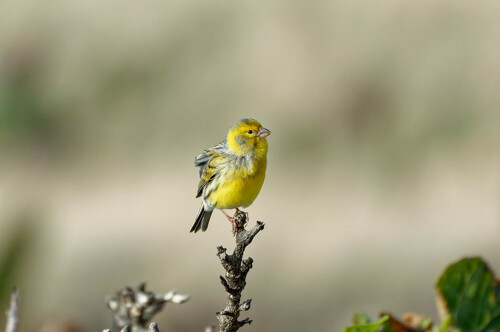 Atlantic Canary
In short
The most reliable field mark to separate European Turtle Dove from Atlantic Canary is size and structure: Turtle Dove is a medium-sized, slender pigeon with a long, wedge-shaped tail, while Atlantic Canary is a much smaller, short-tailed finch. In flight, Turtle Dove shows a distinctive white-bordered, wedge-shaped tail and, in adults, a black-and-white neck patch; canaries never show these features. Juvenile Turtle Doves lack the neck patch but are still much larger and browner than any canary. If you see a small, streaky, yellowish-green bird with a finch-like bill, it's a canary; a larger, brownish, long-tailed bird with a pigeon jizz is a Turtle Dove.
Identification tips
- Size is the first check: Turtle Dove is nearly ten times heavier than Atlantic Canary. If the bird looks pigeon-sized, it's not a canary.
- Tail shape in flight: Turtle Dove of all ages shows a long, wedge-shaped tail with white edges and tips—very obvious when the bird flushes or stoops to drink. Canaries have a short, notched tail with no white wedge.
- Bill shape: Turtle Dove has a typical pigeon bill—slender, slightly decurved, and dark. Canary has a short, conical, finch-like bill, pale or horn-colored.
- Neck patch (adults only): Adult Turtle Doves show a bold black-and-white striped patch on the side of the neck. This is never present in canaries or juvenile Turtle Doves.
- Head and body color: Turtle Dove adults have a blue-grey head and rump, cinnamon-brown wings mottled with black, and a vinaceous breast. Canaries are yellow-green with a yellower face (males), streaked brown upperparts, and a dull yellow rump.
- Juvenile confusion: Juvenile Turtle Doves are brown and lack the neck patch, but are still much larger and have a pigeon jizz. Juvenile canaries are brown and streaky, but always small, with a finch structure.
- Undertail pattern: Turtle Dove shows white undertail coverts and a blackish chevron pattern when viewed from below, especially when the tail is spread. Canaries have pale undertail coverts with no chevron or wedge.
- Leg color: Adult Turtle Doves have red legs and eye-rings; juveniles have brown legs. Canaries have pale or pinkish legs, never red.
- Flight style: Turtle Dove's flight is straight and arrow-like, often with a burst when flushed. Canary's flight is undulating and more erratic, typical of finches.
- Perched posture: Turtle Doves perch upright, with a long tail often drooping below the branch. Canaries perch more horizontally, with a short tail and compact body.
- Voice: Turtle Dove gives a soft, rolling coo; canary gives a rapid, silvery twitter. Use this if the bird is singing or calling.
- Habitat and context: In continental Europe, Turtle Dove is a migrant in open woodland and farmland; wild canaries are only native to Macaronesia. In gardens or parks in Europe, a canary is likely an escapee.
- Flock size: Turtle Doves are usually solitary or in pairs, rarely in large groups. Canaries are often in small flocks, especially outside the breeding season.
- Eye color: Turtle Dove adults have red eye-rings; canaries have dark eyes with no colored ring.
- Seasonal presence: Turtle Dove is a late spring/summer migrant in Europe, absent in winter. Canaries (wild) are resident in their native islands; feral birds may be seen year-round in urban areas.
Size
European Turtle Dove is dramatically larger and heavier than Atlantic Canary: Turtle Dove averages 136 g, with a length of 26–28 cm and a wingspan of 47–53 cm. In contrast, Atlantic Canary averages only 15.3 g, with a length of 10–12 cm and a wingspan of 21–23.7 cm. Even at a distance, Turtle Dove's pigeon-like bulk and long tail stand out against the much smaller, rounder, and more delicate canary. There is no overlap in size; even the largest canary is dwarfed by the smallest Turtle Dove.
Plumage
Juvenile Turtle Doves are brown and dull, lacking the adult's black-and-white neck patch, but still show a long, wedge-shaped tail with white edges and tips in flight—this is visible in all ages and is unique among pigeons and absent in canaries. Adult Turtle Doves have a blue-grey head, cinnamon-brown and black-mottled wings, a vinaceous breast, and a diagnostic black-and-white striped neck patch. Atlantic Canaries, by contrast, are yellow-green with brownish streaking above, a yellow face (especially in males), and a short, notched tail. Juvenile canaries are brown and streaky overall, but always much smaller, with a finch-like bill and no neck pattern. The canary's upperparts are streaked, and the underparts are pale with streaks on the sides, never showing the Turtle Dove's clean white undertail coverts or wedge-shaped tail pattern.
Behaviour
Turtle Doves often feed on the ground in open areas, walking with a pigeon-like gait, and are typically shy and quick to flush. Their flight is described as arrow-like but not especially fast, with a distinctive high, circling nuptial display. Atlantic Canaries are active, agile, and often seen flitting in bushes or trees, rarely on the ground for long. Their flight is undulating and finch-like, and they are much more likely to be seen in small flocks or pairs, often singing from exposed perches.
Habitat
European Turtle Dove prefers open woodlands, edges, and sometimes large gardens, but is generally shy and avoids dense forests. It breeds across much of Europe, the Middle East, and North Africa, migrating to sub-Saharan Africa in winter. Atlantic Canary is native to the Canary Islands, Madeira, and the Azores, where it inhabits a range of habitats from open woodland to cultivated areas and gardens, often at lower elevations. In Europe, wild canaries are not native except as cage escapees; any canary seen outside Macaronesia is likely feral or escaped.
Voice
Turtle Dove has a soft, purring, mournful coo, typical of pigeons and doves, and never produces a finch-like twitter. Atlantic Canary is known for its silvery, rapid twittering song, reminiscent of other finches such as the European serin. If you hear a melodious, high-pitched twitter, it's a canary; a deep, rolling coo points to Turtle Dove.