

European Bee-eater vs European Roller
Merops apiaster versus Coracias garrulus
Play a quiz with European Bee-eater and European Roller
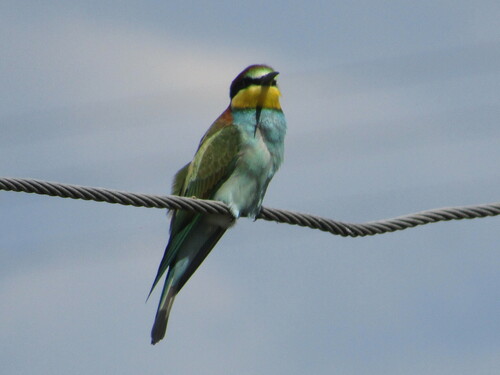 European Bee-eater
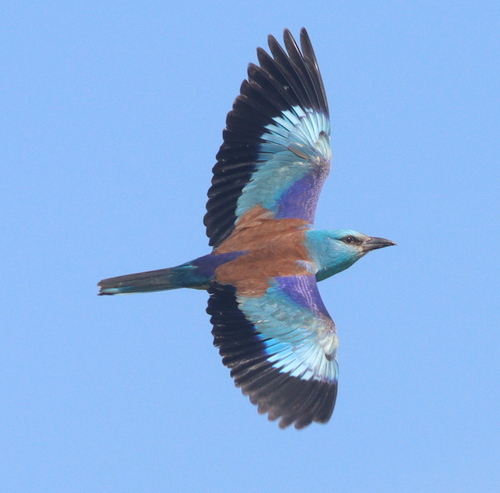 European Roller
In short
The most reliable field mark is overall structure and coloration: European Bee-eater is a slender, long-tailed bird with rich chestnut, yellow, and green plumage, while European Roller is a stocky, broad-headed bird, mainly blue with an orange-brown back. In flight, Bee-eater shows pointed wings and elongated central tail feathers (in adults), whereas Roller appears heavier with broad wings and a square tail. Juvenile Bee-eaters lack the long tail streamers and are duller, but still more slender and multicolored than the uniformly blue Roller. Voice is also a strong separator: Bee-eater gives soft, rolling calls, while Roller is harsh and crow-like.
Identification tips
- Structure in flight: Bee-eater is slender with pointed wings and, in adults, long central tail streamers; Roller is stocky, with broad wings and a square tail. Juvenile Bee-eater lacks streamers but remains slim.
- Bill shape: Bee-eater has a long, gently decurved black bill; Roller has a heavy, straight, dark bill with a hooked tip, much thicker in profile.
- Color pattern: Bee-eater shows a combination of chestnut, yellow, and green (with blue underparts), never mostly blue; Roller is mainly blue with an orange-brown back and blue-black flight feather tips.
- Tail shape: Adult Bee-eater's long, thin central tail feathers are unique; absent in juveniles and non-breeding birds, but tail still appears longer and more tapered than Roller's square-cut tail.
- Head and jizz: Roller has a large, broad head and heavy neck, giving a bull-headed look; Bee-eater is more delicate and streamlined.
- Perched posture: Bee-eater perches upright and lightly, often in groups; Roller sits heavily, often alone or in pairs.
- Upperwing in flight: Roller shows blue upperwings with blue-black tips; Bee-eater's wings are greenish with brown and yellow tones, lacking the blue-black contrast.
- Juvenile confusion: Juvenile Bee-eater is duller and lacks tail streamers, but still shows a mix of colors and a slimmer build than juvenile Roller, which is uniformly blue with a brown back.
- Voice: Bee-eater gives soft, trilling calls; Roller is harsh and crow-like. Listen for these when birds are hidden or distant.
- Habitat context: Bee-eater is often near water, in sandy banks, or open farmland, usually in groups; Roller prefers dry, open woodland or farmland with large trees, often solitary.
- Group behavior: Flocks or groups on wires or banks point to Bee-eater; solitary or paired birds on prominent perches suggest Roller.
- Seasonal changes: Bee-eater's non-breeding and juvenile plumages are duller but never as blue as Roller; Roller's plumage is consistent year-round, only slightly duller in juveniles.
- Flight style: Bee-eater is agile, with buoyant, rapid wingbeats and glides; Roller is powerful and direct, with broad-winged, heavy flight.
- Size impression: Roller is larger and bulkier, comparable to a jay; Bee-eater is smaller and more delicate, closer to a starling in size.
- Pitfalls: Distant or backlit views can obscure color; rely on structure, tail shape, and voice if plumage is unclear.
Size
European Roller is noticeably larger and bulkier than European Bee-eater. Roller measures 29–32 cm in length with a 52–58 cm wingspan, while Bee-eater is 27–29 cm long (including its elongated central tail feathers) and averages 52 g in weight. Roller's heavier build, broader wings, and larger head are obvious in direct comparison, especially in flight or when perched side-by-side. Bee-eater is more slender, with a finer bill and longer, thinner tail (especially in adults).
Plumage
Juvenile and non-breeding Bee-eaters are duller than adults, with blue-green backs and lacking the long central tail feathers, but still show a mix of brown, yellow, and green tones. Juvenile Rollers are a drabber version of the adult but remain mostly blue with a brown back, lacking the Bee-eater's multicolored appearance. Adult Bee-eaters have chestnut and yellow upperparts, green wings, and a black bill, with elongated tail streamers in breeding plumage. Adult Rollers are strikingly blue with an orange-brown back and blue-black flight feather tips, especially obvious in flight. Both sexes are similar in both species. Bee-eater's non-breeding and juvenile plumages can be confused with Roller at a distance, but the Roller never shows the Bee-eater's rich color variety or tail streamers.
Behaviour
Bee-eaters are agile and graceful in flight, often seen sallying after insects with rapid, pointed wingbeats and long glides. They perch upright on wires or exposed branches, often in groups. Rollers have a strong, direct flight with broad, rounded wings and are known for their acrobatic aerial displays with twists and turns. Rollers perch more heavily on prominent branches or wires, often singly or in pairs, and appear more robust and less delicate than Bee-eaters.
Habitat
Both species favor open country with scattered trees, but Bee-eaters are more likely to be seen in open, sandy areas, riverbanks, or farmland, often near water, and frequently in groups. Rollers prefer dry, open woodland, savanna, or farmland with large trees for nesting and perching, and are less tied to water. Bee-eaters often nest colonially in banks; Rollers use tree cavities. Overlap is common in southern Europe and parts of Africa, but Bee-eater is more widespread in Europe.
Voice
Bee-eater gives soft, rolling, liquid calls, often heard as 'prrrt' or 'trill' notes, especially in flight or when perched in groups. Roller has a harsh, crow-like call, described as a raucous series of harsh notes, especially when alarmed. The difference is striking: Bee-eater sounds musical and gentle, Roller is loud and grating.