
Eurasian Wigeon vs Eurasian/Green-winged Teal
Mareca penelope versus Anas crecca
Play a quiz with Eurasian Wigeon and Eurasian/Green-winged Teal
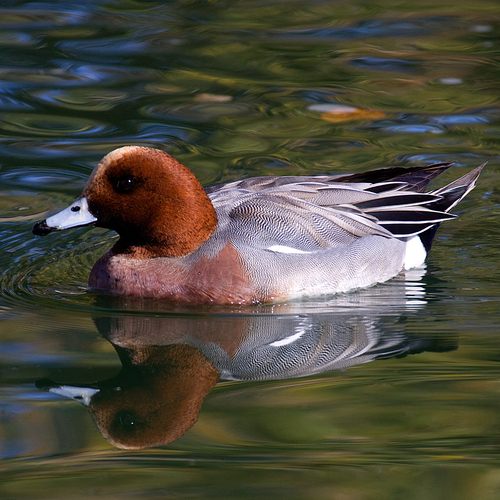 Eurasian Wigeon
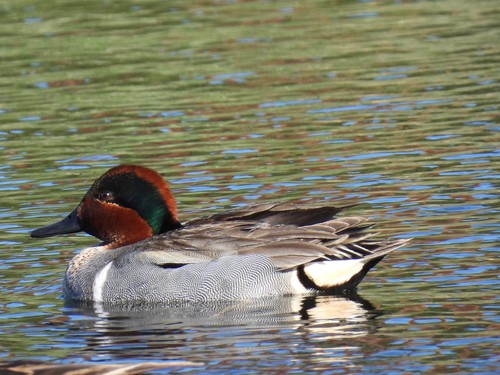 Eurasian/Green-winged Teal
In short
The most reliable field mark to separate Eurasian Wigeon from Eurasian/Green-winged Teal is size: Wigeon is much larger and bulkier, both at rest and in flight. In flight, adult male Wigeon show a bold white upperwing patch, while Teal have a narrower white bar and a more compact, fast-winged jizz. Female and immature birds can be tricky, but Wigeon always appears larger, with a rounder head and stouter bill. Teal, even as juveniles, are distinctly smaller and show a yellowish patch at the tail sides. Use these structural and wing pattern differences first, especially when viewing flocks or birds in flight.
Identification tips
- Size is the first check: Wigeon is much larger and bulkier than Teal in all plumages and at all ages. If you see a small dabbling duck, it's unlikely to be a Wigeon.
- White upperwing patch (Wigeon adult males): In flight or at rest, male Wigeon show a broad, brilliant white patch on the upperwing. Teal have a green speculum with white tips, but the white is much less extensive and not as obvious at a distance.
- Yellowish tail patch (Teal all ages/sexes): Teal show a bright yellowish-buff triangular patch at the tail sides, visible in both sexes and ages, especially in flight or when preening. Wigeon never shows this feature.
- Head pattern (breeding males): Wigeon males have a chestnut head with a pale creamy crown; Teal males have a chestnut head with a broad green eye patch bordered by yellowish-white lines and a vertical white stripe on the flanks.
- Female/immature plumage: Teal females and immatures are mottled brown with a dark eyestripe and scaly pattern, plus the yellowish tail patch. Wigeon females are plainer, more uniform light brown or grayish, and lack the tail patch. Both can be confused with other dabbling ducks, but size and structure help.
- Bill shape: Wigeon has a stouter, shorter bill compared to the more slender Teal bill. This is subtle but visible at close range.
- Flight jizz: Wigeon flies with slower, more deliberate wingbeats and appears broad-winged and steady. Teal are fast, agile, and twisty in flight, often in tight flocks.
- Feeding behavior: Wigeon often graze on land in groups, while Teal are more likely to dabble at the water's edge or in shallow pools.
- Voice: Teal are much more vocal, with sharp whistles and quacks, especially when flushed. Wigeon males have a high-pitched whistle, but are generally quieter.
- Habitat context: In open fields or grassy shores, expect Wigeon. In muddy, shallow, or vegetated wetlands, Teal are more likely, though both can overlap.
- Eclipse plumage: Both species' males resemble females in eclipse, but Wigeon remains larger and bulkier, with a rounder head and stouter bill. Teal in eclipse still show the yellowish tail patch and smaller size.
- Mixed flocks: In mixed dabbling duck flocks, look for the smallest birds (Teal) and the largest (Wigeon). Size and structure are reliable even when plumage is confusing.
- Underwing pattern: Teal underwing is whitish with dense dark spotting on inner coverts and a dark leading edge; Wigeon underwing is less patterned but this is subtle and rarely diagnostic in the field.
- Juvenile confusion: Juvenile Teal are strongly patterned and tiny, with the yellowish tail patch. Juvenile Wigeon are larger, plainer, and lack the tail patch.
- Seasonal context: In autumn and winter, eclipse and juvenile plumages dominate. Use size, structure, and tail patch as primary checks, as head and flank patterns are less reliable.
Size
Eurasian Wigeon is substantially larger: 42–52 cm long with a 71–80 cm wingspan and weight of 500–1,073 g [wikipedia]. Eurasian/Green-winged Teal is much smaller, at 34–43 cm length, 53–59 cm wingspan, and average weight around 340–360 g [wikipedia]. Side-by-side, Wigeon looks almost goose-like compared to the dainty, compact Teal. This size gap is obvious even at a distance or in mixed flocks.
Plumage
-
Juvenile and immature birds: Teal of all ages are much smaller and show a yellowish-buff triangular patch at the tail sides, visible both at rest and in flight. Wigeon immatures lack this feature. Female and immature Teal are mottled brown with a dark eyestripe and scaly pattern, while Wigeon females are plainer, with a more uniform light brown or grayish look (sometimes rufous-headed or gray-morph).
-
Adult breeding males: Wigeon males have a chestnut head with a creamy crown, pink breast, and grey flanks, plus a bold white upperwing patch (visible at rest and in flight). Teal males have a chestnut head with a broad iridescent green eye patch bordered by thin yellowish-white lines, a vertical white stripe along the flanks, and a yellowish patch at the tail sides. Teal's upperwing has a green speculum with white tips, but the white is less extensive than Wigeon's upperwing patch.
-
Non-breeding (eclipse) males and females: Both species' males resemble females in eclipse. Wigeon eclipse males are more uniform brown, similar to females, but still larger and bulkier than Teal. Teal females and eclipse males retain the yellowish tail patch and scaly body pattern. Wigeon females are plainer, lacking strong facial markings or tail patches.
Behaviour
Wigeon often graze on land in tight, upright groups and move with a more waddling gait. In flight, they appear broad-winged and steady, with slower wingbeats. Teal are much more agile and quick, taking off almost vertically and flying in tight, twisting flocks with rapid wingbeats. On water, Teal are more buoyant and active, often dabbling or feeding at the surface, while Wigeon may be seen grazing on grass or resting in open water.
Habitat
Both species overlap in wetland habitats, but Wigeon are more likely to be found grazing on grassy shorelines or in open fields near water, especially in winter. Teal prefer shallow ponds, marshes, and flooded meadows, often sticking closer to dense cover or muddy edges. In mixed flocks, Teal will be the smallest dabbling duck present, while Wigeon will stand out for their size and tendency to feed on land.
Voice
Teal are notably more vocal, with drakes giving a clear, whistled "cryc" or "creelycc" and females producing a sharp "keh" or "neeh" quack. Wigeon males have a distinctive, high-pitched, two- or three-note whistle, while females are quieter and less likely to call in the open. Teal's calls are higher-pitched and more frequent, especially in flight or when flushed.
Eurasian Wigeon · Eurasian/Green-winged Teal · My Tricky Birds