

Eurasian Wigeon vs Common Pochard
Mareca penelope versus Aythya ferina
Play a quiz with Eurasian Wigeon and Common Pochard
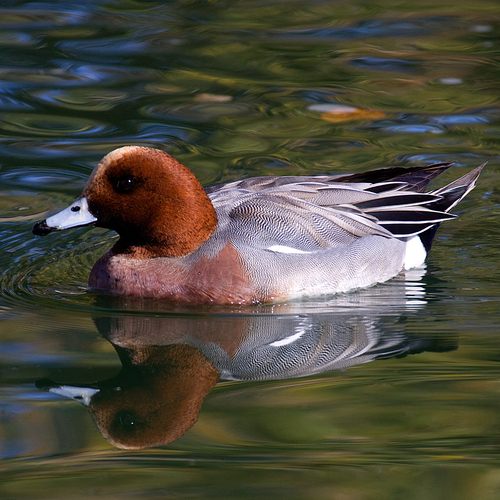 Eurasian Wigeon
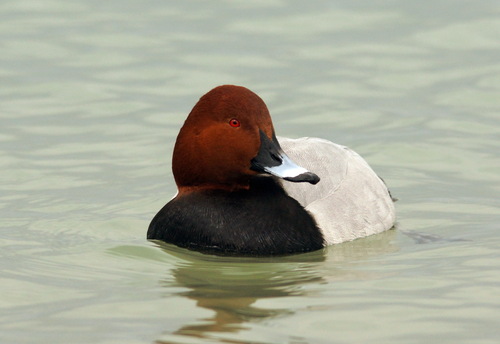 Common Pochard
In short
The most reliable field mark between Eurasian Wigeon and Common Pochard is the upperwing pattern: Eurasian Wigeon of all ages shows a bold white patch on the upperwing, visible both at rest and in flight, while Common Pochard lacks this and instead has uniformly pale grey wings with no strong white panel. Structure is also key: Wigeon is a dabbling duck with a rounded head and short bill, while Pochard is a stockier diving duck with a sloping forehead and longer bill. Males of both species have chestnut heads, but the rest of the plumage and their feeding behavior are very different. In eclipse or female-type plumages, focus on the wing pattern and body shape for separation.
Identification tips
- White upperwing patch (all ages, both sexes): Eurasian Wigeon always shows a bold white patch on the upperwing coverts, visible in flight and often at rest. Common Pochard never shows this; its upperwing is uniformly pale grey. This is the most reliable separation, especially for immatures and females.
- Head shape: Wigeon has a rounded head with a short, steep forehead and small bill. Pochard has a sloping forehead and a longer, more wedge-shaped bill. This is especially noticeable in profile.
- Bill color and pattern (adult males): Wigeon has a short, greyish bill with a black tip. Pochard males have a dark grey bill with a broad blue-grey band across the middle. This can be seen at close range.
- Crown stripe (adult males): Wigeon males have a creamy crown stripe running from the bill to the nape, contrasting with the chestnut head. Pochard males lack any crown stripe; their head is uniformly chestnut.
- Body color (adult males): Wigeon males have grey flanks and back, pinkish breast, and white belly. Pochard males have a pale grey body with fine vermiculations, a black breast, and black tail.
- Female and eclipse plumage: Wigeon females are light brown, sometimes rufous or grayish, but always with the white upperwing patch. Pochard females are brownish and lack any white in the wing. If the wing is not visible, separation is difficult, but Pochard is stockier and has a longer bill.
- Feeding behavior: Wigeon is a dabbling duck, often grazing on land or tipping up in shallow water. Pochard is a diving duck, usually feeding by diving in deeper water. If you see the bird diving repeatedly, it's likely a Pochard.
- Flight style: Wigeon flocks are agile, with rapid wingbeats and tight formations. Pochard flies with deeper, slower wingbeats and appears heavier in flight.
- Habitat context: Wigeon is often seen in shallow wetlands or grazing in fields; Pochard prefers deeper lakes and is rarely far from open water.
- Iris color: Pochard males have a yellow-orange to red iris (brighter in breeding season); Wigeon has a dark eye. This is a subtle mark, best seen at close range.
- Tail shape: Wigeon has a more pointed tail, while Pochard's tail is short and rounded.
- Pitfall - chestnut head: Both adult males have chestnut heads, which can cause confusion at a distance. Always check for the creamy crown stripe (Wigeon) and the white wing patch.
- Pitfall - female confusion: Female Wigeon can resemble female Pochard in overall brown tones, but the white upperwing patch is diagnostic if seen.
- Seasonal changes: In eclipse (non-breeding) plumage, Wigeon males look more like females but retain the white wing patch. Pochard males become duller but do not gain any white in the wing.
- Group association: Wigeon often forms large, tight flocks, sometimes mixed with other dabbling ducks. Pochard is more often in smaller groups or mixed diving duck flocks.
Size
Both species are similar in length and wingspan: Eurasian Wigeon measures 42–52 cm long with a 71–80 cm wingspan [wikipedia], while Common Pochard is 42–49 cm long with a 72–82 cm wingspan [wikipedia]. Wigeon tends to look more compact and upright, while Pochard is stockier and heavier, especially in the body. Weight overlaps but Pochard can be heavier at the upper end (Wigeon: 500–1,073 g; Pochard: 467–1,240 g) [wikipedia].
Plumage
- Juvenile/immature/first-winter and female-type birds: Eurasian Wigeon of all ages and sexes shows a conspicuous white patch on the upperwing (coverts), visible in flight and often at rest. Common Pochard of all ages lacks this, having uniformly pale grey upperwings with no strong white panel. This is the single most reliable mark in flight or when wings are visible.
- Adult males (breeding): Both have chestnut heads, but Wigeon males have a creamy crown stripe and pink breast, with grey flanks and back, black rear, and a white belly. Pochard males have a chestnut head and neck, black breast and tail, and a pale grey body with fine vermiculations; the bill is dark grey with a wide blue-grey band.
- Females and eclipse males: Wigeon females are light brown, sometimes with a rufous or grayish head, and still show the white upperwing patch. Pochard females are brownish with a more uniform appearance and lack any white in the upperwing. Wigeon females can be confused with American Wigeon, but not with Pochard if the wing is seen.
- Head pattern: Wigeon males have a creamy crown, absent in Pochard. Pochard males have a sloping forehead and no crown stripe.
Behaviour
Eurasian Wigeon is a dabbling duck, feeding mostly by grazing or tipping up in shallow water, and is often seen walking on land in flocks. Common Pochard is a diving duck, typically feeding by diving underwater for food, and is less likely to be seen grazing on land. In flight, Wigeon is fast and agile, often in tight flocks, while Pochard is heavier and flies with deeper wingbeats. Pochard is more likely to dive when alarmed, while Wigeon usually swims or takes off.
Habitat
Both species can be found on lakes and wetlands, but Eurasian Wigeon favors shallow lakes, marshes, and flooded fields, often grazing on grasslands nearby. Common Pochard prefers deeper lakes and reservoirs, especially those with open water, and is less likely to be seen far from water. Wigeon flocks are often seen on shorelines or in fields, while Pochard is usually on open water.