
Eurasian Sparrowhawk vs Common Buzzard
Accipiter nisus versus Buteo buteo
Play a quiz with Eurasian Sparrowhawk and Common Buzzard
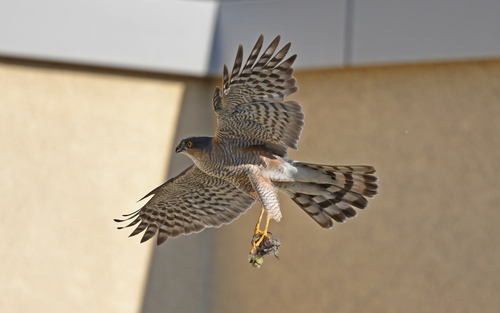 Eurasian Sparrowhawk
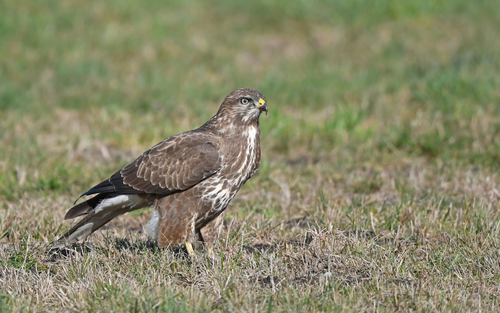 Common Buzzard
In short
The most reliable field mark to separate Eurasian Sparrowhawk from Common Buzzard in any age or season is overall structure: Sparrowhawk is a much smaller, slender raptor with short, rounded wings and a long, square-tipped tail, while Common Buzzard is bulkier with broad wings and a shorter, fanned tail. In flight, Sparrowhawk shows rapid, snappy wingbeats and a flap-flap-glide pattern, whereas Buzzard soars on broad wings with slow, heavy wingbeats and often holds its wings in a shallow 'V'. Juvenile Sparrowhawks are brown above with coarse barring below, but even at this age, their shape and flight style are distinctive. Buzzards are highly variable in plumage, but always appear heavier and broader-winged. Size difference is dramatic: Buzzard is nearly four times heavier than Sparrowhawk.
Identification tips
- Size and bulk: Buzzard is nearly four times heavier than Sparrowhawk. Even at a distance, Buzzard looks much larger and more robust. Size is a reliable first check, especially when seen with other birds for scale.
- Wing shape in flight: Sparrowhawk has short, rounded wings and a long, square-tipped tail, giving a 'cross' or 'T'-shaped silhouette. Buzzard has broad, rounded wings and a shorter, fanned tail, appearing more 'chunky' and less streamlined.
- Tail shape and length: Sparrowhawk's tail is long, narrow, and square-tipped, often held straight out in flight. Buzzard's tail is shorter, broader, and more rounded at the tip.
- Flight style: Sparrowhawk flies with rapid, snappy wingbeats and short glides, often low and direct. Buzzard soars with slow, heavy wingbeats, often circling on thermals with wings in a shallow 'V'.
- Perched posture: Sparrowhawk perches upright and slim, with a long tail hanging down. Buzzard perches more horizontally, appearing thickset with a shorter tail.
- Adult male Sparrowhawk plumage: Look for bluish-grey upperparts and fine orange barring below. No Buzzard shows this combination.
- Adult female Sparrowhawk and juvenile: Brown above with brown barring below, but always with a slender build and long tail. Juveniles have rusty fringes and streaked throats, lacking in Buzzard.
- Buzzard plumage variability: Buzzards can be very pale or very dark, but always look bulkier, with broader wings and a more mottled or patchy underpart pattern. Even pale Buzzards lack the even, fine barring of Sparrowhawk.
- Underwing pattern: Sparrowhawk's underwings are pale with fine barring; Buzzard often shows a pale panel at the base of the primaries (carpal patch) and a more mottled look.
- Eye color: Adult Sparrowhawks have orange to orange-red eyes (males) or yellow to orange (females); juveniles have pale yellow eyes. Buzzard eye color is less distinctive in the field.
- Legs and feet: Sparrowhawk has long, thin legs and toes adapted for catching birds; Buzzard's legs are thicker and shorter, but this is rarely diagnostic at a distance.
- Habitat context: If seen dashing through woodland or hedgerows, Sparrowhawk is more likely. If soaring high over open fields or perched in the open, Buzzard is more likely.
- Behavior with prey: Sparrowhawk often plucks prey on the ground or in cover; Buzzard may be seen feeding on carrion or larger prey in the open.
- Confusion risk: Juvenile Sparrowhawks are sometimes mistaken for small Buzzards, but always check for the long tail, slender shape, and rapid flight. Buzzards are never as slim or agile in flight as Sparrowhawks.
- When in doubt: Focus on structure and flight style first, then check plumage details. Size, shape, and behavior are more reliable than plumage alone, especially given Buzzard's variability.
Size
Eurasian Sparrowhawk is a small raptor, with a typical adult mass of about 220 g, while Common Buzzard is much larger, averaging 878 g. This size gap is obvious in the field, even at a distance. Sparrowhawk is noticeably more slender, with a smaller head and body, and a longer tail relative to its size. Buzzard appears thickset, with a broad chest, large head, and robust body. Even the largest female Sparrowhawk is dwarfed by the smallest Buzzard.
Plumage
Juvenile Sparrowhawks are warm brown above with rusty fringes and coarsely barred or spotted brown below, lacking the clean barring of adults. Their underparts are pale with dark streaks, and the throat is streaked but lacks a central midline stripe. Adult males are bluish-grey above with fine orange barring below; females are brown or greyish-brown above with brown barring below. Buzzards, by contrast, show extreme plumage variability at all ages, ranging from very pale to very dark, but always with broader, less crisp barring or mottling below, and never with the fine, even barring of adult Sparrowhawks. Buzzards lack the rusty fringes and streaked throats of juvenile Sparrowhawks. In flight, Sparrowhawk's underparts are paler and more evenly barred, while Buzzard often shows a paler breast contrasting with darker belly and carpal patches, or a more mottled appearance overall. Buzzard's tail is shorter and more rounded, with less distinct barring than Sparrowhawk's long, square-tipped, clearly barred tail.
Behaviour
Sparrowhawks are agile woodland hunters, flying low and fast with rapid wingbeats and short glides, often weaving through trees or hedgerows. They rarely soar for long periods. Buzzards are classic soarers, often seen circling high on thermals with wings held in a shallow 'V', or perched conspicuously on posts or trees. Their wingbeats are slower and heavier, and they spend much time gliding or soaring. Sparrowhawks are more likely to be seen in quick, direct flight across open ground or darting through cover, while Buzzards are more often seen soaring or perched in the open.
Habitat
Both species can occur in overlapping habitats, but Sparrowhawk is more closely tied to woodland and wooded edges, where it hunts small birds. Buzzard is more generalist, found in open country, farmland, moorland, and woodland edges, often seen soaring over fields or perched in open areas. Sparrowhawk is less likely to be seen soaring high over open country, while Buzzard is rarely seen dashing through dense woodland.