

Eurasian Jay vs Spotted Nutcracker
Garrulus glandarius versus Nucifraga caryocatactes
Play a quiz with Eurasian Jay and Spotted Nutcracker
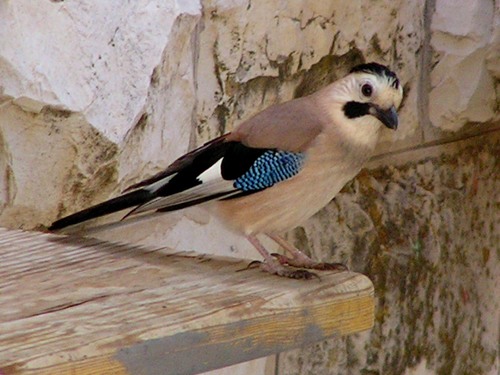 Eurasian Jay
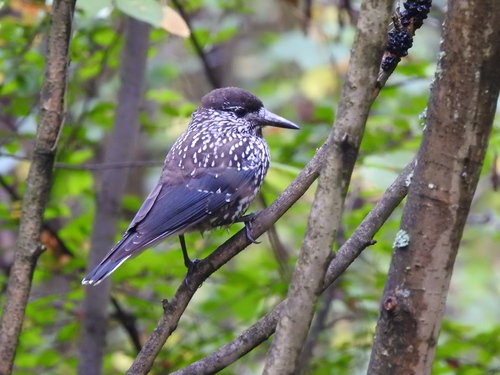 Spotted Nutcracker
In short
The most reliable field mark to separate Eurasian Jay from Spotted Nutcracker is the Eurasian Jay's bright blue, black-barred wing panel (visible on perched and flying birds of all ages), which is completely absent in the Nutcracker. Instead, the Spotted Nutcracker shows a chocolate-brown body with dense white spotting and a large, sharply pointed black bill. Jays are pinkish-brown overall with a black tail and a distinctive black moustache stripe, while Nutcrackers are darker, heavily spotted, and lack any blue in the wing. In flight, the Jay's white rump and blue wing patch contrast with the Nutcracker's broad, dark wings, white vent, and short tail with white corners. Structural differences—especially the Nutcracker's long, stout bill and lack of crest—are also key at any distance.
Identification tips
- Blue wing panel: Eurasian Jay always shows a bright blue, black-barred patch on the upperwing coverts, visible both perched and in flight. Spotted Nutcracker never shows any blue in the wing.
- Overall color and spotting: Spotted Nutcracker is chocolate brown with dense white spots on the face, neck, mantle, and underparts. Eurasian Jay is pinkish-brown with a plain body and lacks any white spotting.
- Bill shape and size: Nutcracker has a long, thick, sharply pointed black bill, much larger and heavier than the Jay's shorter, more delicate bill. This is obvious even at a distance.
- Head shape and crest: Eurasian Jay has a rounded head with a short crest (often raised), giving it a peaked look. Nutcracker's head is slimmer, lacks a crest, and appears more angular.
- Facial markings: Jay has a black moustache stripe bordering a white throat, and a streaked crown. Nutcracker has a white loral spot, white eye-ring, and a dark cap extending onto the nape.
- Tail pattern: In flight, Jay shows a white rump and a long, black tail. Nutcracker has a short, dark tail with white corners above and a white terminal band below, plus a conspicuous white vent.
- Wing pattern in flight: Jay's blue panel and white rump are visible in flight. Nutcracker's wings are broad, dark, and lack any blue; the white vent and short tail are prominent.
- Plumage consistency by age: Nutcracker's juvenile and adult plumage are similar, so white spotting is always present. Jay's blue wing panel is present at all ages.
- Habitat context: Jays are more likely in oak-rich woodlands, parks, and gardens. Nutcrackers are almost always in coniferous or mixed forests, especially with pines or spruces.
- Behavior: Jays are often shy, moving quickly through cover, sometimes seen burying acorns. Nutcrackers are bolder, often seen using their bill to crack nuts or carry seeds.
- Flight style: Both species fly with undulating wingbeats, but Nutcracker appears heavier and broader-winged, with a shorter tail.
- Confusion risk: At a distance, both can appear dark and corvid-like, but the Jay's blue wing panel and the Nutcracker's white spotting and large bill are decisive at any range.
- Vocalizations: Not detailed here, but Jays are known for harsh, screeching calls; Nutcracker's calls are more nasal and less raucous.
- Seasonal context: Nutcrackers may appear outside their usual range in irruption years, but are otherwise rare in lowland or urban settings.
- Perched vs. flight views: The Jay's blue wing panel is visible both perched and in flight; Nutcracker's white spotting and bill shape are best seen when perched, while the white vent and tail corners show in flight.
Size
Both species are medium-sized corvids and can appear similar in length: Eurasian Jay is 34–35 cm long with a 52–58 cm wingspan, while Spotted Nutcracker ranges from 32–38 cm in length and 49–53 cm in wingspan [wikipedia]. However, the Nutcracker tends to look bulkier in the body, with a larger, longer bill and a shorter tail. The Jay is slightly longer-tailed and slimmer overall, with a more rounded head profile due to its crest (often raised).
Plumage
No matter the age, Eurasian Jay always shows a bright blue, black-barred patch on the upperwing coverts—a unique feature not present in the Nutcracker. The Jay's body is pinkish-brown to rufous, with a white throat bordered by a black moustache, a white rump, and a black tail. The crown and forehead are whitish with black streaks. In contrast, Spotted Nutcracker is mid-to-dark chocolate brown all over, densely spotted with white on the face, neck, mantle, and underparts. It has a white loral spot, white eye-ring, and a blackish-brown cap. The wings are dark with a greenish-blue gloss (not bright blue and not barred), and the tail is dark with white corners and a white terminal band below. In flight, Nutcracker shows a white vent and short tail; Jay shows a white rump and longer tail. Juvenile and adult Nutcrackers are similarly patterned, so age is less critical for separation than in some other corvids.
Behaviour
Eurasian Jays are often seen moving through woodland understorey, sometimes flying between trees with slow, undulating wingbeats and flashing their blue wing panels. They may be shy and skittish, quickly disappearing into cover. Jays may also be seen in urban parks. Spotted Nutcrackers are more likely to be found in coniferous forests, moving deliberately and often perching high. Their flight is undulating and appears heavy, with broad wings and a short tail. Nutcrackers are often seen cracking nuts or carrying seeds, sometimes using their large bill to hack open hard shells.
Habitat
Eurasian Jay prefers mixed or deciduous woodland, especially with oaks, but is increasingly found in urban parks and gardens. Spotted Nutcracker is strongly associated with coniferous forests, especially those with pine or spruce, and is rarely found in urban or broadleaf woodland. Jays are more likely in lowland, fragmented, or human-altered habitats; Nutcrackers are birds of higher elevation or northern forests, sometimes erupting into new areas when food is scarce.