
Eurasian Hobby vs Lanner Falcon
Falco subbuteo versus Falco biarmicus
Play a quiz with Eurasian Hobby and Lanner Falcon
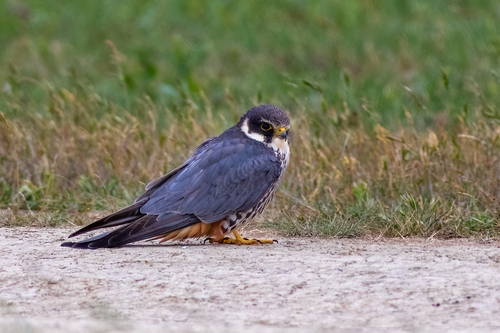 Eurasian Hobby
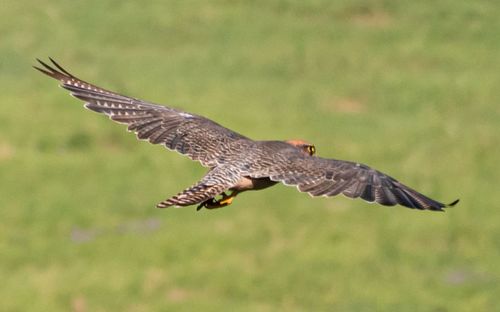 Lanner Falcon
In short
The most reliable way to separate Eurasian Hobby from Lanner Falcon is by size and structure: the Hobby is much smaller and slimmer, with a sickle-winged, swift-like flight profile, while the Lanner is a large, broad-winged falcon with a heavier build. Adult Hobby shows distinctive rufous 'trousers' and vent, contrasting with its streaked underparts and slate-grey upperparts; Lanner adults have a reddish nape and a generally paler, streaked breast. Juvenile Hobbies are browner with scaled upperparts and streaked buff thighs, while young Lanners are also brownish but bulkier and resemble Saker Falcons. In flight, the Hobby's long, narrow wings and square tail are diagnostic, especially when compared to the Lanner's broader wings and longer body. Both species prefer open country, but Lanner is generally resident in Africa and southern Europe, while Hobby is a widespread migrant.
Identification tips
- Size and structure: Lanner Falcon is much larger and bulkier than Eurasian Hobby. If the bird looks slim, swift-like, and small, it's likely a Hobby; if it appears robust and long-winged, consider Lanner.
- Flight profile: Hobby has long, narrow, pointed wings and a square tail, giving a sickle-shaped, swift-like silhouette. Lanner's wings are broader and less pointed, with a longer body and tail.
- Adult plumage - underparts: Hobby adults have crisp black streaks on whitish underparts, with a clean white throat and rich rufous (red) thighs and vent ('trousers'). Lanner adults have a streaked or barred breast but lack the Hobby's rufous vent and thighs.
- Adult plumage - upperparts/head: Hobby is slate-grey above with a dark crown and two short black moustache stripes. Lanner has slate or brown-grey upperparts (often paler in African birds), a reddish nape, and a less sharply defined facial pattern.
- Juvenile/immature plumage: Juvenile Hobby is browner above with a scaled pattern and streaked buff thighs; juvenile Lanner is also brownish but bulkier, with a paler head top and less clear head-side pattern, resembling Saker Falcon more than Hobby.
- Tail shape: Hobby's tail is square-tipped, while Lanner's is longer and may appear more rounded or tapered.
- Behavior in flight: Hobbies are fast, agile, and often seen catching insects or small birds in mid-air, sometimes eating on the wing. Lanners are more likely to soar or perform power-dives, hunting larger prey.
- Perched posture: Hobby perches upright and slim, often on exposed branches or wires. Lanner appears heavier and more robust when perched, with a broader chest.
- Habitat and range: If seen in northern or central Europe, especially in open lowland with scattered woods, Hobby is more likely. In open African savannah or southern Europe, especially in more arid or grassy areas, Lanner is more probable.
- Season: Hobby is migratory and more likely to be seen in Europe during spring and summer; Lanner is resident and can be seen year-round in its range.
- Head pattern: Hobby has a dark crown and two short black moustache stripes; Lanner's head is paler on top with a reddish nape and less distinct facial markings.
- Underpart contrast: The Hobby's underparts are sharply streaked with a strong contrast between the white throat and rufous vent; Lanner's streaking is more diffuse and lacks the rufous vent.
- Vocalization: If heard, a harsh "wray-e" call points to Lanner, but Hobby's call is not described here.
- Group behavior: Hobbies may migrate in small groups; Lanners are more solitary or seen in pairs, especially near nests.
- Common pitfalls: Juvenile Lanners can resemble Saker Falcons and may be confused with Hobby only at a distance; always check for size, structure, and the presence or absence of rufous 'trousers' for Hobby.
Size
Eurasian Hobby is significantly smaller and lighter (body mass ~211 g, length 29–36 cm, wingspan 74–84 cm) than Lanner Falcon (length 43–50 cm, wingspan 95–105 cm). The Hobby appears slim and delicate, with long, pointed wings and a square tail, often resembling a large swift in flight. The Lanner is robust, with a broader chest, longer tail, and heavier build, appearing much bulkier both perched and in flight. This size difference is usually obvious even at a distance.
Plumage
- Juvenile/immature birds:
- Hobby juveniles are generally brown above with a scaled pattern and have streaked buffy thighs and undertail coverts. Their upperparts lack the reddish nape of Lanner and show a more uniform, slim appearance.
- Lanner juveniles are browner overall, also with streaked underparts, but are bulkier and resemble Saker Falcons. They lack the Hobby's rufous 'trousers' and have a more diffuse head pattern, with a paler top of the head and less distinct head-side markings compared to Saker.
- Adults:
- Hobby adults are slate-grey above with a dark crown, two short black moustache stripes, and a clean white throat. The underparts are whitish with black streaks, and the thighs and undertail coverts are a rich, unstreaked rufous—these 'red trousers' are a key field mark. The tail is square-tipped.
- Lanner adults have slate-grey or brown-grey upperparts (paler in African birds), a reddish nape, and a streaked breast. The head pattern is less sharply defined than in Hobby, and the underparts are more evenly streaked or sometimes barred, lacking the Hobby's crisp contrast and rufous vent.
Behaviour
Eurasian Hobby is highly aerial, often seen hawking insects and small birds on the wing, sometimes eating prey in flight. Its flight is swift-like: fast, agile, and buoyant, with frequent gliding and rapid turns. Hobbies are crepuscular outside the breeding season, most active at dawn and dusk, and may migrate in small groups. Lanner Falcon is more likely to be seen soaring or power-diving, often hunting birds and bats. Lanners are usually resident, with only local movements, and are less likely to be seen in the air at dawn or dusk. Their flight is more powerful and less acrobatic than the Hobby's, and they may be seen perched near nests for long periods during the breeding season.
Habitat
Both species favor open country, but with different ranges and preferences. Eurasian Hobby is widespread in lowland open habitats with scattered woods, including farmland, marshes, taiga, and savannah, and is a long-distance migrant. Lanner Falcon prefers open savannah, grasslands, and semi-desert, mainly in Africa and southern Europe, and is largely resident with some local dispersal. Lanner is less likely to be found in northern or heavily wooded areas compared to Hobby.
Voice
The Lanner Falcon's call is a harsh "wray-e". No distinctive vocalization is described for Eurasian Hobby in the provided notes, so voice is not a reliable field mark for separating these two species based on the current information.