
Eurasian Goshawk vs Rough-legged Buzzard
Astur gentilis versus Buteo lagopus
Play a quiz with Eurasian Goshawk and Rough-legged Buzzard
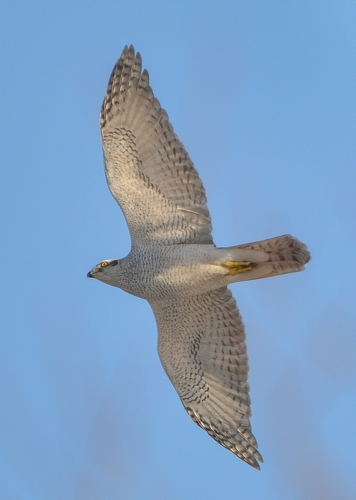 Eurasian Goshawk
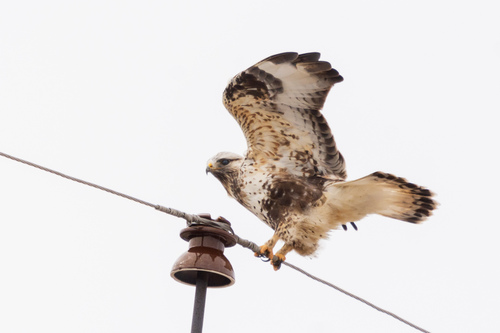 Rough-legged Buzzard
In short
The most reliable field mark to separate Eurasian Goshawk from Rough-legged Buzzard is the underwing pattern in flight: Rough-legged Buzzard (especially light morphs and juveniles) shows a bold dark carpal ('wrist') patch and a white-based tail with a strong dark subterminal band, while Goshawk lacks these features and instead has more uniform underwings and a barred tail. Structurally, Goshawk is bulkier with shorter, broader wings and a longer tail, built for maneuvering in forests, whereas Rough-legged Buzzard is longer-winged and more eagle-like, adapted for soaring. Perched, the Goshawk’s strong white supercilium (eyebrow) and heavy barring below contrast with the Buzzard’s more speckled, variable brown-and-white plumage and feathered legs. Both species are similar in size and mass, so focus on wing and tail shape, flight style, and key plumage marks for confident separation.
Identification tips
- Underwing pattern in flight (all ages): Rough-legged Buzzard shows a bold, dark carpal ('wrist') patch on the underwing and white underwing coverts, while Goshawk lacks this patch and has more uniform underwings. This is the single most reliable field mark at distance.
- Tail pattern (all ages): Buzzard’s tail is white with a strong, single dark subterminal band; Goshawk’s tail is greyish with 3–5 narrow dark bars. This is visible both in flight and when perched.
- Supercilium (eyebrow): Goshawk always has a prominent white supercilium, especially broad in northern birds, while Buzzard lacks this feature. This is a key mark on perched birds.
- Leg feathering: Buzzard’s legs are feathered to the toes (hence 'rough-legged'), giving a fluffy appearance; Goshawk’s legs are robust but less heavily feathered.
- Flight style: Goshawk uses deep, deliberate wingbeats and is agile, often flying low and fast through trees. Buzzard soars with wings in a shallow 'V' and frequently hovers (kites) over open ground—Goshawk never hovers.
- Wing shape: Goshawk’s wings are shorter and broader, with a more rounded tip, suited for maneuvering in woodland. Buzzard’s wings are longer, broader, and more pointed, giving a more eagle-like silhouette.
- Perched structure: When perched, Buzzard’s wings reach or extend beyond the tail tip; Goshawk’s tail is proportionally longer and always projects well beyond the folded wing tips.
- Plumage variability: Goshawk is less variable in adult plumage—always blue-grey or brownish-grey above, finely barred below. Buzzard is highly variable, with light and dark morphs, but always shows the carpal patch and tail pattern.
- Underpart pattern: Goshawk adults have fine, even barring below; juveniles are variably streaked or striped, but never with a broad chest-band. Buzzard often has a broad brown chest-band and more speckled underparts.
- Habitat: Goshawk is almost always in forest or woodland; Buzzard is in open country, especially in winter. If seen in deep woods, expect Goshawk; in open fields, expect Buzzard.
- Bill and feet: Goshawk has a relatively large bill and thick toes, suited for taking large prey; Buzzard’s bill is smaller and talons are relatively small for its size.
- Eye color: Goshawk adults develop orange eyes, but some retain yellowish hues; Buzzard’s eye color is less distinctive and more variable.
- Juvenile confusion: Juvenile Goshawk can be confused with other hawks but not with Buzzard if the carpal patch and tail band are checked. Always focus on these flight marks in young birds.
- Seasonal context: In winter, both may occur in the same region, but habitat choice remains a strong clue—Buzzard in open, Goshawk in woods.
- Pitfalls: Do not rely on overall size or bulk; both are similar in mass. Focus on wing/tail shape, underwing and tail pattern, and habitat for reliable separation.
Size
Both species are almost identical in average body mass (Goshawk: 926g, Rough-legged Buzzard: 925.8g [wikidata]), so size alone is not helpful. However, the Goshawk appears bulkier and more muscular, with a deeper chest and heavier build, while the Rough-legged Buzzard is longer-winged and slightly longer-tailed, giving it a more stretched, eagle-like silhouette in flight. When perched, the Buzzard’s wings often reach or extend past the tail tip, unlike the Goshawk, whose tail is proportionally longer relative to the wings.
Plumage
- Juvenile/immature in flight: Rough-legged Buzzard (especially light morphs) shows a striking dark carpal patch on the underwing, white underwing coverts, and a white tail with a bold dark subterminal band; these features are present in both juveniles and adults, but are especially crisp in young birds. Goshawk juveniles lack the carpal patch and instead have more uniform underwings and a tail with 3–5 dark bars, not a single dark band. Juvenile Goshawks are brown above and variably streaked or striped below, but never show the Buzzard’s contrasting wrist patch or tail pattern.
- Adults: Adult Goshawk is blue-grey or brownish-grey above with fine dark barring below and always shows a strong white supercilium (eyebrow). Adult Rough-legged Buzzard is highly variable but typically brown and white with a broad brown chest-band, speckled underparts, and the diagnostic carpal patch and tail pattern. The Buzzard’s legs are feathered to the toes, unlike the Goshawk’s shorter feathering.
- Perched: Goshawk’s supercilium is always present and broad, especially in northern birds, while the Buzzard lacks this feature. Goshawk’s tail shows multiple bars; Buzzard’s tail is white with a single bold dark band near the tip.
Behaviour
In flight, Goshawk uses deep, deliberate wingbeats and can soar but is more often seen with a 'flap-flap-glide' pattern, reflecting its adaptation to woodland hunting. It is agile, maneuvering quickly through trees. Rough-legged Buzzard is a classic open-country soarer, often seen gliding with wings held in a shallow dihedral, and is unique among large raptors for its frequent hovering (kiting) in place while hunting. This hovering behavior is never seen in Goshawk. When perched, Buzzard’s wings reach or pass the tail tip, and it often selects exposed perches in open habitats, while Goshawk prefers more concealed perches in woodland.
Habitat
Goshawk is a forest specialist, favoring dense temperate woodlands and rarely venturing into open country. Rough-legged Buzzard breeds in arctic and subarctic tundra and winters in open habitats such as fields, moorland, and marshes. In winter, overlap is possible, but Goshawk remains tied to wooded areas, while Buzzard is almost always found in open landscapes. If seen in deep forest, Goshawk is much more likely; in open, treeless terrain, expect Rough-legged Buzzard.