

Motmot

Eurasian Eagle Owl vs Long-eared Owl

Bubo bubo versus Asio otus

Play a quiz with Eurasian Eagle Owl and Long-eared Owl
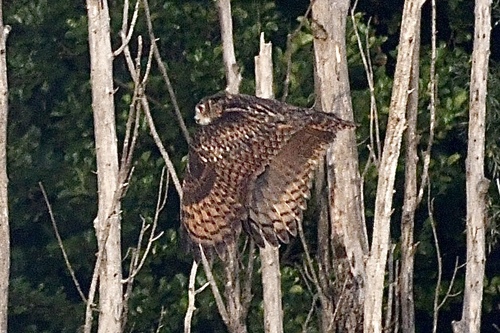
Eurasian Eagle Owl (Bubo bubo) Eurasian Eagle Owl
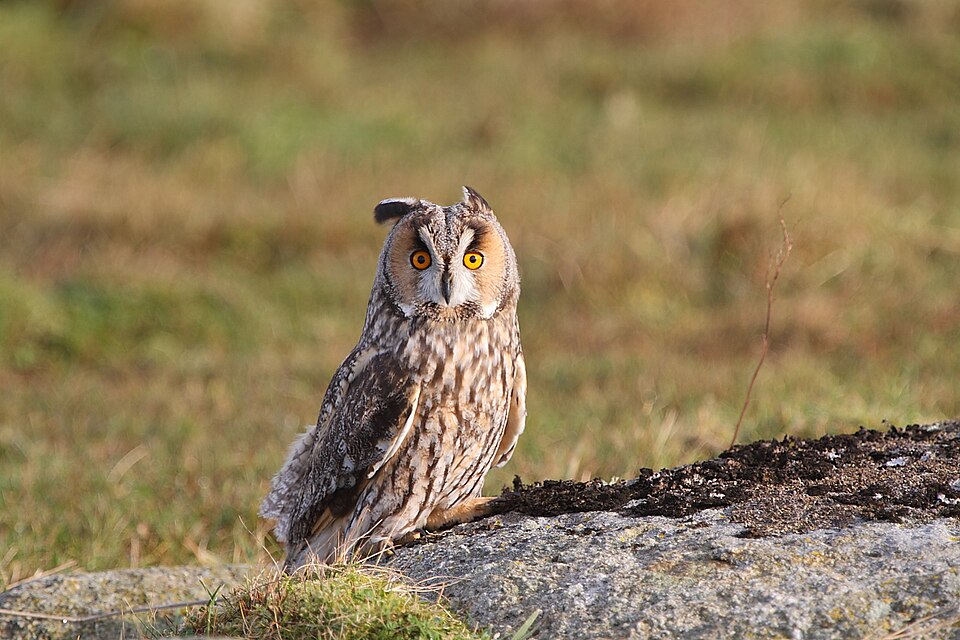
Long-eared Owl (Asio otus) Long-eared Owl

Media

Loading…

In short

The most reliable field mark between Eurasian Eagle Owl and Long-eared Owl is sheer size: Eurasian Eagle Owl is a true giant, while Long-eared Owl is only medium-sized, even appearing slim and delicate. In flight or perched, the eagle-owl’s massive bulk, broad wings, and huge head with prominent ear tufts contrast sharply with the long, slim wings and more centrally placed, upright ear tufts of the Long-eared Owl. Juvenile and adult Long-eared Owls show distinctive pale panels at the base of the primaries, especially visible in flight, which are absent in Eurasian Eagle Owl. Plumage can overlap in general brownish and streaked tones, but the eagle-owl is much darker and more heavily marked, with a broader, more powerful structure throughout.

Identification tips

  1. Size is the single most reliable mark: Eurasian Eagle Owl is vastly larger than Long-eared Owl—if you see a bird that looks as big as a goose or buzzard, it is not a Long-eared Owl. This holds for all ages and sexes.
  2. Flight silhouette: Eagle-owl shows very broad wings, a huge head, and heavy, deep wingbeats; Long-eared Owl is slim, with long, narrow wings and a buoyant, moth-like flight.
  3. Ear tuft placement: Eurasian Eagle Owl’s ear tufts are thick, broad, and set to the sides of the head; Long-eared Owl’s are thinner, more upright, and closer together, almost central on the crown.
  4. Facial disc: Long-eared Owl has a well-developed, often pale-rimmed facial disc with a vertical white line down the center or forming a 'moustache'; Eurasian Eagle Owl’s facial disc is less sharply defined and more blended into the head.
  5. Upperwing in flight (especially juveniles): Long-eared Owl shows pale or orange-buff panels at the base of the primaries, creating a striking flash; Eurasian Eagle Owl lacks this feature entirely at all ages.
  6. Scapulars: Long-eared Owl has prominent whitish scapulars that contrast with the darker back; eagle-owl’s scapulars are less contrasting and more heavily streaked.
  7. Underpart markings: Long-eared Owl’s underparts are paler with herringbone (shaft-streak and crossbar) patterning below the breast; eagle-owl is much more heavily streaked and blotched overall, especially on the chest.
  8. Eye color: Long-eared Owl’s eyes range from yellowish-orange to orange-red; Eurasian Eagle Owl’s eyes are always a vivid orange, but this is less reliable at distance.
  9. Bill size: Eagle-owl has a massive, powerful bill; Long-eared Owl’s bill is proportionally much smaller and less prominent.
  10. Perching behavior: Eurasian Eagle Owl often perches in the open, on rocks or large branches, looking massive and upright; Long-eared Owl prefers dense cover, often in conifers, and is more likely to be seen roosting communally in winter.
  11. Habitat context: If found in rugged, rocky, or remote terrain, especially in the open, favor eagle-owl; if in dense woodland, thickets, or urban parks, especially in winter, favor Long-eared Owl.
  12. Plumage tone: Eagle-owl is generally darker, with a richer brown or rufous base and heavier black streaks; Long-eared Owl is paler, more ochraceous-tawny, with finer streaks and spots.
  13. Sexual dimorphism: Both species show females larger than males, but the size gap between species is always much greater than within either species.
  14. Roosting groups: Long-eared Owls may be found in winter roosts with several birds together; eagle-owls are always solitary or in pairs.
  15. Voice (if heard): Eurasian Eagle Owl gives a deep, booming hoot; Long-eared Owl’s call is much softer and less far-carrying—if you hear a huge, resonant hoot, suspect eagle-owl.

Size

Eurasian Eagle Owl is one of the largest owls in the world, with an average adult body mass of 2686 g [wikidata], and wingspans often exceeding 150 cm. In contrast, Long-eared Owl is medium-sized and much lighter, with males averaging around 197–288 g and females 225–327 g depending on region [wikipedia]. The difference is dramatic: Eurasian Eagle Owl is nearly ten times heavier and has a wingspan about 1.5 times longer. In the field, even at a distance, the eagle-owl’s immense size and bulk are unmistakable compared to the slender, almost dainty Long-eared Owl.

Plumage

Juvenile and adult Long-eared Owls show pale or buffy-orange panels at the base of the primaries, forming a noticeable flash in flight—this is especially prominent in young birds and is not present in Eurasian Eagle Owl of any age [wikipedia]. Long-eared Owl is overall ochraceous-tawny to brownish, with variable blackish streaks and spots, a well-developed facial disc rimmed dusky, and prominent whitish scapulars. Its underparts are paler with herringbone marks below the breast. Eurasian Eagle Owl, by contrast, is much darker and more heavily streaked, with a brownish to rufous base color, broad black streaks on the upperparts and chest, and a generally more imposing, less finely marked appearance. Both species have ear tufts, but the eagle-owl’s are thicker and set more to the side, while Long-eared Owl’s are thinner, more upright, and closer together. Eye color is variable in Long-eared Owl (yellowish-orange to orange-red), while Eurasian Eagle Owl typically has striking orange eyes.

Behaviour

Eurasian Eagle Owl is a powerful, ground-hunting predator, often seen perched on large rocks or open ground, exuding a massive, statuesque presence. Its flight is heavy and deep-winged, matching its size. Long-eared Owl is much more secretive and agile, roosting in dense cover, often in conifers, and flying with a buoyant, moth-like action. In winter, Long-eared Owls may form communal roosts, sometimes in surprisingly urban settings, while eagle-owls are always solitary or paired and require large territories.

Habitat

Both species are widespread across Eurasia, but Eurasian Eagle Owl prefers rocky outcrops, cliffs, and open woodlands, often in remote or rugged terrain. Long-eared Owl is more closely tied to dense woodland edges, thickets, and conifer groves, especially near open hunting grounds. In winter, Long-eared Owls may be found in urban parks or plantations, sometimes in groups, while eagle-owls remain in wild, undisturbed locations.

Voice

No direct comparison in the provided notes. Both species are known for their vocalizations, but the Eurasian Eagle Owl’s call is a deep, booming hoot, while Long-eared Owl gives a much softer, more subdued call. In practice, their voices are unlikely to be confused.

Submit a better description

Use the same sections as the comparison. Your text is published immediately.

The most reliable field mark between Eurasian Eagle Owl and Long-eared Owl is sheer size: Eurasian Eagle Owl is a true giant, while Long-eared Owl is only medium-sized, even appearing slim and delicate. In flight or perched, the eagle-owl’s massive bulk, broad wings, and huge head with prominent ear tufts contrast sharply with the long, slim wings and more centrally placed, upright ear tufts of the Long-eared Owl. Juvenile and adult Long-eared Owls show distinctive pale panels at the base of the primaries, especially visible in flight, which are absent in Eurasian Eagle Owl. Plumage can overlap in general brownish and streaked tones, but the eagle-owl is much darker and more heavily marked, with a broader, more powerful structure throughout.

  1. Size is the single most reliable mark: Eurasian Eagle Owl is vastly larger than Long-eared Owl—if you see a bird that looks as big as a goose or buzzard, it is not a Long-eared Owl. This holds for all ages and sexes.
  2. Flight silhouette: Eagle-owl shows very broad wings, a huge head, and heavy, deep wingbeats; Long-eared Owl is slim, with long, narrow wings and a buoyant, moth-like flight.
  3. Ear tuft placement: Eurasian Eagle Owl’s ear tufts are thick, broad, and set to the sides of the head; Long-eared Owl’s are thinner, more upright, and closer together, almost central on the crown.
  4. Facial disc: Long-eared Owl has a well-developed, often pale-rimmed facial disc with a vertical white line down the center or forming a 'moustache'; Eurasian Eagle Owl’s facial disc is less sharply defined and more blended into the head.
  5. Upperwing in flight (especially juveniles): Long-eared Owl shows pale or orange-buff panels at the base of the primaries, creating a striking flash; Eurasian Eagle Owl lacks this feature entirely at all ages.
  6. Scapulars: Long-eared Owl has prominent whitish scapulars that contrast with the darker back; eagle-owl’s scapulars are less contrasting and more heavily streaked.
  7. Underpart markings: Long-eared Owl’s underparts are paler with herringbone (shaft-streak and crossbar) patterning below the breast; eagle-owl is much more heavily streaked and blotched overall, especially on the chest.
  8. Eye color: Long-eared Owl’s eyes range from yellowish-orange to orange-red; Eurasian Eagle Owl’s eyes are always a vivid orange, but this is less reliable at distance.
  9. Bill size: Eagle-owl has a massive, powerful bill; Long-eared Owl’s bill is proportionally much smaller and less prominent.
  10. Perching behavior: Eurasian Eagle Owl often perches in the open, on rocks or large branches, looking massive and upright; Long-eared Owl prefers dense cover, often in conifers, and is more likely to be seen roosting communally in winter.
  11. Habitat context: If found in rugged, rocky, or remote terrain, especially in the open, favor eagle-owl; if in dense woodland, thickets, or urban parks, especially in winter, favor Long-eared Owl.
  12. Plumage tone: Eagle-owl is generally darker, with a richer brown or rufous base and heavier black streaks; Long-eared Owl is paler, more ochraceous-tawny, with finer streaks and spots.
  13. Sexual dimorphism: Both species show females larger than males, but the size gap between species is always much greater than within either species.
  14. Roosting groups: Long-eared Owls may be found in winter roosts with several birds together; eagle-owls are always solitary or in pairs.
  15. Voice (if heard): Eurasian Eagle Owl gives a deep, booming hoot; Long-eared Owl’s call is much softer and less far-carrying—if you hear a huge, resonant hoot, suspect eagle-owl.

Eurasian Eagle Owl is one of the largest owls in the world, with an average adult body mass of 2686 g [wikidata], and wingspans often exceeding 150 cm. In contrast, Long-eared Owl is medium-sized and much lighter, with males averaging around 197–288 g and females 225–327 g depending on region [wikipedia]. The difference is dramatic: Eurasian Eagle Owl is nearly ten times heavier and has a wingspan about 1.5 times longer. In the field, even at a distance, the eagle-owl’s immense size and bulk are unmistakable compared to the slender, almost dainty Long-eared Owl.

Juvenile and adult Long-eared Owls show pale or buffy-orange panels at the base of the primaries, forming a noticeable flash in flight—this is especially prominent in young birds and is not present in Eurasian Eagle Owl of any age [wikipedia]. Long-eared Owl is overall ochraceous-tawny to brownish, with variable blackish streaks and spots, a well-developed facial disc rimmed dusky, and prominent whitish scapulars. Its underparts are paler with herringbone marks below the breast. Eurasian Eagle Owl, by contrast, is much darker and more heavily streaked, with a brownish to rufous base color, broad black streaks on the upperparts and chest, and a generally more imposing, less finely marked appearance. Both species have ear tufts, but the eagle-owl’s are thicker and set more to the side, while Long-eared Owl’s are thinner, more upright, and closer together. Eye color is variable in Long-eared Owl (yellowish-orange to orange-red), while Eurasian Eagle Owl typically has striking orange eyes.

Eurasian Eagle Owl is a powerful, ground-hunting predator, often seen perched on large rocks or open ground, exuding a massive, statuesque presence. Its flight is heavy and deep-winged, matching its size. Long-eared Owl is much more secretive and agile, roosting in dense cover, often in conifers, and flying with a buoyant, moth-like action. In winter, Long-eared Owls may form communal roosts, sometimes in surprisingly urban settings, while eagle-owls are always solitary or paired and require large territories.

Both species are widespread across Eurasia, but Eurasian Eagle Owl prefers rocky outcrops, cliffs, and open woodlands, often in remote or rugged terrain. Long-eared Owl is more closely tied to dense woodland edges, thickets, and conifer groves, especially near open hunting grounds. In winter, Long-eared Owls may be found in urban parks or plantations, sometimes in groups, while eagle-owls remain in wild, undisturbed locations.

No direct comparison in the provided notes. Both species are known for their vocalizations, but the Eurasian Eagle Owl’s call is a deep, booming hoot, while Long-eared Owl gives a much softer, more subdued call. In practice, their voices are unlikely to be confused.

Discard your changes?

You have unsaved edits. If you leave now, those changes will be lost.

Eurasian Eagle Owl · Long-eared Owl · My Tricky Birds