
Dwarf Bittern vs Little Bittern
Botaurus sturmii versus Botaurus minutus
Play a quiz with Dwarf Bittern and Little Bittern
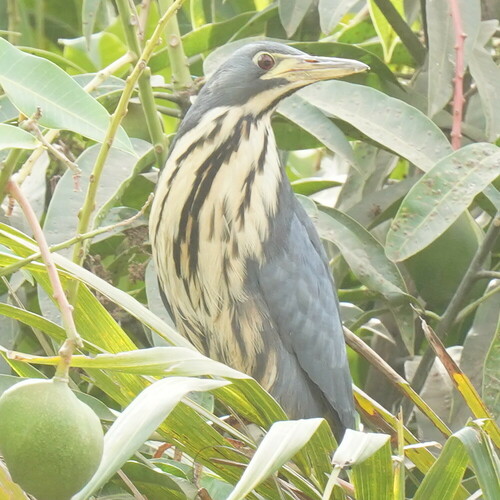 Dwarf Bittern
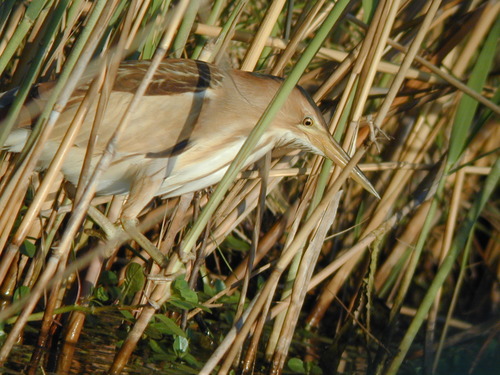 Little Bittern
In short
The most reliable field mark for separating Dwarf Bittern from Little Bittern is the presence of a pale or pinkish buff forewing panel in Little Bitterns of all ages, especially obvious in males, but also present (though duller) in females and juveniles; Dwarf Bittern lacks this contrasting wing panel entirely. Juvenile Little Bitterns are also more heavily streaked above and below than Dwarf Bitterns. Structurally, both are small, slim-necked herons, but Little Bittern is slightly heavier on average and has a reputation for being the smallest European heron. In perched or flight views, focus on the wing panel and overall streaking to avoid confusion, especially with immatures. Both species can occur in sub-Saharan Africa, but Little Bittern is migratory in Europe and only present there in the breeding season.
Identification tips
- Forewing panel in flight or perched: Little Bittern of all ages shows a pale or pinkish buff oval panel on the forewing, formed by the inner wing coverts. This is most obvious in adult males, less so in females and juveniles, but always present. Dwarf Bittern never shows a contrasting pale wing panel—its upperwing is uniformly dark. This is the single most reliable field mark at any age.
- Juvenile streaking: Juvenile Little Bitterns are more heavily streaked above and below, including the wing coverts, and are generally more rufous than Dwarf Bittern juveniles, which are plainer and less streaked. If you see a heavily streaked, rufous-toned bittern, suspect Little Bittern.
- Underwing color in flight: Little Bitterns have a whitish underwing, which can be seen in flight, especially from below. Dwarf Bittern's underwing is not described as contrastingly pale.
- Sexual dimorphism: Adult male Little Bitterns have a glossy black crown, nape, back, tail, and scapulars with a faint green sheen, and clean pale buff underparts. Females are browner with streaked underparts and less contrast. Dwarf Bittern does not show such strong sexual differences or the glossy black upperparts.
- Bill and neck: Both species have long, sharp bills and thick necks. Bill color and shape are not described as diagnostic between these two.
- Size and structure: Both are small, compact herons. Little Bittern is slightly heavier on average and is the smallest European heron, but in the field this is not a reliable separator.
- Season and location: In Europe, Little Bittern is present only from mid-April to October; any small bittern outside this period is likely not Little Bittern. In sub-Saharan Africa, both can occur, but Dwarf Bittern is resident while Little Bittern is a migrant.
- Habitat: Both species prefer wetlands with dense emergent vegetation. Habitat is not a reliable separator unless considering geographic range and season.
- Behavior: Both species are secretive, freeze when alarmed, and fly with rapid, shallow wingbeats. Behavior alone is not diagnostic.
- Pitfalls with immatures: Immature Little Bitterns can be confused with Dwarf Bittern, but the presence of the pale wing panel and heavier streaking in Little Bittern juveniles are key. Always try to see the upperwing in flight or at rest.
- Absence of pale wing panel: If you see a small bittern with a uniformly dark upperwing and no hint of a pale panel, especially in Africa, Dwarf Bittern is much more likely.
- Upperparts gloss: The faint green sheen on the black upperparts of male Little Bittern is not matched in Dwarf Bittern.
- Underpart color: Clean pale buff underparts in male Little Bittern vs. less clean, streaked underparts in females and juveniles; Dwarf Bittern is not described as having such clean or contrasting underparts.
- Community tip: In mixed flocks or at migration hotspots, always check for the pale wing panel before assuming a small bittern is Dwarf Bittern.
Size
Both species are very similar in size, with Dwarf Bittern averaging 142 g and Little Bittern 147 g in body mass [wikidata]. Little Bittern is described as the smallest breeding heron in Europe, with a length of 33–38 cm and wingspan of 52–58 cm [wikipedia]. In the hand or at close range, size is not a reliable separator, but Little Bittern may appear slightly bulkier. In the field, both are small, compact herons with thick necks and long, sharp bills.
Plumage
The key plumage difference is the pale or pinkish buff forewing panel present in all ages and sexes of Little Bittern, most striking in adult males (oval-shaped, contrasting with black wings), less obvious but still present in females and juveniles. Dwarf Bittern lacks any such pale wing panel, so its upperwing is more uniformly dark. Juvenile Little Bitterns are also more heavily streaked above and below, including on the wing coverts, and show a rufous tone; Dwarf Bittern juveniles are less streaked and plainer overall. Adult male Little Bitterns have a glossy black crown, nape, back, tail, and scapulars with a faint green sheen and clean pale buff underparts, while females are browner with streaked underparts and less contrast overall. Dwarf Bitterns do not show the same degree of sexual dimorphism or the contrasting wing panel. In flight, the white underwing of Little Bittern is also a useful mark, especially if seen from below.
Behaviour
Both species are secretive, skulking herons that prefer dense cover and are most often seen when flushed. Their behavior is similar: both freeze with necks extended when alarmed and fly with rapid, shallow wingbeats. There is no strong behavioral difference noted in the sources to separate them in the field.
Habitat
Dwarf Bittern is widely distributed across sub-Saharan Africa, avoiding only very arid regions [wikipedia]. Little Bittern breeds in Europe and migrates to Africa for the non-breeding season, reaching as far south as Eastern Cape and Transvaal [wikipedia]. In Europe, Little Bittern is present only from mid-April to October, so any bittern seen outside this window is unlikely to be Little Bittern. In Africa, both species can occur together, but Dwarf Bittern is resident while Little Bittern is a migrant. Both favor wetlands with dense emergent vegetation.