

Daurian Jackdaw vs House Crow
Coloeus dauuricus versus Corvus splendens
Play a quiz with Daurian Jackdaw and House Crow
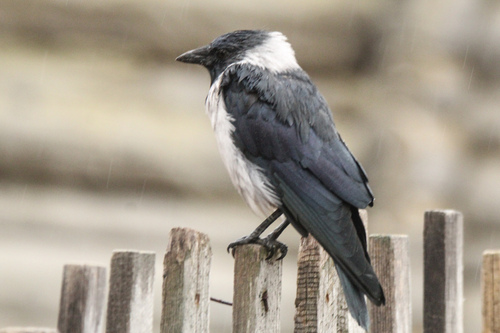 Daurian Jackdaw
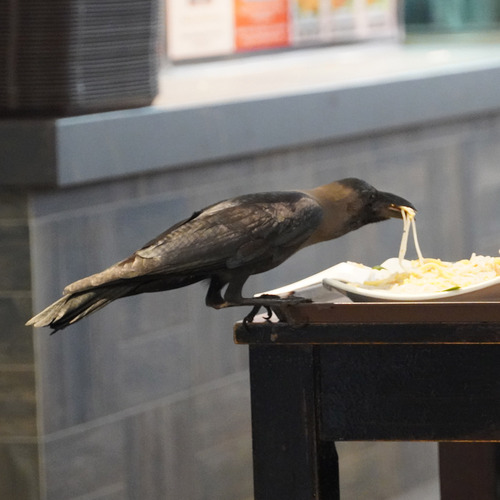 House Crow
In short
The most reliable field mark to separate Daurian Jackdaw from House Crow is the presence of extensive creamy white or pale areas on the lower face, neck, and underparts of many adult Daurian Jackdaws, forming a broad pale collar—completely absent in House Crow. Daurian Jackdaw is also notably smaller and chunkier, with a shorter bill and all-black iris, while the House Crow is longer, slimmer, and shows a clear contrast between its black face/throat and paler grey-brown neck and breast. Young Daurian Jackdaws and dark adults can resemble House Crow in overall darkness, but iris color and subtle plumage details remain useful. Both species may be seen in urban or open habitats, but their structure and plumage differences are diagnostic at close range.
Identification tips
- Pale Collar (Daurian Jackdaw adults): Look for a broad creamy white or pale collar wrapping around the lower face and neck—present in many adults, never in House Crow.
- All-dark Individuals: Young and some adult Daurian Jackdaws can be nearly all dark, resembling House Crow. In these cases, check for subtle pale feathering or grizzled grey ear coverts on Daurian Jackdaw.
- Iris Color: Daurian Jackdaw has a black iris, while House Crow's is dark brown. This can be hard to see at a distance but is diagnostic at close range.
- Head and Throat: House Crow has a sharply defined glossy black forehead, crown, throat, and upper breast, contrasting with a paler grey-brown neck and lower breast. Daurian Jackdaw's black is more confined to the head, throat, wings, and tail, with the rest often pale (adults) or dark (young).
- Bill Structure: Daurian Jackdaw has a shorter, stubbier bill, while House Crow's bill is longer and slimmer, fitting its more elongated head profile.
- Body Shape: Daurian Jackdaw is compact and short-necked, with a shorter tail and a more upright stance. House Crow is longer, slimmer, and appears more stretched out, especially in flight.
- Size: Daurian Jackdaw is about 32 cm long; House Crow is about 40 cm and heavier, often noticeably larger when seen together.
- Wing and Tail: No distinctive age-specific flight pattern marks are described for either species, so rely on perched views for separation.
- Legs: Both have black legs, not useful for separation.
- Habitat Context: If in a densely urban or port setting, House Crow is more likely, especially outside Daurian Jackdaw's range. In open country or rural settlements in eastern Asia, Daurian Jackdaw is more probable.
- Nest Sites: Daurian Jackdaw often uses cavities or tree hollows; House Crow usually nests in open branches.
- Mixed Flocks: If seen with Eurasian Jackdaws, suspect Daurian Jackdaw; House Crow rarely associates with jackdaws.
- Regional Variation: House Crow can show some variation in bill thickness and grey tone, but never develops a pale collar or white underparts.
- Confusion with Other Corvids: Daurian Jackdaw is much smaller than Chinese Collared Crow, which is not likely to be confused with House Crow.
- Fallback: If all else fails, focus on the presence or absence of any pale collar or underparts, iris color, and overall size/shape for the most reliable separation.
Size
Daurian Jackdaw is distinctly smaller and more compact, about 32 cm in length, compared to the House Crow's 40 cm. The House Crow is not only longer but also slimmer and lighter in build, with a more elongated profile. The House Crow's average body mass is around 293.5 g [wikidata], which is heavier than typical jackdaw species. In the field, Daurian Jackdaw often appears short-necked and short-billed, while House Crow looks rangier with a proportionally longer bill and tail.
Plumage
Adult Daurian Jackdaws often show large creamy white or pale areas on the lower face, neck, and underparts, forming a broad pale collar that extends up around the neck—this is the single most distinctive feature and is never present in House Crow. Their head, throat, wings, and tail are glossy black, with grizzled grey ear coverts. However, some adults and all young Daurian Jackdaws can be much darker, resembling House Crow in overall tone. In these cases, iris color (black in Daurian Jackdaw vs. dark brown in House Crow) and the presence of any pale feathering remain useful. House Crow always lacks white or creamy areas; instead, it has a sharply demarcated glossy black forehead, crown, throat, and upper breast, with the rest of the neck and breast a lighter grey-brown. The wings, tail, and legs are black. There are no age-specific upperwing or flight pattern marks described for either species, so perched and close-range views are most reliable for separation.
Behaviour
Both species are social and often seen in flocks, especially around human settlements. Daurian Jackdaw tends to nest in cavities or trees when available, while House Crow is more likely to nest in open branches and is highly adaptable to urban environments. In flight, Daurian Jackdaw appears more compact and direct, while House Crow's longer wings and tail give it a more elongated, sometimes lazier flight profile.
Habitat
Both species are highly adaptable and often found in urban, suburban, and agricultural areas. Daurian Jackdaw is native to eastern Asia and favors open country, farmland, and settlements, often nesting in trees or buildings. House Crow, originally from South Asia, is now widespread in cities and ports across Asia and beyond, typically thriving in densely populated areas and rarely far from human activity. Overlap may occur in some urban settings, but Daurian Jackdaw is more likely in open or rural landscapes, while House Crow is almost always in close association with people.