
Cyprus Wheatear vs Eastern Black-eared Wheatear
Oenanthe cypriaca versus Oenanthe melanoleuca
Play a quiz with Cyprus Wheatear and Eastern Black-eared Wheatear
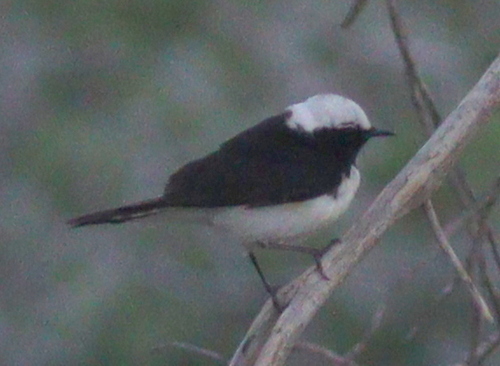 Cyprus Wheatear
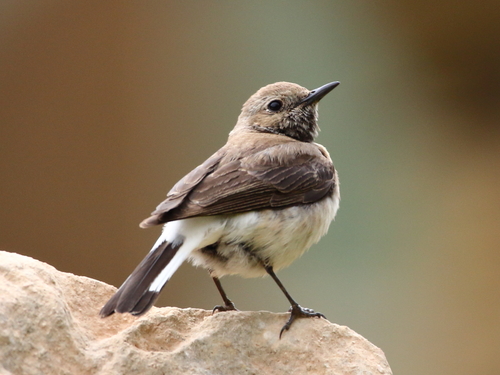 Eastern Black-eared Wheatear
In short
To separate Cyprus Wheatear from Eastern Black-eared Wheatear, focus first on the overall black-and-white contrast and the extent of black on the head and back: Cyprus Wheatear is more uniformly black above, with little to no sexual dimorphism, while Eastern Black-eared Wheatear males show a striking white crown and mantle with a sharp black mask. Cyprus Wheatear is also more arboreal, often seen higher in trees, and its song is a unique high-pitched buzzing, unlike the typical wheatear song. Females and non-breeding birds are trickier, but Cyprus Wheatear remains darker and less buff overall. If you see a wheatear in Cyprus in summer, Cyprus Wheatear is the default, but check for these field marks to be sure.
Identification tips
- Head and back color (adults, all seasons): Cyprus Wheatear is more extensively black above, with more black on the head, back, and tail. Eastern Black-eared Wheatear males have a white or whitish crown and mantle, with a sharply defined black mask and mostly white back.
- Sexual dimorphism: Cyprus Wheatear shows little to no difference between sexes; both male and female look alike. Eastern Black-eared Wheatear shows strong sexual dimorphism, with males much brighter and more contrasting than females.
- Tail pattern: Cyprus Wheatear has slightly more black on the tail than Eastern Black-eared Wheatear. In the latter, all but the central tail feathers are white, with the white often extending to the tip of the inner web.
- Mask and throat: Eastern Black-eared Wheatear males have a sharp black mask extending to the bill and a black or white throat (black-throated birds have more extensive black than Western Black-eared). Cyprus Wheatear's black is more diffuse and covers more of the head.
- Upperparts in non-breeding plumage: Eastern Black-eared Wheatear becomes distinctly buff on the head, mantle, and underparts in autumn and winter, while Cyprus Wheatear remains darker and less buff.
- Female plumage: Female Cyprus Wheatear is similar to the male, remaining dark and lacking strong contrast. Female Eastern Black-eared Wheatear is more gray-brown, with a colder, duller look and a characteristic white lower back.
- Song: Cyprus Wheatear's song is a high-pitched buzzing, insect-like series of bursts, very different from the typical wheatear song. If you hear this, it's diagnostic for Cyprus Wheatear.
- Perching height and behavior: Cyprus Wheatear often perches high (5–10 m) in trees and uses aerial sallying. Eastern Black-eared Wheatear is more often seen on rocks, low shrubs, or the ground.
- Habitat: In Cyprus, woodland or forest-edge birds are almost always Cyprus Wheatear. Eastern Black-eared Wheatear prefers open, rocky, or shrubby habitats.
- Geographic context: Cyprus Wheatear breeds only in Cyprus; elsewhere, it's a rare vagrant. Eastern Black-eared Wheatear is widespread in southeastern Europe and western Asia.
- Seasonal context: In Cyprus during the breeding season, almost all wheatears in wooded habitats are Cyprus Wheatear. Migrants or vagrants should be checked carefully for the above field marks.
- White on back and tail: Eastern Black-eared Wheatear males show a striking white back and tail (except central feathers), while Cyprus Wheatear is darker above and on the tail.
- Buff tones: If you see strong buff tones on the head and underparts (especially in autumn/winter), suspect Eastern Black-eared Wheatear; Cyprus Wheatear stays darker.
- Lack of strong upperpart contrast: Cyprus Wheatear lacks the sharp black-and-white contrast of Eastern Black-eared Wheatear males, appearing more uniformly dark above.
- Pitfalls: Non-breeding and female Eastern Black-eared Wheatears can appear dull and less contrasting, but will still show the white lower back and tail, and lack the extensive black of Cyprus Wheatear.
Size
Both species are small, slender wheatears of similar length (Cyprus Wheatear: 14–15 cm [wikipedia]), with no strong difference in size or structure noted in the available sources. Biometrics do differ subtly, but these are not field-separable with binoculars.
Plumage
Juvenile and first-winter plumages are not described in detail for either species in the provided notes, so focus is on adult and seasonal variation. Adult Cyprus Wheatear is more extensively black above, with more black on the tail, back, and head, and shows little to no difference between sexes. Eastern Black-eared Wheatear males in breeding plumage have a white or nearly white crown, forehead, and mantle, a sharply defined black mask, and a mostly white back and tail, with only the central tail feathers dark. Their underparts are white with a buff tinge, and the throat can be black or white. In non-breeding plumage, Eastern Black-eared Wheatear becomes buffier above and below, but still retains a colder, duller tone in females compared to Western Black-eared Wheatear. Cyprus Wheatear, by contrast, remains darker, with more black on the upperparts and tail, and both sexes look alike year-round.
Behaviour
Cyprus Wheatear is notably more arboreal than Eastern Black-eared Wheatear, often perching 5–10 meters up in trees and using aerial sallying to catch insects. It breeds in woodland and forest-edge habitats, unlike the more typical open-country behavior of Eastern Black-eared Wheatear. Both species use perch-pounce feeding, but Cyprus Wheatear is more likely to be seen in or near trees.
Habitat
Cyprus Wheatear breeds exclusively in Cyprus and is the most arboreal wheatear in the Western Palearctic, preferring woodland or forest edge with some open ground. Eastern Black-eared Wheatear is more widespread and favors open, rocky, or shrubby habitats, rarely venturing into dense woodland. If seen in a well-wooded setting in Cyprus, Cyprus Wheatear is far more likely.
Voice
Cyprus Wheatear's song is a distinctive series of high-pitched buzzing bursts, reminiscent of an insect, and is very different from the typical wheatear song. Eastern Black-eared Wheatear's vocalizations are not described in detail here, but are not noted as similar to Cyprus Wheatear's unique song.
Cyprus Wheatear · Eastern Black-eared Wheatear · My Tricky Birds