

Motmot

Crow-billed Drongo vs Bronzed Drongo

Dicrurus annectens versus Dicrurus aeneus

Play a quiz with Crow-billed Drongo and Bronzed Drongo
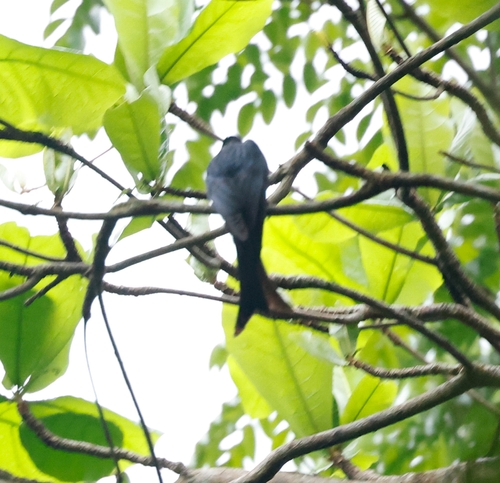
Crow-billed Drongo (Dicrurus annectens) Crow-billed Drongo
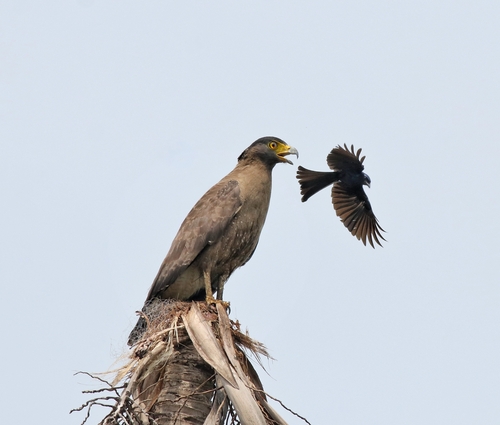
Bronzed Drongo (Dicrurus aeneus) Bronzed Drongo

Media

Loading…

In short

The most reliable field mark between Crow-billed Drongo and Bronzed Drongo is the overall plumage gloss and tail shape: Bronzed Drongo adults show a metallic, spangled gloss on the head, neck, and breast, with a slender, deeply forked tail whose outer feathers flare outward; Crow-billed Drongo is a uniform, jet-black bird with a stouter, less deeply forked tail. Immature Bronzed Drongos can be separated by white-tipped axillaries and a duller, brownish look with reduced spangling, while Crow-billed Drongo immatures remain plain black. Bill structure is also helpful: Crow-billed Drongo has a notably stout bill, unlike the finer bill of Bronzed Drongo. Both species overlap in forested habitats, but Bronzed Drongo is smaller and more compact.

Identification tips

  1. Juvenile/immature Bronzed Drongo shows white-tipped axillaries—look for these in birds stretching or preening, or in flight; Crow-billed Drongo immatures never show this mark.
  2. Immature Bronzed Drongo is dull brownish with little or no metallic gloss or spangling; Crow-billed Drongo immatures are plain black with no gloss or spangles.
  3. Adult Bronzed Drongo has a metallic, spangled gloss on head, neck, and breast; Crow-billed Drongo is uniformly jet-black and lacks any spangled or metallic sheen.
  4. Tail shape is key: Bronzed Drongo's tail is slender, deeply forked, and the outer feathers flare outward; Crow-billed Drongo's tail is only shallowly forked and appears broader.
  5. Bill structure: Crow-billed Drongo has a notably stout, heavy bill, while Bronzed Drongo's bill is finer and less deep.
  6. Body size and jizz: Crow-billed Drongo is heavier and bulkier; Bronzed Drongo is smaller, more compact, and often appears more agile.
  7. Lores and ear coverts: Bronzed Drongo has velvety lores and duller ear coverts; these are subtle but can help at close range.
  8. Perched vs. flight views: In perched birds, focus on tail shape, bill size, and gloss; in flight, look for white axillary tips (immature Bronzed Drongo) and overall jizz.
  9. Plumage pitfalls: In poor light, Bronzed Drongo's gloss may be hard to see—rely on tail shape and bill structure if gloss is not obvious.
  10. No reliable vocal differences are described in the sources provided—do not use voice for separation here.
  11. Both species can occur together in the same forested habitats—do not use habitat alone for ID.
  12. Sexes are similar in both species; do not attempt to sex birds for identification.
  13. Seasonal variation is minimal for adults, but immatures are most likely to be confused—prioritize age-specific marks.
  14. If in doubt, prioritize a combination of tail shape, bill structure, and (for immatures) axillary pattern and gloss.

Size

Crow-billed Drongo is distinctly heavier (body mass ~56g [wikidata]) and more robust than Bronzed Drongo, which is described as 'small' and 'compact' [wikipedia]. Bronzed Drongo is not only lighter but also appears more delicate in build, with a finer bill and slenderer tail. In direct comparison, Crow-billed Drongo will look bulkier and heavier-billed, while Bronzed Drongo is noticeably daintier.

Plumage

Immature Bronzed Drongos (juveniles and first-years) have white-tipped axillaries and an overall duller, brownish plumage with reduced metallic gloss and spangling, especially on the head and breast. This contrasts with Crow-billed Drongo immatures, which remain plain black without spangling or white axillary tips. Adult Bronzed Drongos are characterized by a metallic, spangled gloss on the head, neck, and breast, and velvety lores, while Crow-billed Drongo adults are entirely jet-black with no gloss or spangling. The tail of Bronzed Drongo is slender, deeply forked, and the outer feathers flare outward slightly, whereas Crow-billed Drongo's tail is only shallowly forked and appears more robust. These differences are visible both perched and in flight, but the axillary pattern in young Bronzed Drongo is especially diagnostic in flight or when preening.

Behaviour

Bronzed Drongo is noted for making aerial sallies from perches to catch insects in the shaded forest canopy, often appearing more active and agile. Crow-billed Drongo may also sally for insects but is generally less described as acrobatic or as tightly associated with aerial foraging in the canopy. Both species can be seen perched conspicuously, but Bronzed Drongo's smaller size and more energetic movements can be a subtle behavioral clue.

Habitat

Both species occur in moist tropical forests across South and Southeast Asia, often overlapping in range and habitat. Bronzed Drongo is particularly associated with the forest canopy and shaded areas, while Crow-billed Drongo is also a forest bird but may be encountered in a wider variety of wooded habitats. Habitat alone is not reliably diagnostic where ranges overlap.

Submit a better description

Use the same sections as the comparison. Your text is published immediately.

The most reliable field mark between Crow-billed Drongo and Bronzed Drongo is the overall plumage gloss and tail shape: Bronzed Drongo adults show a metallic, spangled gloss on the head, neck, and breast, with a slender, deeply forked tail whose outer feathers flare outward; Crow-billed Drongo is a uniform, jet-black bird with a stouter, less deeply forked tail. Immature Bronzed Drongos can be separated by white-tipped axillaries and a duller, brownish look with reduced spangling, while Crow-billed Drongo immatures remain plain black. Bill structure is also helpful: Crow-billed Drongo has a notably stout bill, unlike the finer bill of Bronzed Drongo. Both species overlap in forested habitats, but Bronzed Drongo is smaller and more compact.

  1. Juvenile/immature Bronzed Drongo shows white-tipped axillaries—look for these in birds stretching or preening, or in flight; Crow-billed Drongo immatures never show this mark.
  2. Immature Bronzed Drongo is dull brownish with little or no metallic gloss or spangling; Crow-billed Drongo immatures are plain black with no gloss or spangles.
  3. Adult Bronzed Drongo has a metallic, spangled gloss on head, neck, and breast; Crow-billed Drongo is uniformly jet-black and lacks any spangled or metallic sheen.
  4. Tail shape is key: Bronzed Drongo's tail is slender, deeply forked, and the outer feathers flare outward; Crow-billed Drongo's tail is only shallowly forked and appears broader.
  5. Bill structure: Crow-billed Drongo has a notably stout, heavy bill, while Bronzed Drongo's bill is finer and less deep.
  6. Body size and jizz: Crow-billed Drongo is heavier and bulkier; Bronzed Drongo is smaller, more compact, and often appears more agile.
  7. Lores and ear coverts: Bronzed Drongo has velvety lores and duller ear coverts; these are subtle but can help at close range.
  8. Perched vs. flight views: In perched birds, focus on tail shape, bill size, and gloss; in flight, look for white axillary tips (immature Bronzed Drongo) and overall jizz.
  9. Plumage pitfalls: In poor light, Bronzed Drongo's gloss may be hard to see—rely on tail shape and bill structure if gloss is not obvious.
  10. No reliable vocal differences are described in the sources provided—do not use voice for separation here.
  11. Both species can occur together in the same forested habitats—do not use habitat alone for ID.
  12. Sexes are similar in both species; do not attempt to sex birds for identification.
  13. Seasonal variation is minimal for adults, but immatures are most likely to be confused—prioritize age-specific marks.
  14. If in doubt, prioritize a combination of tail shape, bill structure, and (for immatures) axillary pattern and gloss.

Crow-billed Drongo is distinctly heavier (body mass ~56g [wikidata]) and more robust than Bronzed Drongo, which is described as 'small' and 'compact' [wikipedia]. Bronzed Drongo is not only lighter but also appears more delicate in build, with a finer bill and slenderer tail. In direct comparison, Crow-billed Drongo will look bulkier and heavier-billed, while Bronzed Drongo is noticeably daintier.

Immature Bronzed Drongos (juveniles and first-years) have white-tipped axillaries and an overall duller, brownish plumage with reduced metallic gloss and spangling, especially on the head and breast. This contrasts with Crow-billed Drongo immatures, which remain plain black without spangling or white axillary tips. Adult Bronzed Drongos are characterized by a metallic, spangled gloss on the head, neck, and breast, and velvety lores, while Crow-billed Drongo adults are entirely jet-black with no gloss or spangling. The tail of Bronzed Drongo is slender, deeply forked, and the outer feathers flare outward slightly, whereas Crow-billed Drongo's tail is only shallowly forked and appears more robust. These differences are visible both perched and in flight, but the axillary pattern in young Bronzed Drongo is especially diagnostic in flight or when preening.

Bronzed Drongo is noted for making aerial sallies from perches to catch insects in the shaded forest canopy, often appearing more active and agile. Crow-billed Drongo may also sally for insects but is generally less described as acrobatic or as tightly associated with aerial foraging in the canopy. Both species can be seen perched conspicuously, but Bronzed Drongo's smaller size and more energetic movements can be a subtle behavioral clue.

Both species occur in moist tropical forests across South and Southeast Asia, often overlapping in range and habitat. Bronzed Drongo is particularly associated with the forest canopy and shaded areas, while Crow-billed Drongo is also a forest bird but may be encountered in a wider variety of wooded habitats. Habitat alone is not reliably diagnostic where ranges overlap.

Discard your changes?

You have unsaved edits. If you leave now, those changes will be lost.

Crow-billed Drongo · Bronzed Drongo · My Tricky Birds