

Crane Hawk vs Harris's Hawk
Geranospiza caerulescens versus Parabuteo unicinctus
Play a quiz with Crane Hawk and Harris's Hawk
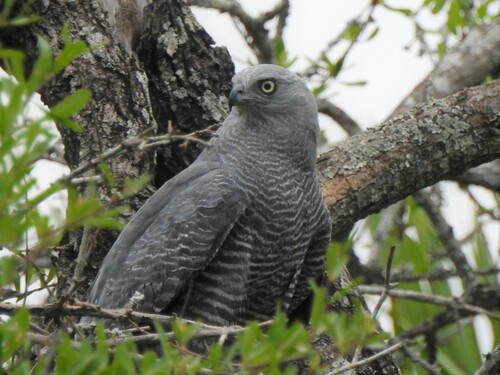 Crane Hawk
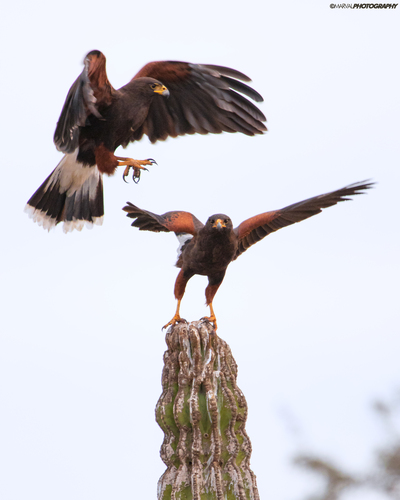 Harris's Hawk
In short
The most reliable field mark between Crane Hawk and Harris's Hawk is the juvenile wing and underpart pattern: juvenile Harris's Hawks show pale, buffy underwings with brown streaking and a pale panel on the outer wing, whereas Crane Hawks of all ages are more uniformly dark. Adult Harris's Hawks are much heavier-bodied and display bold white bands at both the base and tip of the tail, while Crane Hawks lack these distinct tail bands and are slimmer overall. In perched views, Harris's Hawk shows chestnut shoulders and thighs, while Crane Hawk is more uniformly gray to blackish. Behaviorally, Crane Hawk’s unique double-jointed legs and habit of probing into tree cavities is distinctive if observed. Both species may overlap in range in northern South America, but Harris's Hawk is much larger and more robust.
Identification tips
- Juvenile wing and underpart pattern: Juvenile Harris's Hawks have buffy underwings with brown streaking and a pale panel on the outer wing, plus heavily streaked pale underparts. Crane Hawk juveniles are uniformly dark and lack these pale panels or streaking. This is the most reliable field mark in flight for immatures.
- Tail pattern: Adult Harris's Hawks show bold white bands at both the base and tip of the tail, visible in flight and when perched. These bands are broader in P. u. harrisi. Crane Hawk lacks these strong white tail bands, showing a more uniform tail.
- Chestnut patches: Harris's Hawk (all ages) displays rich chestnut on the shoulders and thighs, especially obvious in adults. Crane Hawk is uniformly gray to blackish with no chestnut.
- Overall coloration: Crane Hawk is more monochrome, with little contrast between body parts, while Harris's Hawk is dark brown with contrasting chestnut and white.
- Size and structure: Harris's Hawk is much larger and bulkier (843.7 g vs. 303.5 g). It appears deep-chested and robust, while Crane Hawk is slender and lightly built. This is useful when size can be judged.
- Legs and behavior: If observed, Crane Hawk’s double-jointed legs and habit of probing into tree cavities is diagnostic. Harris's Hawk never shows this behavior.
- Flight style: Harris's Hawk often glides low over open terrain and may be seen in groups. Crane Hawk forages singly, often perching high or flying through wooded areas.
- Habitat: Harris's Hawk prefers open or semi-open habitats, often perching on cacti or small trees. Crane Hawk is more likely in forested or riparian habitats, especially near water.
- Group size: Harris's Hawk is often seen in groups or family parties, especially during hunting or at nests. Crane Hawk is usually solitary.
- Juvenile confusion: Juvenile Harris's Hawks can look very different from adults, being much paler and streaked, but always show the chestnut plumage and pale wing panels. Crane Hawk juveniles are not paler or streaked.
- Perched silhouette: Harris's Hawk appears heavy-bodied with a large head and deep chest. Crane Hawk is slim with a more delicate, upright posture.
- Tail length and shape: Harris's Hawk has a relatively long tail with a squared tip, accentuated by the white bands. Crane Hawk’s tail is more uniform and less boldly marked.
- Subspecies variation: If seen in northern South America, note that P. u. unicinctus (southern subspecies) is smaller and has a more patterned, lighter underwing than P. u. harrisi, but both still show the white tail bands and chestnut patches.
- Nesting context: Harris's Hawk nests are often in open country, sometimes with multiple adults attending. Crane Hawk nests high in tree canopies, often among epiphytes.
- When marks fail: At great distance or in poor light, size and tail pattern are the most reliable; if only a silhouette is visible, note group size and any chestnut tones for Harris's Hawk, or look for probing behavior for Crane Hawk.
Size
Harris's Hawk is significantly larger and heavier than Crane Hawk, with an average adult mass of 843.7 g compared to the Crane Hawk's 303.5 g [wikidata]. In the field, Harris's Hawk appears bulkier, with a deeper chest and heavier build, while Crane Hawk is slender and more lightly built. This size difference is noticeable both in flight and when perched, especially if seen together or with familiar reference species.
Plumage
Juvenile Harris's Hawks are distinctly paler below, with heavy white or buff streaking on the underparts and buffy underwings marked with brown streaking. The primaries are whitish except at the tips, creating a pale panel on the outer wing in flight. The tail of juveniles also shows a paler band than adults. In contrast, Crane Hawk of all ages is more uniformly gray to blackish, lacking the pale underwing panels or streaked underparts. Adult Harris's Hawks are dark brown overall with rich chestnut on the shoulders and thighs, and show bold white bands at both the base and tip of the tail—these bands are broader in the northern subspecies (P. u. harrisi) and narrower but still present in P. u. unicinctus. Crane Hawk lacks these strong tail bands and is more evenly colored, with only subtle clinal variation across its range. In perched views, Harris's Hawk's chestnut patches are diagnostic, while Crane Hawk appears more monochrome.
Behaviour
Crane Hawk is unique among Neotropical raptors for its double-jointed tarsal bones, allowing it to probe into tree cavities and crevices for prey—a behavior not seen in Harris's Hawk. Crane Hawk often forages by scanning from a perch or flying low and swooping down, but its cavity-probing is a standout behavioral field mark. Harris's Hawk is well known for cooperative hunting and social nesting, often seen in small groups, and may show three birds attending a single nest. Harris's Hawk typically hunts from perches or glides low over open terrain, rarely showing the probing behavior of Crane Hawk.
Habitat
Both species can occur in overlapping regions in northern South America, but Harris's Hawk is more often found in open or semi-open habitats such as savannas, scrub, and desert edges, frequently nesting in small trees, shrubs, or cacti. Crane Hawk prefers wooded areas, especially near water, and is more likely to be seen in forested or riparian zones, often perching high in the canopy or probing tree cavities. If seen in dense forest or probing in epiphytes, Crane Hawk is more likely; in open country or perched on cacti, Harris's Hawk is favored.