

Cory's Shearwater vs Sooty Shearwater
Calonectris diomedea versus Ardenna grisea
Play a quiz with Cory's Shearwater and Sooty Shearwater
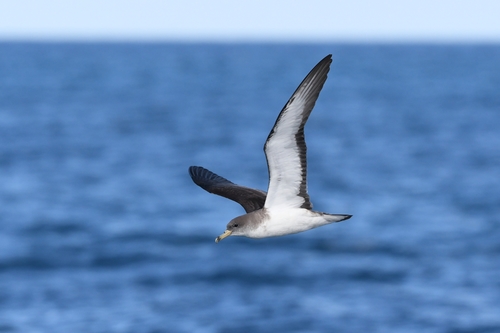 Cory's Shearwater
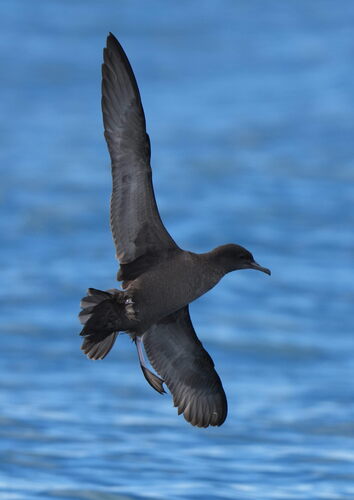 Sooty Shearwater
In short
The most reliable field mark to separate Cory's (Scopoli's) Shearwater from Sooty Shearwater is the underwing pattern: Cory's shows mostly white underwings with a broad white panel extending to the wingtips (especially the outermost primary), while Sooty Shearwater has dark underwings with only a narrow silvery central stripe. Sooty Shearwater appears overall much darker, often looking nearly black or dark chocolate-brown, whereas Cory's is brownish-grey above and white below. In flight, Sooty Shearwater's powerful, stiff-winged, direct flight and all-dark look contrast with Cory's more languid, pale-bellied appearance. These differences are visible in all plumages, but especially clear in good light and when viewing the underwing. Structure and bill color can help at close range, but underwing and overall darkness are the most practical field marks.
Identification tips
- Underwing pattern is key: Cory's Shearwater shows mostly white underwings with a broad white panel reaching the wingtips, especially on the outermost primary (P10); Sooty Shearwater has dark underwings with only a narrow silvery central stripe. This is visible in all ages and is the most reliable field mark in flight.
- Overall darkness: Sooty Shearwater appears all dark—blackish or dark chocolate-brown above and below—while Cory's is brownish-grey above and clean white below. In poor light, Sooty can look entirely black, but Cory's always shows a strong contrast between upperparts and white underparts.
- Bill color: Cory's has a pale yellow bill with a dark tip, while Sooty has a uniformly dark bill. This is best seen at close range but can help when visible.
- Flight style: Sooty Shearwater flies with stiff, straight wings and a powerful, direct flight, often shearing low over the water; Cory's is more languid, with slower, deeper wingbeats and more banking glides. This can be a supporting clue at distance.
- Upperwing color: Cory's upperwings are dark brown but with paler fringes, while Sooty's are uniformly dark with little contrast.
- Tail and rump: Cory's has whitish-tipped upper tail-coverts and a dark brown tail; Sooty's tail is dark and blends with the rest of the body, lacking pale tips.
- Head and nape: Sooty may show a slightly paler head or nape in good light, but never the strong contrast of Cory's white face and underparts.
- Size and structure: Cory's is bulkier and longer-winged, but this is subtle and not reliable unless birds are side by side.
- Habitat and range: In the Mediterranean, a large pale-bellied shearwater is almost certainly Cory's; in the North Atlantic, Sooty is the only all-dark large shearwater. Consider location and season for context.
- On the water: Cory's appears paler and bulkier, Sooty is a dark, low-slung shape.
- Voice: Not useful at sea; Sooty is vocal only at breeding sites or in feeding frenzies.
- Juvenile/immature confusion: No age-specific upperwing marks are noted for either species, so the underwing and overall darkness remain the best clues for all ages.
- Flock behavior: Sooty Shearwaters may occur in huge, fast-moving flocks, especially during migration; Cory's typically in smaller groups.
- Common pitfalls: In poor light, Sooty may look black and featureless, but Cory's always shows a white belly and underwing. At distance, check for the white underwing flash of Cory's versus the dark underwing of Sooty.
- When in doubt: Prioritize underwing pattern and overall darkness, then use bill color and flight style as supporting marks.
Size
Cory's Shearwater is slightly larger and heavier (body mass ~886 g) with a longer wingspan (112–122 cm) compared to Sooty Shearwater (wingspan 94–110 cm). Both are similar in length (Cory's 45–52 cm, Sooty 40–51 cm), but Cory's is bulkier and longer-winged. In the field, size difference is subtle and easily masked by distance or posture, so is not usually diagnostic unless birds are side by side.
Plumage
The underwing pattern is the most important difference at all ages: Cory's Shearwater (including immatures) has mostly white underwings with a broad white area extending to the wingtips, especially the outermost primary (P10), forming a bright, open look in flight. Sooty Shearwater of all ages is much darker overall, with underwings that are dark except for a narrow, silvery stripe along the center. Above, Cory's is brownish-grey with paler feather fringes and a white belly, while Sooty is uniformly dark chocolate-brown to blackish, sometimes showing a slightly paler head or nape but never with the extensive white below seen on Cory's. Bill color also differs: Cory's has a pale yellow bill with a dark tip, while Sooty has a dark bill. These contrasts hold for adults and immatures; there are no age-specific upperwing marks noted for either species.
Behaviour
In flight, Sooty Shearwater is notably powerful and direct, with stiff, straight wings and a flight style reminiscent of a small albatross, often shearing low over the water with few wingbeats. Cory's Shearwater has a more languid, gliding flight, often banking and arcing with slower, deeper wingbeats. Both species may follow ships or feeding whales, but Sooty Shearwaters are more likely to be seen in immense, fast-moving flocks, especially during migration. On the water, Cory's may appear bulkier and paler, while Sooty blends in as a dark shape.
Habitat
Cory's Shearwater breeds on rocky Mediterranean islands and is most likely seen in the Mediterranean or nearby Atlantic waters, especially outside the breeding season. Sooty Shearwater breeds in the southern hemisphere (New Zealand, South Atlantic islands) and migrates widely, appearing in northern oceans during the boreal summer. In the Atlantic, Sooty is the only all-dark large shearwater, while Cory's is the pale-bellied, white-underwinged species. Overlap is possible in the Atlantic, especially during migration, but context can help: a large, pale-bellied shearwater in the Mediterranean is almost certainly Cory's.
Voice
Sooty Shearwater is vocal at night on breeding grounds, with loud coos and croaks, but is usually silent at sea except when competing for food. Cory's Shearwater's voice is not described in these notes. Vocalizations are not typically useful for field separation at sea.