

Motmot

Cory's Shearwater vs Great Shearwater

Calonectris diomedea versus Ardenna gravis

Play a quiz with Cory's Shearwater and Great Shearwater
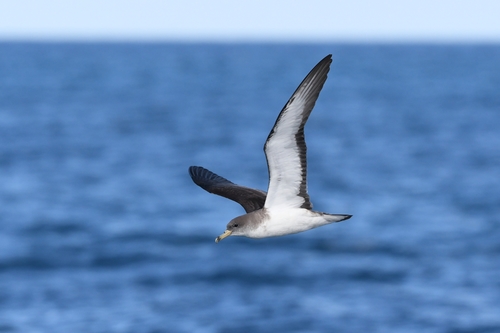
Cory's Shearwater (Calonectris diomedea) Cory's Shearwater
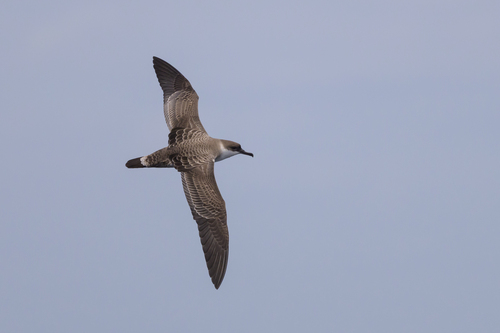
Great Shearwater (Ardenna gravis) Great Shearwater

Media

Loading…

In short

The most reliable field mark to separate Cory's Shearwater from Great Shearwater in flight is the underwing pattern: Cory's shows extensive white on the underwing, especially on the outer primaries (notably P10), while Great Shearwater has a narrower white underwing with a dark trailing edge and a more obvious dark bar at the shoulder. Great Shearwater also shows a distinctive dark belly patch and a black cap, both absent in Cory's. Bill color is another quick check—Cory's has a pale yellow bill with a dark tip, while Great's is all dark. Both are large shearwaters with similar size and flight style, but careful attention to these plumage and structural details will allow confident identification, even at a distance.

Identification tips

  1. Underwing pattern: Cory's Shearwater shows extensive white on the underwing, especially on the outermost primaries (notably P10), with only a narrow dark trailing edge. Great Shearwater has a narrower white underwing, a more prominent dark trailing edge, and a dark bar at the shoulder. This is the single most reliable field mark in flight for all ages.
  2. Belly patch: Great Shearwater has a distinct brown belly patch visible from below; Cory's Shearwater has clean white underparts without a belly patch. This mark is visible in all plumages and is especially helpful when birds bank or fly overhead.
  3. Head pattern: Great Shearwater shows a blackish cap contrasting with a white lower face and throat, while Cory's has a plain, pale head with no cap. This is best seen in good light or at close range.
  4. Bill color: Cory's Shearwater has a pale yellow bill with a dark tip; Great Shearwater's bill is entirely dark. Bill color can be hard to see at distance but is diagnostic at close range.
  5. Tail pattern: Great Shearwater shows a white horseshoe-shaped patch at the base of the tail, visible from behind or below. Cory's lacks this mark, having a uniformly dark tail.
  6. Upperparts: Cory's is brownish-grey above with lighter feather fringes, while Great Shearwater is darker overall, especially on the back and wings.
  7. Flight style: Both glide on stiff wings, but Great Shearwater's flight is more direct and stiff, sometimes reminiscent of a large Manx Shearwater. Cory's is more languid and buoyant, but this is subtle and not always reliable.
  8. Size and structure: Both are large, broad-winged shearwaters of similar size; size is not a reliable separator in the field.
  9. Leg and foot color: Cory's has pale flesh-colored legs and feet, but these are rarely visible at sea.
  10. Voice: Great Shearwater may give a piercing 'eeyah' when resting in groups; Cory's is usually silent at sea.
  11. Habitat and range: Overlap occurs in the North Atlantic, especially in late summer and autumn. Do not rely on range alone for separation in these areas.
  12. Sex and age: Both sexes and all ages are similar within each species; no strong age-related pitfalls are noted for these two in the field.
  13. Common pitfalls: Immature Cory's can appear darker above, but will never show the belly patch or black cap of Great Shearwater. In poor light, the underwing pattern is still the best separator.
  14. Mixed flocks: Both species may occur together in feeding flocks or behind fishing boats—use multiple marks for confident ID.
  15. When in doubt: Prioritize underwing pattern and belly patch, as these are visible in most flight views and are not shared between the two species.

Size

Both species are similar in size, with Cory's Shearwater slightly heavier on average (body mass ~886 g) and with a length of 45–52 cm and wingspan of 112–122 cm. Great Shearwater is just a bit smaller, at 43–51 cm in length and a wingspan of 105–122 cm. In the field, size alone is not a reliable separator, as overlap is substantial and both appear as large, broad-winged shearwaters.

Plumage

For all ages, Cory's Shearwater is brownish-grey above with darker wings and mostly white below, lacking any strong markings on the head or belly. The underwing is strikingly white, especially on the outer primaries, with only a narrow dark trailing edge. Great Shearwater, by contrast, has a blackish cap, a dark bill, and a distinct brown belly patch that is visible from below. The upperparts are darker overall, and the underwing has a narrower white area with a more prominent dark trailing edge and a dark bar at the shoulder. Great Shearwater also shows a white horseshoe-shaped patch at the base of the tail, which Cory's lacks. These differences are present in adults and immatures, and are most easily seen when the birds bank or glide low over the water. Sexes are similar in both species.

Behaviour

Both species exhibit classic shearwater flight, gliding low over the waves with stiff, straight wings and few wingbeats. Great Shearwater's flight is described as more 'stiff' and direct, reminiscent of a large Manx Shearwater, while Cory's is typically more languid and buoyant. Both will follow fishing boats and feed in mixed flocks, so behavior alone is not a strong separator. However, Great Shearwater is often more gregarious, forming large rafts on the water.

Habitat

Cory's Shearwater breeds on Mediterranean islands and forages in the Atlantic outside the breeding season, while Great Shearwater breeds in the South Atlantic and migrates north, often seen off both sides of the Atlantic. Both species can overlap in the North Atlantic during migration and post-breeding dispersal, especially off western Europe and the eastern seaboard of North America. Habitat at sea is similar—open ocean, often far from land.

Voice

Great Shearwater has a piercing 'eeyah' cry, usually heard when resting in groups on the water. Cory's Shearwater is generally silent at sea, and voice is not a reliable field mark unless birds are vocalizing at close range, which is rare during migration or pelagic trips.

Submit a better description

Use the same sections as the comparison. Your text is published immediately.

The most reliable field mark to separate Cory's Shearwater from Great Shearwater in flight is the underwing pattern: Cory's shows extensive white on the underwing, especially on the outer primaries (notably P10), while Great Shearwater has a narrower white underwing with a dark trailing edge and a more obvious dark bar at the shoulder. Great Shearwater also shows a distinctive dark belly patch and a black cap, both absent in Cory's. Bill color is another quick check—Cory's has a pale yellow bill with a dark tip, while Great's is all dark. Both are large shearwaters with similar size and flight style, but careful attention to these plumage and structural details will allow confident identification, even at a distance.

  1. Underwing pattern: Cory's Shearwater shows extensive white on the underwing, especially on the outermost primaries (notably P10), with only a narrow dark trailing edge. Great Shearwater has a narrower white underwing, a more prominent dark trailing edge, and a dark bar at the shoulder. This is the single most reliable field mark in flight for all ages.
  2. Belly patch: Great Shearwater has a distinct brown belly patch visible from below; Cory's Shearwater has clean white underparts without a belly patch. This mark is visible in all plumages and is especially helpful when birds bank or fly overhead.
  3. Head pattern: Great Shearwater shows a blackish cap contrasting with a white lower face and throat, while Cory's has a plain, pale head with no cap. This is best seen in good light or at close range.
  4. Bill color: Cory's Shearwater has a pale yellow bill with a dark tip; Great Shearwater's bill is entirely dark. Bill color can be hard to see at distance but is diagnostic at close range.
  5. Tail pattern: Great Shearwater shows a white horseshoe-shaped patch at the base of the tail, visible from behind or below. Cory's lacks this mark, having a uniformly dark tail.
  6. Upperparts: Cory's is brownish-grey above with lighter feather fringes, while Great Shearwater is darker overall, especially on the back and wings.
  7. Flight style: Both glide on stiff wings, but Great Shearwater's flight is more direct and stiff, sometimes reminiscent of a large Manx Shearwater. Cory's is more languid and buoyant, but this is subtle and not always reliable.
  8. Size and structure: Both are large, broad-winged shearwaters of similar size; size is not a reliable separator in the field.
  9. Leg and foot color: Cory's has pale flesh-colored legs and feet, but these are rarely visible at sea.
  10. Voice: Great Shearwater may give a piercing 'eeyah' when resting in groups; Cory's is usually silent at sea.
  11. Habitat and range: Overlap occurs in the North Atlantic, especially in late summer and autumn. Do not rely on range alone for separation in these areas.
  12. Sex and age: Both sexes and all ages are similar within each species; no strong age-related pitfalls are noted for these two in the field.
  13. Common pitfalls: Immature Cory's can appear darker above, but will never show the belly patch or black cap of Great Shearwater. In poor light, the underwing pattern is still the best separator.
  14. Mixed flocks: Both species may occur together in feeding flocks or behind fishing boats—use multiple marks for confident ID.
  15. When in doubt: Prioritize underwing pattern and belly patch, as these are visible in most flight views and are not shared between the two species.

Both species are similar in size, with Cory's Shearwater slightly heavier on average (body mass ~886 g) and with a length of 45–52 cm and wingspan of 112–122 cm. Great Shearwater is just a bit smaller, at 43–51 cm in length and a wingspan of 105–122 cm. In the field, size alone is not a reliable separator, as overlap is substantial and both appear as large, broad-winged shearwaters.

For all ages, Cory's Shearwater is brownish-grey above with darker wings and mostly white below, lacking any strong markings on the head or belly. The underwing is strikingly white, especially on the outer primaries, with only a narrow dark trailing edge. Great Shearwater, by contrast, has a blackish cap, a dark bill, and a distinct brown belly patch that is visible from below. The upperparts are darker overall, and the underwing has a narrower white area with a more prominent dark trailing edge and a dark bar at the shoulder. Great Shearwater also shows a white horseshoe-shaped patch at the base of the tail, which Cory's lacks. These differences are present in adults and immatures, and are most easily seen when the birds bank or glide low over the water. Sexes are similar in both species.

Both species exhibit classic shearwater flight, gliding low over the waves with stiff, straight wings and few wingbeats. Great Shearwater's flight is described as more 'stiff' and direct, reminiscent of a large Manx Shearwater, while Cory's is typically more languid and buoyant. Both will follow fishing boats and feed in mixed flocks, so behavior alone is not a strong separator. However, Great Shearwater is often more gregarious, forming large rafts on the water.

Cory's Shearwater breeds on Mediterranean islands and forages in the Atlantic outside the breeding season, while Great Shearwater breeds in the South Atlantic and migrates north, often seen off both sides of the Atlantic. Both species can overlap in the North Atlantic during migration and post-breeding dispersal, especially off western Europe and the eastern seaboard of North America. Habitat at sea is similar—open ocean, often far from land.

Great Shearwater has a piercing 'eeyah' cry, usually heard when resting in groups on the water. Cory's Shearwater is generally silent at sea, and voice is not a reliable field mark unless birds are vocalizing at close range, which is rare during migration or pelagic trips.

Discard your changes?

You have unsaved edits. If you leave now, those changes will be lost.

Cory's Shearwater · Great Shearwater · My Tricky Birds