

Common Whitethroat vs Dartford Warbler
Curruca communis versus Curruca undata
Play a quiz with Common Whitethroat and Dartford Warbler
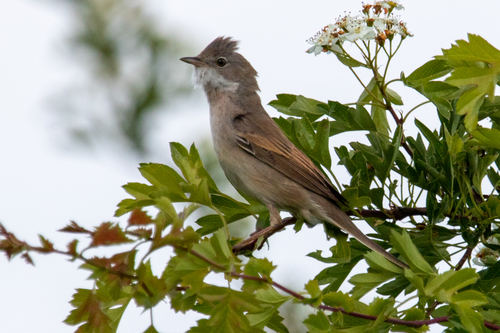 Common Whitethroat
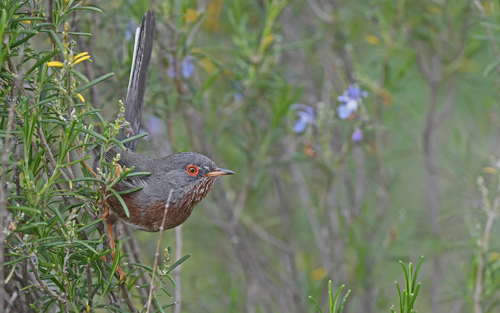 Dartford Warbler
In short
The most reliable field mark to separate Common Whitethroat from Dartford Warbler is the presence of a long, thin tail and reddish underparts with a red eye in Dartford Warbler, versus the shorter tail and more contrasting grey head and white throat (in males) of Common Whitethroat. Juvenile and female plumages can be confusing, but Dartford Warbler always shows a longer tail and more subdued, reddish-brown underparts, while Common Whitethroat is generally buff below with chestnut fringes on the wings. In flight or at rest, Dartford Warbler's tail length and muted, blending tones stand out, while Common Whitethroat is more contrasting and often appears brighter. Vocalizations differ, with Common Whitethroat giving a scratchy, scolding song and Dartford Warbler being quieter and less conspicuous.
Identification tips
- Tail length: Dartford Warbler always shows a long, thin tail, often held cocked or flicked; Common Whitethroat's tail is shorter and less prominent. This is the single most reliable structural mark.
- Head and throat contrast (adult males): Male Common Whitethroat has a striking grey head and bright white throat; Dartford Warbler male has a grey or grey-brown head but no sharp white throat, instead showing a reddish throat with white spots.
- Underparts color: Dartford Warbler is dull reddish-brown below with a dirty white belly patch; Common Whitethroat is buff below, lacking the reddish wash, and appears cleaner and brighter.
- Eye color: Dartford Warbler male has a red eye and eye-ring, which can be visible at close range; Common Whitethroat lacks this feature.
- Upperparts: Common Whitethroat is brown above with chestnut fringes on the secondaries (visible at close range or in good light); Dartford Warbler is more uniformly grey-brown or grey above, blending into its habitat.
- Female and juvenile confusion: Female and juvenile Common Whitethroat lack the male's grey head and have duller throats, but still show a shorter tail and less reddish below than Dartford Warbler. Juvenile Dartford Warbler resembles the female but always has a long tail and some reddish tones below.
- Flight and jizz: Dartford Warbler appears elongated and often flies low and weakly over heath, with its long tail trailing; Common Whitethroat is more compact and makes short, fluttery flights between perches.
- Habitat context: Dartford Warbler is almost always in heathland with gorse or heather; Common Whitethroat is found in a wider range of open scrub, hedgerows, and woodland edge.
- Vocalizations: A fast, scratchy, scolding song is diagnostic for Common Whitethroat; Dartford Warbler is much quieter and less likely to sing prominently.
- Season and migration: Common Whitethroat is a summer migrant in most of Europe; Dartford Warbler is resident or only locally migratory. Seeing a warbler in winter in western Europe is much more likely to be Dartford Warbler.
- Bill shape: Both have thin, pointed bills typical of warblers; not a strong field mark for separation.
- Plumage blending: Dartford Warbler's muted, blending tones help it disappear in heathland; Common Whitethroat is more contrasting and stands out more in open habitats.
- Secondary fringes: Chestnut fringes to the secondaries are a subtle but supporting mark for Common Whitethroat, especially in good light.
- White throat: Only Common Whitethroat (especially males) shows a clean, white throat; Dartford Warbler's throat is reddish with white spots.
- Pitfalls: In poor light or quick views, female and juvenile Common Whitethroat can look quite plain, but check for tail length and underpart color—Dartford Warbler is always longer-tailed and more reddish below.
Size
Common Whitethroat is slightly heavier (body mass ~14.5g [wikidata]), but both are small warblers and size alone is rarely diagnostic in the field. Dartford Warbler is noted for its proportionally much longer, thinner tail, which makes it appear more elongated and slender, especially when perched or moving through vegetation. Both are similar in overall body length, but the tail of Dartford Warbler is noticeably longer relative to its body.
Plumage
Juvenile and female Common Whitethroats are mainly brown above and buff below, with chestnut fringes to the secondaries. Adult males stand out with a grey head and bright white throat, while females lack the grey head and have a duller throat. Dartford Warbler of all ages shows a long, thin tail, greyish or grey-brown upperparts, and dull reddish-brown underparts, with a dirty white belly patch. Males have a red eye and a reddish throat with white spots; females and juveniles are paler below and browner above, but still show the long tail and reddish tones. The muted, blending tones of Dartford Warbler contrast with the more sharply marked and brighter Common Whitethroat, especially in adult males. No distinctive age-specific upperwing patterns are described for either species, so separation relies on overall coloration, tail length, and head/throat contrast.
Behaviour
Dartford Warbler is often seen skulking low in heathland or scrub, moving with its long tail cocked or flicked, and tends to be more secretive. It may perch atop gorse or heather but quickly drops back into cover. Common Whitethroat is more likely to be seen actively foraging in open scrub or hedgerows, often perching conspicuously and making short, fluttering flights between perches. In flight, Common Whitethroat appears more compact and less elongated than Dartford Warbler.
Habitat
Common Whitethroat breeds in a wide range of open habitats with shrubs, including hedgerows, scrub, and woodland edges across much of Europe and western Asia, and is strongly migratory, wintering in Africa and Asia. Dartford Warbler is much more habitat-restricted, favoring dry heathland with gorse or heather in western and southern Europe, and is largely resident in its range. Seeing a warbler in extensive heathland or gorse strongly favors Dartford Warbler, while open farmland, hedgerows, or mixed scrub is more typical for Common Whitethroat.
Voice
Common Whitethroat has a fast, scratchy, scolding song, and its call is a hoarse, nasal wed-wed or woid-woid, with a rough, drawn-out warning cry. Dartford Warbler is less vocal and more subdued, with no distinctive song or call described in the provided notes. In areas where both occur, a scratchy, prominent song usually points to Common Whitethroat.