

Common Swift vs Pallid Swift
Apus apus versus Apus pallidus
Play a quiz with Common Swift and Pallid Swift
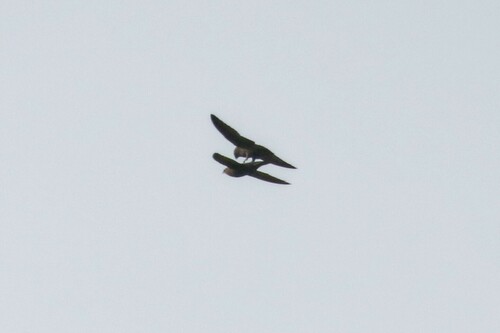 Common Swift
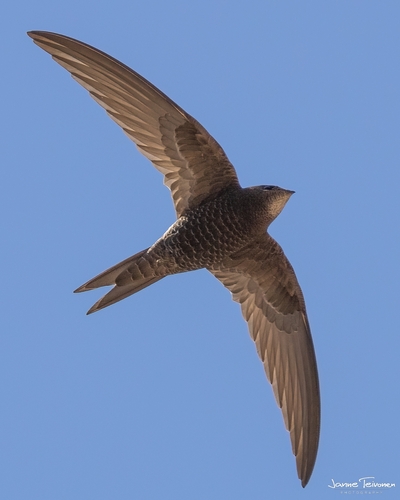 Pallid Swift
In short
Separating Common Swift from Pallid Swift is a classic field challenge, as both are very similar in size, shape, and flight style. The most reliable mark in good light is the overall tone and contrast: Pallid Swift shows a paler, browner appearance with a large, obvious white throat patch and more contrasty underparts, rump, and flight feathers, while Common Swift is a more uniform blackish-brown with only a small, less visible pale chin. Look for the scaly or mottled belly and paler flight feathers on Pallid, especially when seen from below. Both species share the same sickle-shaped wings and forked tail, so structure alone is rarely diagnostic. Calls are similar but may differ subtly in dryness and pattern. Only careful scrutiny of plumage contrast, especially in strong sunlight, usually clinches the ID.
Identification tips
- Throat Patch: Pallid Swift has a large, obvious white throat patch visible from a distance, while Common Swift's pale chin is much smaller and often invisible except at close range or in good light.
- Overall Tone: Pallid Swift is paler and browner, especially when seen in sunlight, whereas Common Swift is a uniform blackish-brown. This is most apparent when several swifts are present for comparison.
- Plumage Contrast: Look for the more contrasty appearance of Pallid Swift: paler underparts, rump, and flight feathers stand out against the darker body. Common Swift lacks this contrast and appears more uniform.
- Belly Texture: Pallid Swift often shows a scaly or mottled belly, especially in good light. Common Swift's belly is plain and unmarked.
- Flight Feathers: The paler flight feathers of Pallid Swift can create a subtle panel effect on the underwing, adding to the contrast. Common Swift's wings are uniformly dark.
- Rump: Pallid Swift's rump is paler and can be noticeable in good light; Common Swift's rump does not contrast with the rest of the body.
- Tail and Wing Shape: Both species have a short, forked tail and long, crescent-shaped wings. Structure alone is not a reliable separator.
- Size and Bulk: Both are similar in size and shape, but Pallid Swift may appear slightly chunkier. This is a subtle impression and not diagnostic on its own.
- Flight Style: Any difference in flight action is very subtle and should not be relied on unless you have extensive experience with both species.
- Voice: Calls are similar; Pallid Swift's may be drier or more disyllabic, but this is not a safe field mark for most observers.
- Lighting Conditions: In poor light or against a bright sky, both species can appear uniformly dark, making separation very difficult. Always try to view swifts in good light and from below.
- Plumage Wear and Age: No distinctive juvenile or immature wing patterns are described for either species, so all field marks apply to all ages.
- Season and Range: Not diagnostic here; both species can overlap in range and season.
- Pitfalls: Beware of relying on single features in poor light or at a distance. Multiple field marks in combination, especially throat patch size and underpart contrast, are the safest route to identification.
- Comparison Flocks: If both species are present, direct comparison can make the differences in tone and contrast more obvious. If only one species is present, be especially cautious with identification.
Size
Both species are essentially the same length (16–17 cm) and wingspan, and structure is very similar with long, swept-back wings and a short, forked tail. Pallid Swift has a recorded average body mass of 41.3 g, but no comparative mass is given for Common Swift; in the field, they are not reliably separable by size or bulk. Any impression of chunkiness in Pallid Swift is subtle and best used in combination with plumage marks.
Plumage
No age-specific juvenile or immature upperwing patterns are described for either species, so all contrasts below apply to adults and immatures alike. Pallid Swift stands out in good light by being a paler, browner swift with a large, obvious white throat patch that is visible from a distance. Its underparts and rump are paler and show more contrast with the rest of the body, and the belly often appears scaly or mottled. The flight feathers and underwing coverts are slightly paler, giving a more contrasty look overall. Common Swift is a uniform blackish-brown, with only a small white or pale grey chin patch that is not visible at a distance, and lacks the strong contrast of Pallid. Both have similar wing and tail shapes, and both can appear very dark in poor light or against a bright sky, which can obscure these subtle differences.
Behaviour
Both species spend almost their entire lives on the wing, rarely perching except to breed, and share the same rapid, agile, scything flight style. There is a suggestion that Pallid Swift may appear slightly chunkier and have a subtly different flight action, but this is not a consistently reliable field mark and should be used with caution. Both species feed on aerial insects and drink on the wing. Behavioral differences are not diagnostic in the field.
Habitat
No habitat differences are described in the provided notes. Both species are aerial insectivores and are typically seen high in the sky, often over urban areas, water, or open country.
Voice
Both species give loud, piercing screams in flight. The Pallid Swift's call is described as a loud, dry scream, possibly more disyllabic than the Common Swift's, but both are very similar and difficult to separate by ear alone. The Common Swift's call has two pitch levels, with the higher given by females, but this is not a practical field mark for separation.