

Motmot

Common Swift vs Pacific Swift

Apus apus versus Apus pacificus

Play a quiz with Common Swift and Pacific Swift
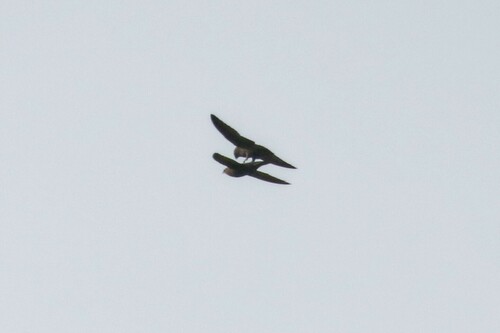
Common Swift (Apus apus) Common Swift
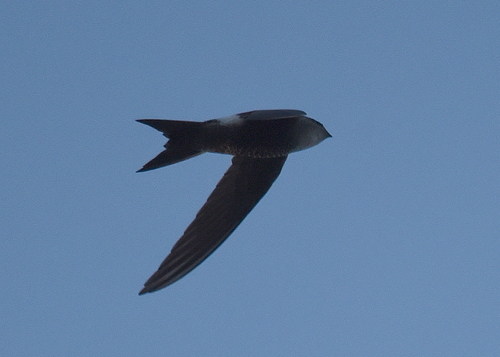
Pacific Swift (Apus pacificus) Pacific Swift

Media

Loading…

In short

The most reliable field mark to separate Common Swift from Pacific Swift is the white rump band: Pacific Swift always shows a bold white rump, while Common Swift is entirely dark except for a small, often hidden, pale throat patch. In flight, Pacific Swift also has a deeper tail fork and slightly longer wings, giving it a more angular look. Juvenile Pacific Swifts have pale feather fringes, especially on the wings and belly, creating a scaly effect below—this is never shown by Common Swift. Both species are very similar in overall structure and flight style, but careful attention to rump, tail depth, and underpart pattern will separate them in most views.

Identification tips

  1. White rump band: Pacific Swift always shows a bold white rump band, visible from above and often from below; Common Swift never shows this (all ages).
  2. Underpart pattern in juveniles: Juvenile Pacific Swifts have pale feather fringes on the belly and wings, giving a scaly or patterned appearance from below; Common Swift juveniles are uniformly dark below.
  3. Tail fork depth: Pacific Swift has a noticeably deeper forked tail compared to the shallower fork of Common Swift; best seen in gliding or when tail is spread.
  4. Wing length and shape: Pacific Swift's wings are longer and more angular, contributing to a more powerful, slightly less crescent-shaped silhouette than Common Swift.
  5. Broader rump: The white rump of Pacific Swift is not only paler but also broader than the small, dark rump of Common Swift.
  6. Throat patch: Common Swift has a small pale chin patch, but it is subtle and rarely visible in the field; Pacific Swift may have a greyer throat (especially in A. p. kurodae), but this is less useful than the rump band.
  7. Size: Pacific Swift is slightly larger and bulkier, but size is only useful with direct comparison or experience.
  8. Head projection: Pacific Swift has a more protruding head, giving a slightly different profile in flight, though this is subtle.
  9. Plumage pitfalls: Rare leucistic Common Swifts may show pale on the rump, but never a full, clean white band as in Pacific Swift. Always check for other marks.
  10. Sex and age: Both species are similar between sexes; age differences are most visible in Pacific Swift juveniles (scaly underparts, pale fringes).
  11. Flight style: Both species are fast and agile, but Pacific Swift may appear more powerful and slightly less fluttery due to size and wing shape.
  12. Habitat and range: Use location as a clue—Pacific Swift is expected in Asia/Australasia, Common Swift in Europe/Africa. Vagrants are rare but possible.
  13. Voice: Both species scream in flight; do not rely on voice for separation.
  14. Seasonality: Be aware of migration timing; Pacific Swift is a passage migrant in Southeast Asia and Australia, Common Swift in Europe and Africa.
  15. Direct comparison: When both species are present (rare), Pacific Swift will stand out by size, deeper tail fork, and especially the white rump.

Size

Pacific Swift is slightly larger, measuring 17–18 cm in length with a wingspan of 43–54 cm, and is the largest Apus swift. Common Swift is a bit smaller at 16–17 cm long and a 38–40 cm wingspan. The difference is subtle in the field, but Pacific Swift may appear bulkier and longer-winged, especially when seen alongside Common Swift. Females of Pacific Swift are slightly heavier than males, but this is not a field mark.

Plumage

Juvenile Pacific Swifts show pale fringes on the wing and body feathers, giving a scaly appearance to the belly and a slightly paler look overall—this is most obvious in fresh juveniles and fades as they moult. Adults of Pacific Swift always show a broad white rump band, contrasting with otherwise black upperparts, and a slightly greyer head. The underparts are black, but the feather fringes can give a patterned look from below. Common Swift, of all ages, is uniformly blackish-brown above and below, with only a small pale chin patch that is rarely visible in the field and never a white rump. The tail of Pacific Swift is more deeply forked, and the rump broader and whiter, while Common Swift's tail is shorter and less deeply forked. Southern Pacific Swift subspecies (A. p. kurodae) have a narrower white rump and greyer throat, but still show the white rump band. No Common Swift, even leucistic, shows the full white rump band of Pacific Swift, though rare pale-throated or aberrant birds can cause confusion.

Behaviour

Both species are highly aerial, rarely perching except at the nest, and spend most of their lives on the wing. Their flight is fast and direct with rapid wingbeats and long glides. Pacific Swift may appear slightly more powerful and angular in flight due to its larger size, longer wings, and deeper tail fork, but their jizz is otherwise very similar. Both form screaming parties, but this is not a reliable separator.

Habitat

Common Swift breeds across Europe and winters in Africa, while Pacific Swift breeds in eastern Asia and winters in Southeast Asia and Australia. Vagrants of Pacific Swift can appear in Europe and elsewhere, but Common Swift does not occur in the Pacific Swift's core Asian breeding range. Habitat overlap is rare except for vagrancy or on migration. Both species prefer open skies over lowlands and near water, but context is usually a clue: Pacific Swift is expected in Asia and Australasia, Common Swift in Europe and Africa.

Voice

Both species give loud, piercing screams in flight, and their calls are similar in tone and structure. There is no reliable field separation by voice alone based on available sources.

Submit a better description

Use the same sections as the comparison. Your text is published immediately.

The most reliable field mark to separate Common Swift from Pacific Swift is the white rump band: Pacific Swift always shows a bold white rump, while Common Swift is entirely dark except for a small, often hidden, pale throat patch. In flight, Pacific Swift also has a deeper tail fork and slightly longer wings, giving it a more angular look. Juvenile Pacific Swifts have pale feather fringes, especially on the wings and belly, creating a scaly effect below—this is never shown by Common Swift. Both species are very similar in overall structure and flight style, but careful attention to rump, tail depth, and underpart pattern will separate them in most views.

  1. White rump band: Pacific Swift always shows a bold white rump band, visible from above and often from below; Common Swift never shows this (all ages).
  2. Underpart pattern in juveniles: Juvenile Pacific Swifts have pale feather fringes on the belly and wings, giving a scaly or patterned appearance from below; Common Swift juveniles are uniformly dark below.
  3. Tail fork depth: Pacific Swift has a noticeably deeper forked tail compared to the shallower fork of Common Swift; best seen in gliding or when tail is spread.
  4. Wing length and shape: Pacific Swift's wings are longer and more angular, contributing to a more powerful, slightly less crescent-shaped silhouette than Common Swift.
  5. Broader rump: The white rump of Pacific Swift is not only paler but also broader than the small, dark rump of Common Swift.
  6. Throat patch: Common Swift has a small pale chin patch, but it is subtle and rarely visible in the field; Pacific Swift may have a greyer throat (especially in A. p. kurodae), but this is less useful than the rump band.
  7. Size: Pacific Swift is slightly larger and bulkier, but size is only useful with direct comparison or experience.
  8. Head projection: Pacific Swift has a more protruding head, giving a slightly different profile in flight, though this is subtle.
  9. Plumage pitfalls: Rare leucistic Common Swifts may show pale on the rump, but never a full, clean white band as in Pacific Swift. Always check for other marks.
  10. Sex and age: Both species are similar between sexes; age differences are most visible in Pacific Swift juveniles (scaly underparts, pale fringes).
  11. Flight style: Both species are fast and agile, but Pacific Swift may appear more powerful and slightly less fluttery due to size and wing shape.
  12. Habitat and range: Use location as a clue—Pacific Swift is expected in Asia/Australasia, Common Swift in Europe/Africa. Vagrants are rare but possible.
  13. Voice: Both species scream in flight; do not rely on voice for separation.
  14. Seasonality: Be aware of migration timing; Pacific Swift is a passage migrant in Southeast Asia and Australia, Common Swift in Europe and Africa.
  15. Direct comparison: When both species are present (rare), Pacific Swift will stand out by size, deeper tail fork, and especially the white rump.

Pacific Swift is slightly larger, measuring 17–18 cm in length with a wingspan of 43–54 cm, and is the largest Apus swift. Common Swift is a bit smaller at 16–17 cm long and a 38–40 cm wingspan. The difference is subtle in the field, but Pacific Swift may appear bulkier and longer-winged, especially when seen alongside Common Swift. Females of Pacific Swift are slightly heavier than males, but this is not a field mark.

Juvenile Pacific Swifts show pale fringes on the wing and body feathers, giving a scaly appearance to the belly and a slightly paler look overall—this is most obvious in fresh juveniles and fades as they moult. Adults of Pacific Swift always show a broad white rump band, contrasting with otherwise black upperparts, and a slightly greyer head. The underparts are black, but the feather fringes can give a patterned look from below. Common Swift, of all ages, is uniformly blackish-brown above and below, with only a small pale chin patch that is rarely visible in the field and never a white rump. The tail of Pacific Swift is more deeply forked, and the rump broader and whiter, while Common Swift's tail is shorter and less deeply forked. Southern Pacific Swift subspecies (A. p. kurodae) have a narrower white rump and greyer throat, but still show the white rump band. No Common Swift, even leucistic, shows the full white rump band of Pacific Swift, though rare pale-throated or aberrant birds can cause confusion.

Both species are highly aerial, rarely perching except at the nest, and spend most of their lives on the wing. Their flight is fast and direct with rapid wingbeats and long glides. Pacific Swift may appear slightly more powerful and angular in flight due to its larger size, longer wings, and deeper tail fork, but their jizz is otherwise very similar. Both form screaming parties, but this is not a reliable separator.

Common Swift breeds across Europe and winters in Africa, while Pacific Swift breeds in eastern Asia and winters in Southeast Asia and Australia. Vagrants of Pacific Swift can appear in Europe and elsewhere, but Common Swift does not occur in the Pacific Swift's core Asian breeding range. Habitat overlap is rare except for vagrancy or on migration. Both species prefer open skies over lowlands and near water, but context is usually a clue: Pacific Swift is expected in Asia and Australasia, Common Swift in Europe and Africa.

Both species give loud, piercing screams in flight, and their calls are similar in tone and structure. There is no reliable field separation by voice alone based on available sources.

Discard your changes?

You have unsaved edits. If you leave now, those changes will be lost.

Common Swift · Pacific Swift · My Tricky Birds