

Motmot

Common Scoter vs Black Scoter

Melanitta nigra versus Melanitta americana

Play a quiz with Common Scoter and Black Scoter
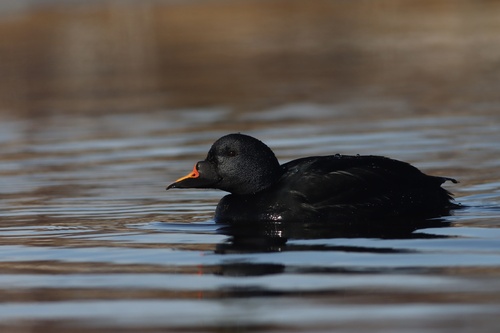
Common Scoter (Melanitta nigra) Common Scoter
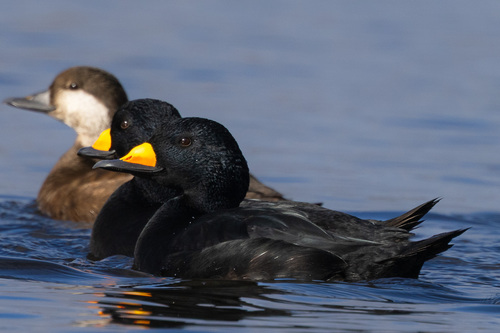
Black Scoter (Melanitta americana) Black Scoter

Media

Loading…

In short

The most reliable field mark between Common Scoter and Black Scoter is the male's bill: Common Scoter males have a mostly black bill with limited yellow around the nostrils, while Black Scoter males show a more extensively yellow, bulbous bill. Females of both species are very similar—brown with pale cheeks—making them difficult to separate visually. Both species lack white in the plumage of adult males and have similar bulky shapes. Vocalizations are distinct but are rarely diagnostic in the field for most observers. In most cases, separation in the field is extremely challenging, especially for females and immatures, and often not possible without hearing the birds.

Identification tips

  1. Adult male bill color is the best field mark: Common Scoter males have a mostly black bill with only some yellow around the nostrils, while Black Scoter males have a much more extensively yellow, bulbous bill. This is most visible in good light and at close range.
  2. Adult male plumage otherwise identical: Both are all black with no white anywhere on the body or wings. Do not rely on plumage alone to separate males.
  3. Females and immatures are extremely similar: Both are brown with pale cheeks and lack white in the plumage. The extent of pale on the face is not reliably different between the two.
  4. No useful age-specific wing or flight pattern differences: Neither species shows distinctive upperwing marks or contrasting panels in any age or sex.
  5. Structure is not reliably different: Both are bulky sea ducks with large, bulbous bills. Bill shape is similar; only color differs in adult males.
  6. Size overlap is extensive: While Common Scoter can be slightly larger, this is not a reliable field mark due to overlap and variation.
  7. Vocalizations are distinct but rarely diagnostic in the field: Unless you are familiar with both species' calls and hear them well, do not rely on voice for separation.
  8. Behavior is not a separator: Both species dive for food, form large flocks, and behave similarly on the water and in flight.
  9. Habitat overlap is extensive: Both winter on temperate coasts and breed in northern wetlands; habitat preference is not a reliable separator where ranges overlap.
  10. Range is the most practical clue: In Europe, assume Common Scoter unless there is strong evidence for Black Scoter; in North America, the reverse. Vagrancy does occur, so always check the bill color on males.
  11. Context of observation: If you see a male with a mostly black bill and only a hint of yellow, it is likely a Common Scoter; if the bill is strikingly yellow and bulbous, it is a Black Scoter.
  12. Flock composition: Mixed flocks are rare but possible in areas of vagrancy; scrutinize all males for bill color.
  13. Do not rely on cheek pattern in females: Both have pale cheeks, and the extent is not reliably different.
  14. No white in wings or body in either species: If you see white, you are likely looking at a different scoter species.
  15. If in doubt, especially with females or immatures, identification may not be possible in the field.

Size

Both species are large sea ducks with a bulky build. Common Scoter is slightly larger overall, measuring 43–54 cm in length, while Black Scoter is 43–49 cm. Adult male Black Scoters average 1,100 g and 49 cm, with females averaging about 980 g and 45 cm. The size overlap is considerable, and in the field, structural differences are subtle and not reliable for separation.

Plumage

No age-specific upperwing or flight pattern differences are described for these two species; both lack distinctive white in the wings or body at all ages. Adult males of both species are all black, but the bill color differs: Common Scoter males have a mostly black bill with some yellow at the nostrils, while Black Scoter males have a more extensively yellow, bulbous bill. Females and immatures of both species are brown with pale cheeks and are extremely similar, with both showing more extensive pale areas on the face compared to other scoters. There are no described differences in juvenile or first-winter upperwing pattern between these two species.

Behaviour

Both species dive for crustaceans and mollusks and form large, tightly packed flocks on coastal waters in winter. Their feeding, flocking, and flight behaviors are essentially identical in the field. Black Scoter males may perform a diagnostic downward head movement when stretching wings, but this is subtle and rarely observed at distance.

Habitat

Both species breed near water—lakes, rivers, or the sea—in northern latitudes, and winter on temperate coastal waters. Black Scoter may show a preference for sheltered embayments with mixed depths, but this is not a reliable field separation. In their respective ranges, habitat overlap is extensive.

Voice

Vocalizations are diagnosably distinct between the two species, but the specific differences are not detailed in the notes. In practice, most field birders do not use voice to separate these species unless familiar with both calls and in close proximity.

Submit a better description

Use the same sections as the comparison. Your text is published immediately.

The most reliable field mark between Common Scoter and Black Scoter is the male's bill: Common Scoter males have a mostly black bill with limited yellow around the nostrils, while Black Scoter males show a more extensively yellow, bulbous bill. Females of both species are very similar—brown with pale cheeks—making them difficult to separate visually. Both species lack white in the plumage of adult males and have similar bulky shapes. Vocalizations are distinct but are rarely diagnostic in the field for most observers. In most cases, separation in the field is extremely challenging, especially for females and immatures, and often not possible without hearing the birds.

  1. Adult male bill color is the best field mark: Common Scoter males have a mostly black bill with only some yellow around the nostrils, while Black Scoter males have a much more extensively yellow, bulbous bill. This is most visible in good light and at close range.
  2. Adult male plumage otherwise identical: Both are all black with no white anywhere on the body or wings. Do not rely on plumage alone to separate males.
  3. Females and immatures are extremely similar: Both are brown with pale cheeks and lack white in the plumage. The extent of pale on the face is not reliably different between the two.
  4. No useful age-specific wing or flight pattern differences: Neither species shows distinctive upperwing marks or contrasting panels in any age or sex.
  5. Structure is not reliably different: Both are bulky sea ducks with large, bulbous bills. Bill shape is similar; only color differs in adult males.
  6. Size overlap is extensive: While Common Scoter can be slightly larger, this is not a reliable field mark due to overlap and variation.
  7. Vocalizations are distinct but rarely diagnostic in the field: Unless you are familiar with both species' calls and hear them well, do not rely on voice for separation.
  8. Behavior is not a separator: Both species dive for food, form large flocks, and behave similarly on the water and in flight.
  9. Habitat overlap is extensive: Both winter on temperate coasts and breed in northern wetlands; habitat preference is not a reliable separator where ranges overlap.
  10. Range is the most practical clue: In Europe, assume Common Scoter unless there is strong evidence for Black Scoter; in North America, the reverse. Vagrancy does occur, so always check the bill color on males.
  11. Context of observation: If you see a male with a mostly black bill and only a hint of yellow, it is likely a Common Scoter; if the bill is strikingly yellow and bulbous, it is a Black Scoter.
  12. Flock composition: Mixed flocks are rare but possible in areas of vagrancy; scrutinize all males for bill color.
  13. Do not rely on cheek pattern in females: Both have pale cheeks, and the extent is not reliably different.
  14. No white in wings or body in either species: If you see white, you are likely looking at a different scoter species.
  15. If in doubt, especially with females or immatures, identification may not be possible in the field.

Both species are large sea ducks with a bulky build. Common Scoter is slightly larger overall, measuring 43–54 cm in length, while Black Scoter is 43–49 cm. Adult male Black Scoters average 1,100 g and 49 cm, with females averaging about 980 g and 45 cm. The size overlap is considerable, and in the field, structural differences are subtle and not reliable for separation.

No age-specific upperwing or flight pattern differences are described for these two species; both lack distinctive white in the wings or body at all ages. Adult males of both species are all black, but the bill color differs: Common Scoter males have a mostly black bill with some yellow at the nostrils, while Black Scoter males have a more extensively yellow, bulbous bill. Females and immatures of both species are brown with pale cheeks and are extremely similar, with both showing more extensive pale areas on the face compared to other scoters. There are no described differences in juvenile or first-winter upperwing pattern between these two species.

Both species dive for crustaceans and mollusks and form large, tightly packed flocks on coastal waters in winter. Their feeding, flocking, and flight behaviors are essentially identical in the field. Black Scoter males may perform a diagnostic downward head movement when stretching wings, but this is subtle and rarely observed at distance.

Both species breed near water—lakes, rivers, or the sea—in northern latitudes, and winter on temperate coastal waters. Black Scoter may show a preference for sheltered embayments with mixed depths, but this is not a reliable field separation. In their respective ranges, habitat overlap is extensive.

Vocalizations are diagnosably distinct between the two species, but the specific differences are not detailed in the notes. In practice, most field birders do not use voice to separate these species unless familiar with both calls and in close proximity.

Discard your changes?

You have unsaved edits. If you leave now, those changes will be lost.

Common Scoter · Black Scoter · My Tricky Birds