

Common Sandpiper vs Spotted Sandpiper
Actitis hypoleucos versus Actitis macularius
Play a quiz with Common Sandpiper and Spotted Sandpiper
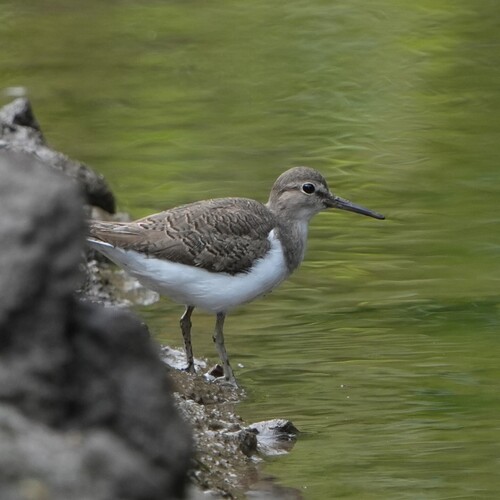 Common Sandpiper
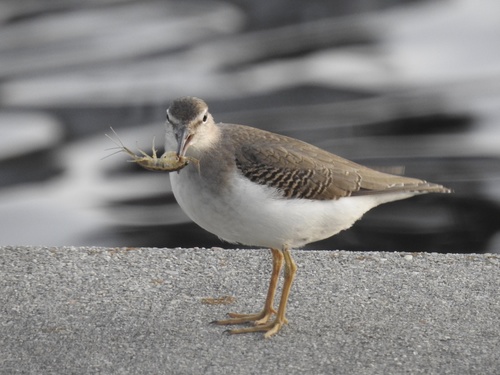 Spotted Sandpiper
In short
The most reliable field mark between Common Sandpiper and Spotted Sandpiper in non-breeding or juvenile plumage is the upperwing pattern in flight: Common Sandpiper shows a crisper, more contrasting wing pattern, while Spotted Sandpiper's is more washed-out. On the ground, leg color is helpful—Common Sandpiper has darker yellowish legs, Spotted Sandpiper's are paler yellow. In breeding season, Spotted Sandpiper is unmistakable with bold black spots on the underparts, which Common Sandpiper never shows. Both species have similar size and shape, and both bob their tails, but careful attention to wing pattern and leg color is key, especially outside the breeding season when plumage is otherwise very similar.
Identification tips
- Upperwing pattern in flight (all ages): Common Sandpiper shows a crisper, more contrasting wing pattern with distinct barring and sharp edges; Spotted Sandpiper's is more washed-out and less distinct. This is the best mark for immatures and non-breeding birds.
- Juvenile/immature plumage: Juvenile Common Sandpiper is more heavily barred above with buff edges to wing feathers; Spotted Sandpiper juveniles lack this crisp barring and edging.
- Breeding plumage (adults): Spotted Sandpiper has bold black spots on the white underparts; Common Sandpiper never shows spots, remaining clean white below.
- Leg color: Common Sandpiper's legs are darker yellowish; Spotted Sandpiper's are paler yellow. This is subtle but useful in good light.
- Bill color: Both species have a pale base and dark tip, but Spotted Sandpiper's bill is more orange at the base, especially in breeding plumage.
- Supercilium: Spotted Sandpiper may show a white supercilium, but this is not always obvious or reliable.
- Size and structure: Both are essentially identical in size and shape; do not use this as a separator.
- Tail-bobbing behavior: Both species bob their tails while walking; this is not a separator.
- Flight style: Both have stiff-winged, low flight over water; not a separator.
- Group size: Common Sandpiper is more often solitary or in small groups; Spotted Sandpiper's flocking behavior is not distinctive.
- Habitat: Both use similar habitats; do not rely on habitat for separation where both could occur.
- Seasonal context: If seen in Eurasia, likely Common Sandpiper; in North America, likely Spotted Sandpiper, but vagrants do occur.
- Sex differences: Not externally visible for field ID; Spotted Sandpiper females are heavier but not distinguishable by eye.
- Voice: Not described as distinctive in the sources; do not use for separation.
- When in doubt: Prioritize upperwing pattern in flight and, in breeding season, the presence or absence of underpart spots.
Size
Both species are very close in size, with adults measuring 18–20 cm in length. Spotted Sandpiper has a slightly larger wingspan (37–40 cm) compared to Common Sandpiper (32–35 cm), but this difference is subtle and rarely diagnostic in the field. Weight is not a practical field mark, though Spotted Sandpiper females are heavier on average than males, but this is not visible. Structure (bill length, body shape) is essentially identical between the two.
Plumage
Juvenile and non-breeding birds of both species are extremely similar, but the upperwing pattern in flight is a key separator: Common Sandpiper (all ages) shows a crisper, more contrasting wing pattern, with more distinct barring and sharper edges, especially in juveniles, which also have buff edges to the wing feathers and heavier barring above. Spotted Sandpiper's wing pattern is more washed-out and less contrasting, lacking the crispness of Common Sandpiper. In breeding season, adult Spotted Sandpipers have bold black spots on the white underparts, a feature never present on Common Sandpiper. Both have brown upperparts and white underparts otherwise. Leg color is subtly different: Common Sandpiper's legs are darker yellowish, while Spotted Sandpiper's are paler yellow. Bill color is similar, but Spotted Sandpiper's is slightly more orange at the base. Spotted Sandpiper also shows a white supercilium, but this is not always obvious.
Behaviour
Both species show the distinctive Actitis tail-bobbing walk and a stiff-winged, low flight over water. Common Sandpiper is more often seen singly or in small groups, rarely joining mixed flocks, while Spotted Sandpiper's flocking behavior is not described as distinctive. Both species forage along water edges and show similar foraging movements.
Habitat
Habitat is not a reliable separator where ranges overlap, as both species use similar shorelines, riverbanks, and lake edges. Common Sandpiper is Palearctic, Spotted Sandpiper is Nearctic, but vagrants do occur and habitat overlap is possible, so do not rely on context alone.