

Common Raven vs Brewer's Blackbird
Corvus corax versus Euphagus cyanocephalus
Play a quiz with Common Raven and Brewer's Blackbird
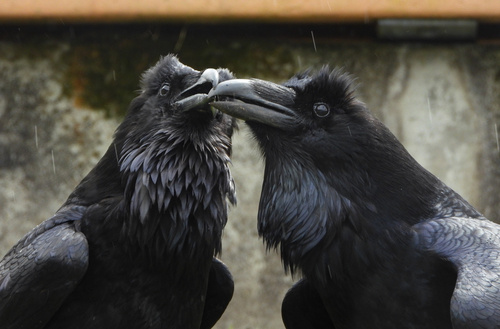 Common Raven
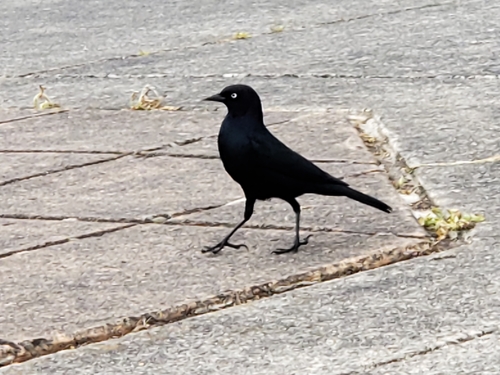 Brewer's Blackbird
In short
The most reliable field mark to separate Common Raven from Brewer's Blackbird is overall size and structure: ravens are enormous, heavy-billed birds with a wedge-shaped tail and shaggy throat, while Brewer's Blackbirds are much smaller, slimmer, and lack shaggy throat feathers. In flight, ravens show a long, wedge-shaped tail and broad wings, while Brewer's Blackbirds have shorter, more typical blackbird tails and wings. Adult male Brewer's Blackbirds have a glossy purple head and yellow eye, while ravens are all-black with a heavier, curved bill. Juvenile ravens are duller but still much larger than any blackbird. Calls are also distinctive, with the raven's deep croak contrasting with the blackbird's sharp 'check.'
Identification tips
- Size: Ravens are huge, with a mass nearly 15 times that of a Brewer's Blackbird. If the bird looks crow- or hawk-sized, it's a raven; if it's closer to a robin or starling, it's a blackbird. This holds for all ages and sexes.
- Tail shape in flight: Ravens have a long, wedge-shaped tail, especially obvious when fanned. Brewer's Blackbird has a shorter, more squared or slightly rounded tail typical of blackbirds. This is visible in both perched and flying birds.
- Bill structure: The raven's bill is massive, thick, and slightly curved, with a prominent 'beard' of bristly feathers at the base. Brewer's Blackbird has a slim, straight bill with no shaggy feathers. Bill size and shape are reliable at all ages.
- Throat feathers: Ravens have shaggy, elongated throat feathers (especially when calling or displaying), while Brewer's Blackbird's throat is smooth and never shaggy.
- Plumage gloss and color: Adult male Brewer's Blackbird shows a glossy purple head and greenish body, with a bright yellow eye. Ravens are all-black with a subtle iridescence but never show purple or green highlights restricted to the head. Female Brewer's Blackbird is brownish-grey with faint gloss and a dark eye, never truly black.
- Eye color: Adult male Brewer's Blackbird has a striking yellow eye; females and juveniles have dark eyes. Ravens have a dark brown iris as adults and blue-grey as juveniles. A yellow eye on a black bird rules out raven.
- Flight style: Ravens soar and glide with little wing-flapping, often showing acrobatic flight. Brewer's Blackbirds fly with steady, direct wingbeats and rarely soar.
- Perched posture: Ravens appear massive and heavy-billed, often with a hunched posture and shaggy throat. Brewer's Blackbirds are slim, upright, and lack any throat 'beard.'
- Social behavior: Ravens are usually solitary or in pairs, rarely in large flocks. Brewer's Blackbirds are often in flocks, especially outside breeding season.
- Vocalizations: Ravens give a deep, croaking call; Brewer's Blackbird gives a sharp, metallic 'check.' If you hear a deep croak, it's a raven.
- Habitat context: Brewer's Blackbirds are more likely in open, human-modified habitats and in flocks. Ravens can occur in a range of habitats but are less likely to be seen in large groups in open fields.
- Juvenile confusion: Juvenile ravens are duller than adults but still much larger and bulkier than any blackbird. Brewer's Blackbird juveniles are brownish and never show the size, bill, or throat features of a raven.
- Nest and colony context: Brewer's Blackbirds nest in colonies, often in trees or reeds. Ravens nest singly or in pairs, usually on cliffs or large trees.
- Head shape: Ravens have a heavier, more domed head with a pronounced bill; Brewer's Blackbird has a more slender, rounded head.
- Legs and feet: Ravens have stout, strong legs and feet; Brewer's Blackbird's legs are proportionally thinner and less robust.
Size
Common Raven is dramatically larger, with a body mass around 947 g and a length of about 66 cm, compared to Brewer's Blackbird at about 63 g. Ravens are among the largest passerines, with a wingspan up to 153 cm, while Brewer's Blackbird is a medium-sized blackbird, much closer in size to a robin or starling. Even at a distance, the raven's bulk, long wings, and massive bill are obvious, making size alone a strong separator in most views.
Plumage
No age-specific wing or flight pattern marks are described for either species, but plumage differences are clear in adults and most immatures. Common Raven is entirely black with an iridescent sheen, a shaggy throat, and a large, curved bill. Juveniles are similar but slightly duller, with a blue-grey iris and pinkish gape at first. Brewer's Blackbird adult males have a glossy black body with a striking iridescent purple head and yellow eye; females are brownish-grey with faint iridescence and a dark eye. Both sexes of Brewer's Blackbird lack the raven's shaggy throat and have a much slimmer, straight bill. In flight, ravens show a long, wedge-shaped tail and broad wings, while Brewer's Blackbird has a typical blackbird tail and wing shape. There is no mention of distinctive juvenile wing patterns for either species, but the overall structure and tail shape are reliable at all ages.
Behaviour
Common Ravens are often seen soaring or gliding with little wing-flapping, displaying agility despite their size. They are usually solitary or in pairs, especially when foraging, but subadults may roost together. Brewer's Blackbirds are social, often foraging in flocks, especially outside the breeding season. They walk with jerky head movements and may follow vehicles to feed on disturbed insects. During breeding, they nest in loose colonies and can be aggressive towards predators, sometimes mobbing them.
Habitat
Both species can be found in a wide range of habitats, but context can help: Common Ravens are more likely in open country, mountains, forests, and even urban areas, but usually not in tight flocks. Brewer's Blackbirds are often in open areas, fields, and near water, especially in colonies during breeding season. They are more likely to be seen in large, noisy flocks, especially in winter, and often around human activity such as parking lots and agricultural fields.
Voice
The Common Raven gives a deep, resonant croak, very different from the Brewer's Blackbird's sharp 'check' call. The raven's voice is much lower-pitched and carries farther. Brewer's Blackbird calls are higher, shorter, and more metallic. Vocalizations are a quick way to separate the two if heard well.