

Motmot

Common Quail vs Lesser Redpoll

Coturnix coturnix versus Acanthis cabaret

Play a quiz with Common Quail and Lesser Redpoll
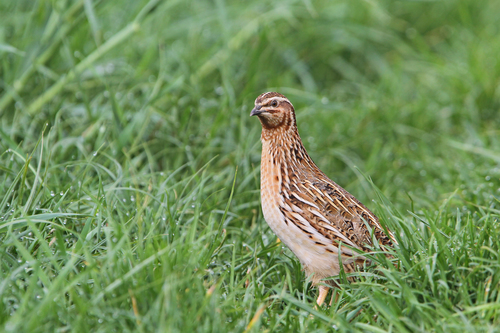
Common Quail (Coturnix coturnix) Common Quail
Lesser Redpoll (Acanthis cabaret) Lesser Redpoll

Media

Loading…

In short

The most reliable way to separate Common Quail from Lesser Redpoll is by overall structure and jizz: Common Quail is a compact, round-bodied ground bird with long, pointed wings (for a gamebird) and a streaked brown plumage, while Lesser Redpoll is a small, slim finch with a conical bill, a red forehead, and pale wingbars. In flight or perched, the quail’s size, shape, and terrestrial habits stand out against the redpoll’s arboreal, active finch behavior. Juvenile and adult plumages do not overlap: the quail is always earth-toned and streaked, lacking any red or wingbars, while the redpoll shows a red forehead (adults), pale wing stripes, and a black bib. Voice is also a strong separator, with the quail’s three-part call very different from the redpoll’s finch-like twitters.

Identification tips

  1. Size and shape: Common Quail is much larger, rounder, and heavier than Lesser Redpoll. Use size as a first check, especially if seen near other small birds.
  2. Bill shape: Quail has a short, stout, chicken-like bill; redpoll has a slim, pointed, conical finch bill. Bill shape is diagnostic at close range.
  3. Wing pattern: Quail’s wings are plain brown and long (for a gamebird), with no wingbars or pale patches. Redpoll shows two pale wing stripes on each wing, visible in all ages and especially obvious in flight or when perched.
  4. Head markings: Quail has a white eyestripe and, in males, a white chin; never any red or black on the face. Redpoll has a red forehead (adults), black bib, and no eyestripe.
  5. Breast color: Male redpolls often show a pink or red flush on the breast, never present in quail. Female and juvenile redpolls are streaked but still lack the quail’s earth-toned, unmarked breast.
  6. Leg color: Redpoll has brown legs; quail’s legs are not described as distinctive but are proportionally thicker and suited for walking.
  7. Tail shape: Quail has a short, rounded tail; redpoll’s tail is not specifically described but is typical of finches—slightly notched and proportionally longer.
  8. Behavior: Quail is almost always on the ground, running or crouching in cover. Redpoll is active in trees and bushes, often seen hanging or flitting about.
  9. Flight style: Quail flies in a fast, direct burst when flushed, close to the ground. Redpoll has a bounding, undulating flight typical of finches.
  10. Habitat: Quail is found in open grassland or farmland, never in trees. Redpoll is found in woodland, especially with birch or alder, and often perches high.
  11. Vocalization: Quail’s three-part call is very different from the redpoll’s finch-like twittering. If you hear a repeated three-note call, it is quail; if you hear trills and twitters, it is redpoll.
  12. Group size: Redpolls are often in flocks, especially in winter. Quail are usually solitary or in small, loose groups.
  13. Seasonal context: Quail is migratory and may be present only in the breeding season in temperate regions; redpoll may be present year-round or as a winter visitor, depending on location.
  14. Sex/age pitfalls: Juvenile and female redpolls lack the red breast but still have wingbars and a streaked, slim look. Quail of all ages are streaked brown with no wingbars or red.
  15. Confusion risk: The only real confusion arises from distant, brief views in open country, but structure, behavior, and habitat should quickly resolve the ID.

Size

Common Quail is much larger and heavier than Lesser Redpoll. Quail measures 16–18 cm in length with a wingspan of 32–35 cm and weighs 70–140 g [wikipedia]. In contrast, Lesser Redpoll is only 11.5–14 cm long, with a wingspan of 19–22 cm and a weight of 12–16 g [wikipedia]. This makes the quail over twice as long and several times heavier than the redpoll. Even at a distance, the quail’s bulk and rounded shape are obvious, while the redpoll is a tiny, light-bodied finch.

Plumage

There is no overlap in plumage between these two species at any age. Common Quail (all ages and sexes) is streaked brown overall with a white eyestripe and, in males, a white chin. Its wings are long and plain brown, lacking any wingbars or bright patches. Lesser Redpoll (all ages) is brownish-grey with dark streaks, a distinct red patch on the forehead (adults), a black bib, and two pale wing stripes. Males often show a pinkish or red suffusion on the breast. The redpoll’s wings are shorter and show clear pale stripes, unlike the quail’s plain wings. Juvenile and immature redpolls still show the pale wingbars and streaked appearance, but never the earth-toned, rounded look of a quail.

Behaviour

Common Quail is a ground-dwelling bird, rarely seen perched except when flushed; it prefers to run or crouch in grass and only flies when disturbed, usually in a fast, direct burst. Lesser Redpoll is highly active, foraging in trees and shrubs, often hanging upside down or flitting between branches. Redpolls are social, often in flocks, and rarely seen on the ground except when feeding on fallen seeds. In flight, the quail appears heavy and direct, while the redpoll is light, bounding, and agile.

Habitat

Common Quail is found in open country, grasslands, and agricultural fields, always on the ground. It avoids trees and dense forest. Lesser Redpoll is a bird of boreal and temperate woodlands, especially birch and alder stands, and is most often seen in trees or bushes. It may visit weedy fields in winter but is still more arboreal than the quail. Seeing a bird in a tree or bush is a strong hint for redpoll; a bird flushed from grass or crops is almost certainly a quail.

Voice

Common Quail gives a distinctive call of three repeated chirps in quick succession, often described as 'wet-my-lips' or similar, and is more often heard than seen. Lesser Redpoll produces typical finch calls: twittering, trills, and a metallic 'chit-chit' or 'tchet'. The quail’s call is unique and not easily confused with any finch, while the redpoll’s song is typical of small finches.

Submit a better description

Use the same sections as the comparison. Your text is published immediately.

The most reliable way to separate Common Quail from Lesser Redpoll is by overall structure and jizz: Common Quail is a compact, round-bodied ground bird with long, pointed wings (for a gamebird) and a streaked brown plumage, while Lesser Redpoll is a small, slim finch with a conical bill, a red forehead, and pale wingbars. In flight or perched, the quail’s size, shape, and terrestrial habits stand out against the redpoll’s arboreal, active finch behavior. Juvenile and adult plumages do not overlap: the quail is always earth-toned and streaked, lacking any red or wingbars, while the redpoll shows a red forehead (adults), pale wing stripes, and a black bib. Voice is also a strong separator, with the quail’s three-part call very different from the redpoll’s finch-like twitters.

  1. Size and shape: Common Quail is much larger, rounder, and heavier than Lesser Redpoll. Use size as a first check, especially if seen near other small birds.
  2. Bill shape: Quail has a short, stout, chicken-like bill; redpoll has a slim, pointed, conical finch bill. Bill shape is diagnostic at close range.
  3. Wing pattern: Quail’s wings are plain brown and long (for a gamebird), with no wingbars or pale patches. Redpoll shows two pale wing stripes on each wing, visible in all ages and especially obvious in flight or when perched.
  4. Head markings: Quail has a white eyestripe and, in males, a white chin; never any red or black on the face. Redpoll has a red forehead (adults), black bib, and no eyestripe.
  5. Breast color: Male redpolls often show a pink or red flush on the breast, never present in quail. Female and juvenile redpolls are streaked but still lack the quail’s earth-toned, unmarked breast.
  6. Leg color: Redpoll has brown legs; quail’s legs are not described as distinctive but are proportionally thicker and suited for walking.
  7. Tail shape: Quail has a short, rounded tail; redpoll’s tail is not specifically described but is typical of finches—slightly notched and proportionally longer.
  8. Behavior: Quail is almost always on the ground, running or crouching in cover. Redpoll is active in trees and bushes, often seen hanging or flitting about.
  9. Flight style: Quail flies in a fast, direct burst when flushed, close to the ground. Redpoll has a bounding, undulating flight typical of finches.
  10. Habitat: Quail is found in open grassland or farmland, never in trees. Redpoll is found in woodland, especially with birch or alder, and often perches high.
  11. Vocalization: Quail’s three-part call is very different from the redpoll’s finch-like twittering. If you hear a repeated three-note call, it is quail; if you hear trills and twitters, it is redpoll.
  12. Group size: Redpolls are often in flocks, especially in winter. Quail are usually solitary or in small, loose groups.
  13. Seasonal context: Quail is migratory and may be present only in the breeding season in temperate regions; redpoll may be present year-round or as a winter visitor, depending on location.
  14. Sex/age pitfalls: Juvenile and female redpolls lack the red breast but still have wingbars and a streaked, slim look. Quail of all ages are streaked brown with no wingbars or red.
  15. Confusion risk: The only real confusion arises from distant, brief views in open country, but structure, behavior, and habitat should quickly resolve the ID.

Common Quail is much larger and heavier than Lesser Redpoll. Quail measures 16–18 cm in length with a wingspan of 32–35 cm and weighs 70–140 g [wikipedia]. In contrast, Lesser Redpoll is only 11.5–14 cm long, with a wingspan of 19–22 cm and a weight of 12–16 g [wikipedia]. This makes the quail over twice as long and several times heavier than the redpoll. Even at a distance, the quail’s bulk and rounded shape are obvious, while the redpoll is a tiny, light-bodied finch.

There is no overlap in plumage between these two species at any age. Common Quail (all ages and sexes) is streaked brown overall with a white eyestripe and, in males, a white chin. Its wings are long and plain brown, lacking any wingbars or bright patches. Lesser Redpoll (all ages) is brownish-grey with dark streaks, a distinct red patch on the forehead (adults), a black bib, and two pale wing stripes. Males often show a pinkish or red suffusion on the breast. The redpoll’s wings are shorter and show clear pale stripes, unlike the quail’s plain wings. Juvenile and immature redpolls still show the pale wingbars and streaked appearance, but never the earth-toned, rounded look of a quail.

Common Quail is a ground-dwelling bird, rarely seen perched except when flushed; it prefers to run or crouch in grass and only flies when disturbed, usually in a fast, direct burst. Lesser Redpoll is highly active, foraging in trees and shrubs, often hanging upside down or flitting between branches. Redpolls are social, often in flocks, and rarely seen on the ground except when feeding on fallen seeds. In flight, the quail appears heavy and direct, while the redpoll is light, bounding, and agile.

Common Quail is found in open country, grasslands, and agricultural fields, always on the ground. It avoids trees and dense forest. Lesser Redpoll is a bird of boreal and temperate woodlands, especially birch and alder stands, and is most often seen in trees or bushes. It may visit weedy fields in winter but is still more arboreal than the quail. Seeing a bird in a tree or bush is a strong hint for redpoll; a bird flushed from grass or crops is almost certainly a quail.

Common Quail gives a distinctive call of three repeated chirps in quick succession, often described as 'wet-my-lips' or similar, and is more often heard than seen. Lesser Redpoll produces typical finch calls: twittering, trills, and a metallic 'chit-chit' or 'tchet'. The quail’s call is unique and not easily confused with any finch, while the redpoll’s song is typical of small finches.

Discard your changes?

You have unsaved edits. If you leave now, those changes will be lost.

Common Quail · Lesser Redpoll · My Tricky Birds