
Common Pochard vs Ferruginous Duck
Aythya ferina versus Aythya nyroca
Play a quiz with Common Pochard and Ferruginous Duck
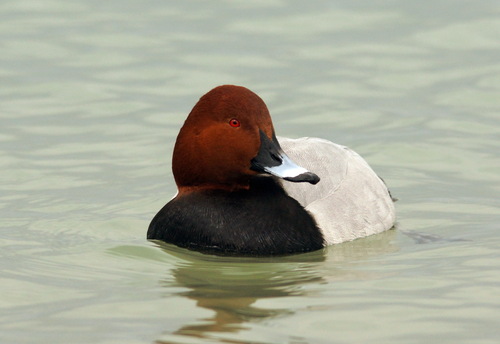 Common Pochard
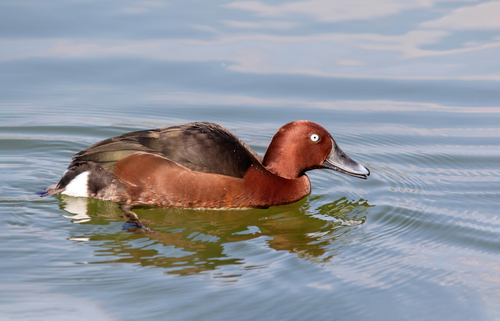 Ferruginous Duck
In short
The most reliable field mark to separate Common Pochard and Ferruginous Duck is the male's body and undertail: Ferruginous Duck males show a rich, dark chestnut overall with a distinctive, pure white undertail patch, while Common Pochard males have a chestnut head but a pale grey body and black breast/tail. In flight, Ferruginous Duck shows a white belly and underwing patch, which Common Pochard lacks. Female and immature birds are trickier, but Ferruginous Duck is overall darker and more uniform, with a dark eye (female) or yellow eye (male), while Common Pochard females are paler and have a brownish iris. Bill pattern and iris color are also helpful at close range.
Identification tips
- White undertail patch (male Ferruginous Duck): Look for a pure white triangular patch under the tail, especially when the male curls his tail during display. Common Pochard never shows this mark.
- Overall body color (adult males): Ferruginous Duck is rich, dark chestnut all over; Common Pochard has a chestnut head/neck only, with a pale grey body and black breast/tail.
- Flight pattern (all ages): Ferruginous Duck shows a white belly and white underwing patch in flight, lacking in Common Pochard.
- Bill pattern: Common Pochard has a dark grey bill with a broad blue-grey band across the middle; Ferruginous Duck's bill is more uniformly dark and lacks a strong contrasting band.
- Eye color: Male Ferruginous Duck has a yellow eye; female Ferruginous Duck has a dark eye. Common Pochard males have a yellow-orange to red iris (brighter in breeding season), females have a brown iris, and juveniles start with yellow-olive.
- Female/immature confusion: Female and immature Ferruginous Ducks are more uniformly dark brown with little contrast, while Common Pochard females are paler, with a browner iris and more contrast between head, body, and breast.
- Head and forehead shape: Common Pochard has a sloping forehead and a relatively long bill, giving a distinctive profile. Ferruginous Duck is more rounded and compact.
- Tail shape: Common Pochard is short-tailed and stocky; Ferruginous Duck may appear slightly longer-tailed, especially when displaying the undertail patch.
- Behavioral cues: Watch for Ferruginous Duck males curling the tail to expose the white undertail; this is never seen in Common Pochard.
- Association in flocks: Both can occur together, but Ferruginous Duck is less social and may be found in smaller groups or singly, especially in breeding season.
- Habitat preference: Ferruginous Duck prefers more vegetated, secluded wetlands; Common Pochard is more likely in open water.
- Seasonal changes: In winter, both species may lose some plumage brightness, but the undertail and overall body color differences persist.
- Juvenile iris color: Juvenile Common Pochard has a yellow-olive iris, shifting to adult color in first winter; Ferruginous Duck juveniles follow the adult pattern (male yellow, female dark).
- Plumage contrast: Common Pochard always shows a strong contrast between chestnut head, black breast/tail, and pale grey body; Ferruginous Duck is more uniform in tone.
- When in doubt: Focus on undertail color, body contrast, and eye color as the most reliable field marks, especially in mixed flocks or poor light.
Size
Both species are medium-sized diving ducks and can appear similar in the field. Ferruginous Duck averages about 551.5 g in body mass [wikidata], which is within the lower to mid-range of Common Pochard's reported winter weights (467–1240 g) [wikipedia], so size overlap is substantial. Structure is more helpful: Common Pochard is stockier and short-tailed with a sloping forehead and relatively long bill, while Ferruginous Duck is less bulky and often appears more compact and rounded.
Plumage
Juvenile and female Ferruginous Ducks are overall darker brown and more uniform than Common Pochard, lacking the pale grey body and black breast/tail contrast of male Common Pochard. Adult male Ferruginous Duck is a rich, dark chestnut all over with a pure white undertail patch, visible both at rest and especially when the tail is curled during display. In flight, Ferruginous Duck shows a white belly and a prominent white underwing patch, which is absent in Common Pochard. Common Pochard males have a chestnut head and neck, black breast and tail, and a pale grey body with fine vermiculations. Female Common Pochard is paler brown with a less contrasting pattern and a brownish iris, while Ferruginous Duck females are duller, more uniformly brown, and have a dark eye. Juvenile iris color in Common Pochard is yellow-olive, turning to adult color in the first winter; Ferruginous Duck males have a yellow eye, females a dark eye. Bill pattern is also useful: Common Pochard shows a dark grey bill with a wide blue-grey band across the middle, while Ferruginous Duck's bill is less distinctly patterned.
Behaviour
Both species are diving ducks, often seen in mixed flocks in winter. Ferruginous Duck is less social than Common Pochard but can form large flocks where common, sometimes associating with Common Pochard and other Aythya species. Ferruginous Duck males may display by curling the tail to show the white undertail patch. Both species feed by diving and dabbling, but Ferruginous Duck is noted for more frequent nocturnal feeding and upending.
Habitat
Both species occur in similar wetland habitats across the Palearctic, often together in winter. Ferruginous Duck prefers more vegetated, secluded waters for breeding and may nest singly or in loose colonies, sometimes with gulls. Common Pochard is widespread and breeds in open wetlands, often in larger aggregations.