

Motmot

Common Kestrel vs Red-footed Falcon

Falco tinnunculus versus Falco vespertinus

Play a quiz with Common Kestrel and Red-footed Falcon
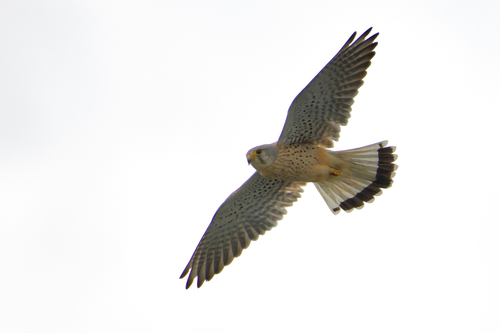
Common Kestrel (Falco tinnunculus) Common Kestrel
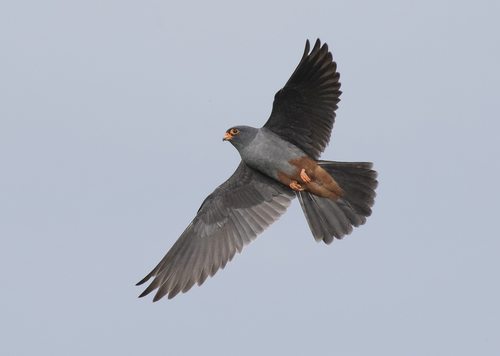
Red-footed Falcon (Falco vespertinus) Red-footed Falcon

Media

Loading…

In short

The most reliable field mark between Common Kestrel and Red-footed Falcon is the overall plumage coloration, especially in adult males: Common Kestrel males are rufous above with a blue-grey head and tail, while Red-footed Falcon males are entirely blue-grey with striking red legs and undertail. Juveniles and females are trickier, but Common Kestrel always shows a brown, heavily streaked look with a long, barred tail, while Red-footed Falcon juveniles and females are browner above with a pale face and dark moustache. In flight, both are slim, long-winged falcons, but kestrels have a longer tail and more spotted upperparts. Pay close attention to face pattern and underwing color if you see a perched or flying bird at close range.

Identification tips

  1. Adult male plumage: If the bird is all blue-grey with red legs and undertail, it's a male Red-footed Falcon; if it's rufous above with a blue-grey head and tail, it's a male Common Kestrel.
  2. Female and juvenile face pattern: Red-footed Falcon females and juveniles have a pale face with a strong dark moustache and eye-stripe, while Common Kestrel females and juveniles have a more uniform face with a black malar stripe but no bold mask.
  3. Tail pattern: Common Kestrel of all ages shows a long, brown tail with multiple narrow black bars and a clear black tip with a white edge; Red-footed Falcon has a less distinctly barred tail, especially in juveniles and females.
  4. Underwing color in flight: Male Red-footed Falcons have uniform grey underwings, while Common Kestrels show paler, streaked underwings with contrast between coverts and flight feathers.
  5. Upperwing pattern: Juvenile and female Common Kestrels have spotted upperwings and more contrast between coverts and flight feathers; Red-footed Falcons are plainer and darker above.
  6. Size and structure: Kestrels are slightly larger and longer-tailed, giving a more stretched appearance in flight; Red-footed Falcons look more compact and agile.
  7. Hunting behavior: If you see a bird hovering for extended periods, it's almost certainly a Common Kestrel; Red-footed Falcons rarely hover and prefer to hunt from perches or in active flight.
  8. Leg and undertail color: Red-footed Falcons (especially males) have bright red legs and undertail coverts, which are never shown by Common Kestrel.
  9. Plumage streaking: Common Kestrel juveniles and females are heavily streaked below; Red-footed Falcon juveniles are streaked but often look cleaner and more buffy below, with less dense streaking.
  10. Face color in females: Female Red-footed Falcons have a white face with black markings and orange head/underparts; female Common Kestrels are brown-capped and lack orange tones.
  11. Perched jizz: Kestrels often appear more upright and long-tailed when perched, while Red-footed Falcons are more compact.
  12. Habitat context: In western and central Europe, a falcon seen in urban or suburban settings is much more likely to be a Common Kestrel; Red-footed Falcons are rare and usually found in open steppe or grassland, often near colonies of Rooks or nest boxes.
  13. Flock size: Red-footed Falcons may be seen in small groups, especially on migration; Common Kestrels are usually solitary or in pairs.
  14. Bare part color: Both have yellow cere and eye-ring, but Red-footed Falcon's red legs are distinctive in adults.
  15. Juvenile confusion risk: If you see a brown falcon with a pale face and strong dark moustache, consider Red-footed Falcon; if the face is more uniform and the tail is long and barred, it's likely a Common Kestrel.

Size

Common Kestrel is slightly heavier on average (184 g vs 158.5 g) and marginally longer (32–39 cm vs 28–34 cm), with a broader wingspan (65–82 cm vs 65–75 cm). In the field, this difference is subtle, but kestrels often appear a bit bulkier and longer-tailed, whereas Red-footed Falcons are a touch more compact and agile. Both are small for raptors, but kestrel females can look especially large compared to male Red-footed Falcons.

Plumage

Juveniles and females are the main confusion risk. Juvenile Common Kestrels resemble adult females: brown above with blackish spots, buff below with bold streaks, and a brown, barred tail. Juvenile Red-footed Falcons are brown above and buff below with dark streaks, but their face is paler with a strong dark moustache and eye-stripe, and their tail is less distinctly barred. Adult male Common Kestrels have rufous upperparts with black spots, a blue-grey head and tail, and a clear black subterminal tail band with a narrow white tip; underparts are buff with fine streaks. Adult male Red-footed Falcons are uniform blue-grey with red legs and undertail, and their underwings are also grey, lacking the pale or streaked look of kestrel. Female Red-footed Falcons have a grey back and wings, orange head and underparts, and a white face with black markings; female kestrels are brown above and streaky below, lacking the orange tones and with a more uniform face. All ages of kestrel have a prominent black malar stripe, but Red-footed Falcon females and juveniles have a more extensive dark mask and moustache. In flight, kestrels show a longer, more obviously barred tail and more contrasty upperwing pattern, while Red-footed Falcons are plainer and darker-winged.

Behaviour

Common Kestrels are famous for their hovering hunting style, often seen facing into the wind and holding position above fields. Red-footed Falcons rarely hover, instead hunting from perches or catching insects on the wing with more agile, direct flight. Both may perch on wires or exposed branches, but kestrels are more likely to be seen alone or in loose pairs, while Red-footed Falcons sometimes gather in small flocks, especially on migration or near breeding colonies.

Habitat

Common Kestrel is widespread and adaptable, found in open countryside, farmland, urban areas, and even nesting on buildings. Red-footed Falcon is more localized, preferring open grasslands, steppe, and agricultural areas with scattered trees, especially near colonies of Rooks or artificial nest boxes. In western Europe, Red-footed Falcon is much rarer and mostly seen on passage, while Common Kestrel is a year-round resident in many areas.

Submit a better description

Use the same sections as the comparison. Your text is published immediately.

The most reliable field mark between Common Kestrel and Red-footed Falcon is the overall plumage coloration, especially in adult males: Common Kestrel males are rufous above with a blue-grey head and tail, while Red-footed Falcon males are entirely blue-grey with striking red legs and undertail. Juveniles and females are trickier, but Common Kestrel always shows a brown, heavily streaked look with a long, barred tail, while Red-footed Falcon juveniles and females are browner above with a pale face and dark moustache. In flight, both are slim, long-winged falcons, but kestrels have a longer tail and more spotted upperparts. Pay close attention to face pattern and underwing color if you see a perched or flying bird at close range.

  1. Adult male plumage: If the bird is all blue-grey with red legs and undertail, it's a male Red-footed Falcon; if it's rufous above with a blue-grey head and tail, it's a male Common Kestrel.
  2. Female and juvenile face pattern: Red-footed Falcon females and juveniles have a pale face with a strong dark moustache and eye-stripe, while Common Kestrel females and juveniles have a more uniform face with a black malar stripe but no bold mask.
  3. Tail pattern: Common Kestrel of all ages shows a long, brown tail with multiple narrow black bars and a clear black tip with a white edge; Red-footed Falcon has a less distinctly barred tail, especially in juveniles and females.
  4. Underwing color in flight: Male Red-footed Falcons have uniform grey underwings, while Common Kestrels show paler, streaked underwings with contrast between coverts and flight feathers.
  5. Upperwing pattern: Juvenile and female Common Kestrels have spotted upperwings and more contrast between coverts and flight feathers; Red-footed Falcons are plainer and darker above.
  6. Size and structure: Kestrels are slightly larger and longer-tailed, giving a more stretched appearance in flight; Red-footed Falcons look more compact and agile.
  7. Hunting behavior: If you see a bird hovering for extended periods, it's almost certainly a Common Kestrel; Red-footed Falcons rarely hover and prefer to hunt from perches or in active flight.
  8. Leg and undertail color: Red-footed Falcons (especially males) have bright red legs and undertail coverts, which are never shown by Common Kestrel.
  9. Plumage streaking: Common Kestrel juveniles and females are heavily streaked below; Red-footed Falcon juveniles are streaked but often look cleaner and more buffy below, with less dense streaking.
  10. Face color in females: Female Red-footed Falcons have a white face with black markings and orange head/underparts; female Common Kestrels are brown-capped and lack orange tones.
  11. Perched jizz: Kestrels often appear more upright and long-tailed when perched, while Red-footed Falcons are more compact.
  12. Habitat context: In western and central Europe, a falcon seen in urban or suburban settings is much more likely to be a Common Kestrel; Red-footed Falcons are rare and usually found in open steppe or grassland, often near colonies of Rooks or nest boxes.
  13. Flock size: Red-footed Falcons may be seen in small groups, especially on migration; Common Kestrels are usually solitary or in pairs.
  14. Bare part color: Both have yellow cere and eye-ring, but Red-footed Falcon's red legs are distinctive in adults.
  15. Juvenile confusion risk: If you see a brown falcon with a pale face and strong dark moustache, consider Red-footed Falcon; if the face is more uniform and the tail is long and barred, it's likely a Common Kestrel.

Common Kestrel is slightly heavier on average (184 g vs 158.5 g) and marginally longer (32–39 cm vs 28–34 cm), with a broader wingspan (65–82 cm vs 65–75 cm). In the field, this difference is subtle, but kestrels often appear a bit bulkier and longer-tailed, whereas Red-footed Falcons are a touch more compact and agile. Both are small for raptors, but kestrel females can look especially large compared to male Red-footed Falcons.

Juveniles and females are the main confusion risk. Juvenile Common Kestrels resemble adult females: brown above with blackish spots, buff below with bold streaks, and a brown, barred tail. Juvenile Red-footed Falcons are brown above and buff below with dark streaks, but their face is paler with a strong dark moustache and eye-stripe, and their tail is less distinctly barred. Adult male Common Kestrels have rufous upperparts with black spots, a blue-grey head and tail, and a clear black subterminal tail band with a narrow white tip; underparts are buff with fine streaks. Adult male Red-footed Falcons are uniform blue-grey with red legs and undertail, and their underwings are also grey, lacking the pale or streaked look of kestrel. Female Red-footed Falcons have a grey back and wings, orange head and underparts, and a white face with black markings; female kestrels are brown above and streaky below, lacking the orange tones and with a more uniform face. All ages of kestrel have a prominent black malar stripe, but Red-footed Falcon females and juveniles have a more extensive dark mask and moustache. In flight, kestrels show a longer, more obviously barred tail and more contrasty upperwing pattern, while Red-footed Falcons are plainer and darker-winged.

Common Kestrels are famous for their hovering hunting style, often seen facing into the wind and holding position above fields. Red-footed Falcons rarely hover, instead hunting from perches or catching insects on the wing with more agile, direct flight. Both may perch on wires or exposed branches, but kestrels are more likely to be seen alone or in loose pairs, while Red-footed Falcons sometimes gather in small flocks, especially on migration or near breeding colonies.

Common Kestrel is widespread and adaptable, found in open countryside, farmland, urban areas, and even nesting on buildings. Red-footed Falcon is more localized, preferring open grasslands, steppe, and agricultural areas with scattered trees, especially near colonies of Rooks or artificial nest boxes. In western Europe, Red-footed Falcon is much rarer and mostly seen on passage, while Common Kestrel is a year-round resident in many areas.

Discard your changes?

You have unsaved edits. If you leave now, those changes will be lost.

Common Kestrel · Red-footed Falcon · My Tricky Birds