

Common Ground Dove vs Velvety Manakin
Columbina passerina versus Lepidothrix velutina
Play a quiz with Common Ground Dove and Velvety Manakin
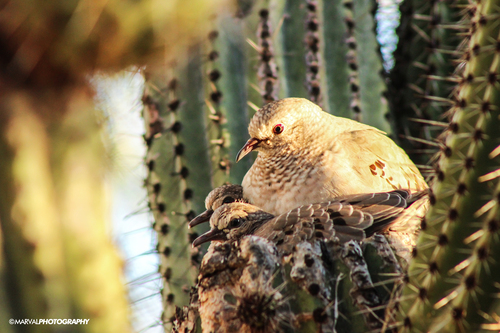 Common Ground Dove
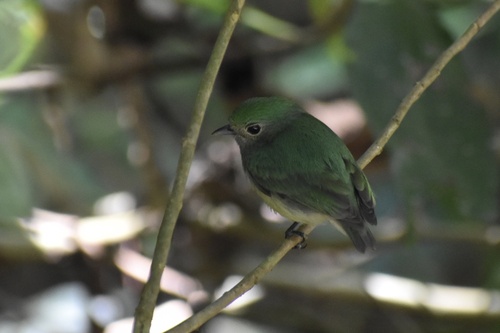 Velvety Manakin
In short
The most reliable field mark is the presence of chestnut primaries and wing borders in flight on Common Ground Dove (all ages), which are never shown by Velvety Manakin. If you see a small, chunky dove with scaly head and short tail flashing chestnut in the wings as it flies from the ground, it's a Common Ground Dove. Velvety Manakin, by contrast, is a tiny, round-bodied forest bird: adult males are jet black with a bright blue crown, while females are green above and grayish below. Structure, behavior, and habitat are also strongly divergent: doves are terrestrial and often in open or edge habitats, manakins are arboreal and forest-interior. Size overlaps, but jizz, bill shape, and wing pattern are decisive.
Identification tips
- Chestnut in the wing (flight): If you see chestnut primaries and wing borders as the bird flies, it's a Common Ground Dove (all ages). Velvety Manakin never shows this.
- Scaly head and breast: Common Ground Dove (both sexes, all ages) has a distinctive scaly pattern on the head and upper breast; Velvety Manakin never does.
- Bill color and shape: Common Ground Dove has a short, thick, yellow bill with a black tip and pink feathering at the base; Velvety Manakin's bill is smaller, bluish-gray above, dark below, and lacks pink at the base.
- Tail shape and length: Common Ground Dove has a very short tail, almost stubby; Velvety Manakin's tail is proportionally longer (though still short for a songbird) and not as square.
- Adult male plumage: Male Common Ground Dove is brown with slate-gray crown and pinkish belly; male Velvety Manakin is deep black with a bright blue crown and nape, and a purplish-blue wash on the rump.
- Adult female plumage: Female Common Ground Dove is gray-brown and scaly; female Velvety Manakin is grass-green above, gray-green on the face and throat, and olive-grayish below.
- Iris color: Velvety Manakin (both sexes) has a bright reddish-brown or deep red iris; Common Ground Dove's iris color is not specified, but is never bright red.
- Perched behavior: Common Ground Dove is usually on the ground, walking or feeding; Velvety Manakin is almost always perched in trees or sallying for food.
- Flight style: Dove flies low and direct, often flushing from the ground; manakin makes short, fluttery flights between perches, rarely seen on the ground.
- Habitat: Dove is found in open, disturbed, or edge habitats; manakin is a forest-interior bird in humid lowland and foothill forests.
- Voice: Dove gives soft, rising-pitch whoops in repetition; manakin does not, and its calls are not described here but are never dove-like.
- Pink feathering around bill: Only Common Ground Dove shows this feature.
- Black spotting on wing coverts: Only Common Ground Dove has brown wings with black spots; manakin's wings are plain black (male) or green (female).
- Sexual dimorphism: Both species are sexually dimorphic, but in completely different ways: dove males are slightly more colorful, manakin males are dramatically different from females.
- Geographic context: If you are in the southern US or Caribbean, expect Common Ground Dove; if in humid forests of Costa Rica, Panama, or Chocó, expect Velvety Manakin.
Size
Common Ground Dove is slightly larger, at 15–18 cm in length and 26–40 g in mass [wikipedia], compared to Velvety Manakin's 8–11 cm length (mass not specified, but manakins are generally lighter) [wikipedia]. However, both are among the smallest in their respective groups, and at a glance, both can appear tiny. The dove is stouter and more compact, with a short tail and a chunky, rounded body. The manakin is more delicate, with a proportionally larger head, shorter bill, and a more upright posture.
Plumage
-
Juvenile/immature/flight view: Common Ground Dove of all ages shows chestnut primaries and wing borders in flight, a unique feature among small doves and not present in Velvety Manakin. The dove's upperwing coverts and feathers are brown with black spots, and the tail is short and matches the back. No age of Velvety Manakin ever shows chestnut in the wing.
-
Adult male: Common Ground Dove males have a scaly, slate-gray crown, pinkish-gray belly, and brown back; Velvety Manakin males are deep black with a bright blue crown and nape, and a purplish-blue wash on the rump—never scaly or brown.
-
Adult female: Female Common Ground Dove is grayer and more evenly colored than the male, but still brown overall with scaly head and breast, and pink around the bill. Female Velvety Manakin is grass-green above, brightest on the rump, with a pale gray-green face and throat, dull green breast/flanks, and olive-grayish belly—never scaly or brown.
-
Bill and face: Common Ground Dove has a yellow bill with a black tip and pink feathering around the base; Velvety Manakin has a bluish-gray maxilla and dark mandible, with a reddish or deep red iris.
-
Tail: Dove's tail is very short and matches the back, while manakin's tail is proportionally longer and less conspicuous.
Behaviour
Common Ground Dove is almost always seen on the ground, walking or feeding in open areas or at edges, and flushes with a whir of wings showing chestnut. It rarely perches high. Velvety Manakin is almost exclusively arboreal, perching quietly in the midstory or canopy, often making short sallying flights for fruit or insects. Females and juveniles may join mixed-species flocks. The dove's flight is direct and low; the manakin's is quick and fluttery, often between perches.
Habitat
Common Ground Dove prefers open country, scrub, fields, and edges in the southern US, Central America, the Caribbean, and northern South America [wikipedia]. It is rarely found in dense forest. Velvety Manakin is a forest-interior or edge species of humid lowland and foothill forests in Costa Rica, Panama, and the Chocó–Magdalena region [wikipedia]. If you are deep in humid forest, especially in Central or South America, the manakin is far more likely; in open or disturbed habitats, especially in the southern US or Caribbean, expect the dove.
Voice
Common Ground Dove gives a series of soft, rising-pitch 'whoops' in repetition, quite distinct from any manakin. Velvety Manakin's voice is not described in the provided notes, but manakins typically give high-pitched, short notes or mechanical sounds, never a dove-like whoop. If you hear a repeated, soft, rising whoop, it's the dove.